How Did Animals Survive The Ice Age
Interactive passage with audio narration, comprehension questions, and printable PDF.
By completing this purchase you agree to our Terms of Use and Privacy Policy. Your subscription renews automatically until you cancel. You can cancel anytime from your account settings. All sales are final and non-refundable. Digital content is available for download in your account immediately upon purchase.
What's included
How Did Animals Survive The Ice Age preview and details
About this printable How Did Animals Survive The Ice Age science reading passage, NGSS-aligned (Grade 6)
Sample passage and quiz from How Did Animals Survive The Ice Age
Reading passage and comprehension quiz preview
How Did Animals Survive The Ice Age
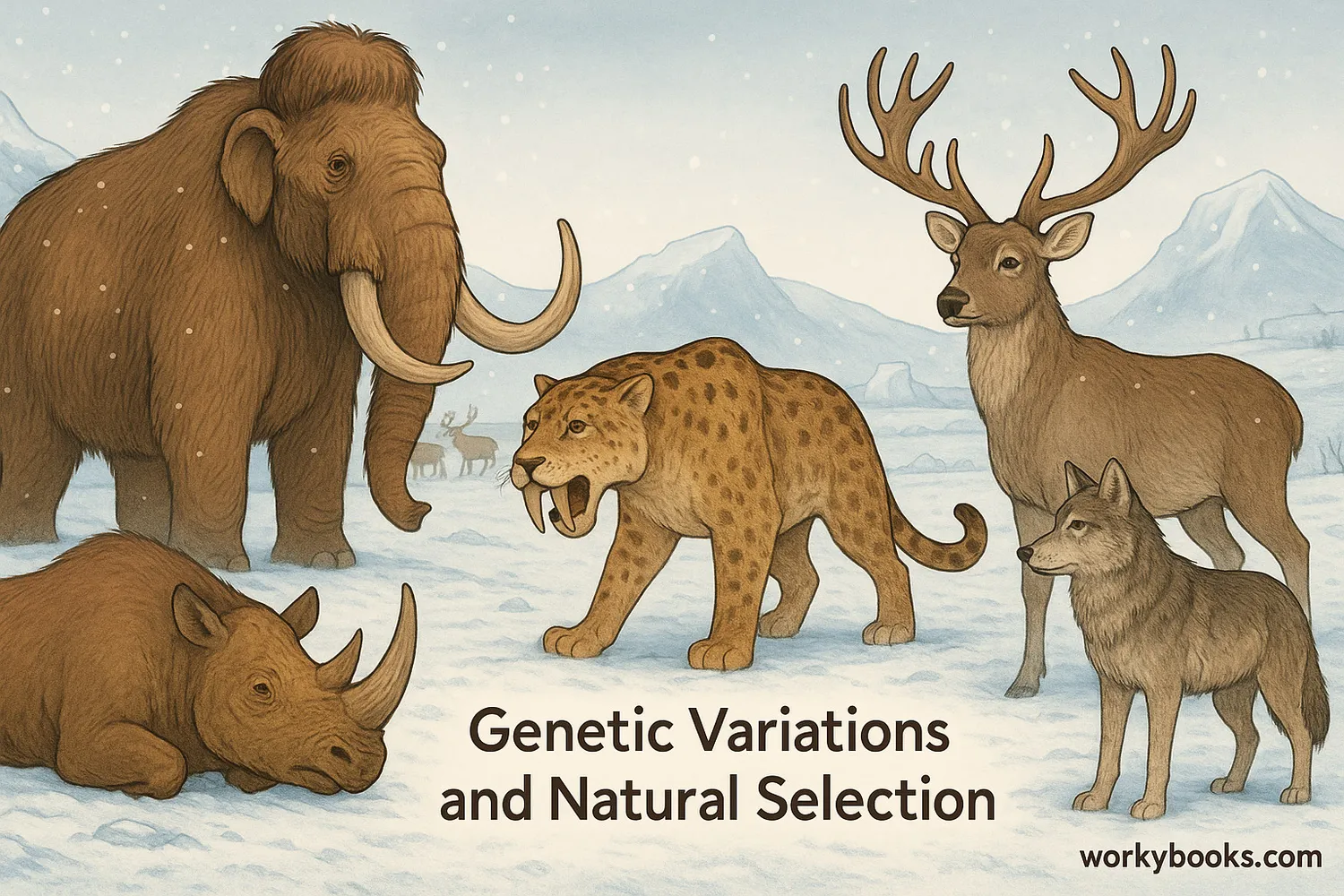
Imagine a world covered in vast sheets of ice, where temperatures plunged far below freezing, and food was scarce. This was Earth during the Ice Age, a time of extreme cold that lasted for thousands of years. Yet, incredible animals not only survived but thrived in this harsh environment. How did they do it?
The answer lies in something called genetic variations. Think of it like a deck of cards. Each animal in a species has slightly different traits, just like each card is unique. Some deer might have thicker fur, while others have thinner fur. Some wolves might be faster, others stronger. These small differences, or variations, are passed down from parents to offspring.
During the Ice Age, the animals with traits best suited to the cold environment had a much better chance of staying alive. For example, a woolly mammoth with extra-thick fur and a layer of fat would be warmer than a mammoth with thinner fur. This extra warmth meant it could survive the freezing temperatures, find food, and eventually have babies. This process, where individuals with helpful traits are more likely to survive and reproduce, is called natural selection. Over many generations, these helpful traits became more common in the population.
Another key to survival was adaptation – a change that helps an organism live better in its environment. Besides thick fur, Ice Age animals developed other amazing adaptations. The woolly mammoth had small ears to reduce heat loss, and its tusks helped it clear snow to find plants. The saber-toothed cat had powerful jaws and enormous canine teeth, perfect for hunting large, thick-skinned prey like mammoths and giant sloths. These adaptations weren't just random; they were the result of countless generations of natural selection, favoring individuals with the most beneficial traits.
So, the next time you think about the Ice Age, remember that the animals weren't just lucky. They were survivors, shaped by the power of genetic variations and natural selection, demonstrating nature's incredible ability to adapt to even the most challenging conditions. Their legacy reminds us of the importance of diversity in life.
Interesting Fact: The woolly mammoth's closest living relative is the Asian elephant, though mammoths were much hairier and had larger tusks.
Comprehension quiz (10 questions)
1. What was a key feature of the Ice Age environment?
2. Which animal is the woolly mammoth's closest living relative?
3. Animals with helpful traits are more likely to survive and reproduce. Is this true or false?
4. What does the term 'adaptation' mean in the passage?
5. How did thick fur help woolly mammoths survive?
6. Why did saber-toothed cats have large canine teeth?
7. What is the main idea of the passage about animal survival?
8. If a modern animal population faced an sudden ice age, which trait would most likely become more common over time?
9. Imagine an Ice Age bird. What adaptation might help it survive that a modern bird might not have?
10. How does 'natural selection' relate to an animal's chances of having offspring in the Ice Age?
Perfect for the way you teach
- Build comprehension skills
- Auto-graded quiz
- Differentiated reading
- Read together at home
- Improve fluency
- Quiet reading time
- Reading curriculum support
- Independent practice
- Track Lexile growth