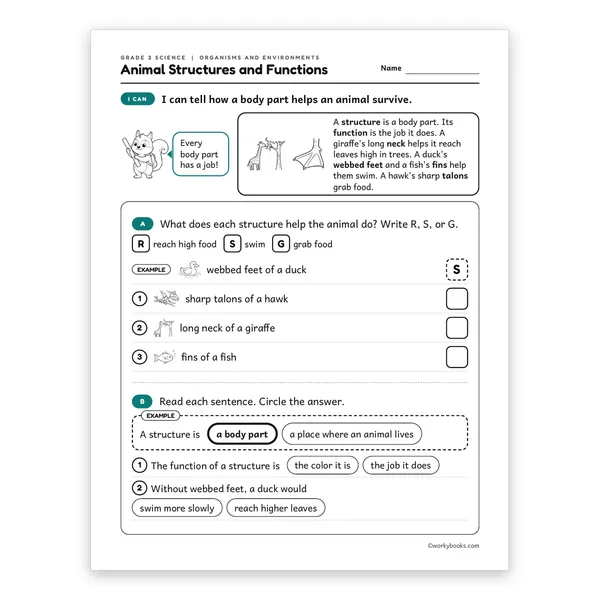
This learning resource is available in interactive and printable formats. The interactive worksheet can be played online and assigned to students. The Printable PDF version can be downloaded and printed for completion by hand.
This audio-integrated reading passage, "How Ducks Swim & Walk," explores the fascinating ways ducks use their unique external structures to thrive in their environment. Students will learn about the adaptations of webbed feet for powerful swimming and efficient walking, and how their waterproof feathers keep them warm and dry. Aligned with NGSS 4-LS1-1, this passage helps fourth graders understand how animal structures support survival, growth, and behavior, using the duck as a perfect example. Key concepts include buoyancy, preening, and the specialized design of a duck's body for both land and water.
CONTENT PREVIEW
Expand content preview
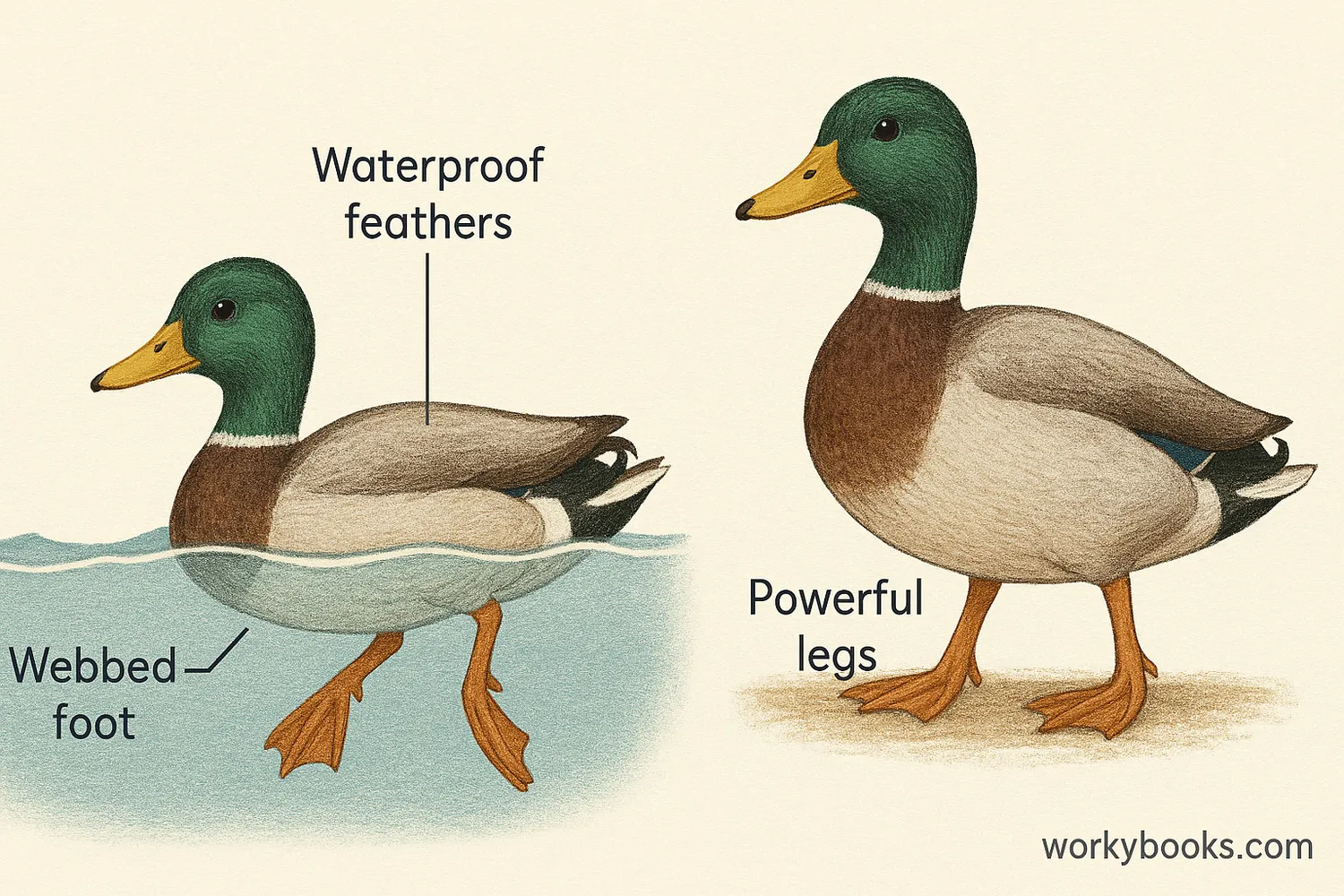
Duck adaptations: webbed feet, waterproof feathers, and strong legs for land and water.
Can Ducks Fly?
Ducks are amazing birds that live in ponds, lakes, and rivers. They are famous for swimming, but did you know that ducks can also fly? Ducks have special body features called adaptations that help them live in watery places.
One important adaptation is their webbed feet. There is skin between each toe, which makes their feet look like paddles. When a duck pushes its feet backward in the water, the webbing spreads out, acting like swim fins. This helps ducks move forward quickly, just like you move faster in a pool when you wear flippers!
Ducks also have a funny way of walking called a waddle. This happens because their legs are set far apart and are positioned toward the back of their bodies. These leg positions are perfect for swimming, but they make ducks walk in a side-to-side way on land. That’s why ducks look like they are wobbling when they walk.
Another special feature is their waterproof feathers. Ducks have a special gland near their tail that makes oil. The duck uses its beak to spread this oil over its feathers. The oily feathers work like a raincoat, keeping water out. This allows ducks to float and stay dry even after diving or swimming for a long time.
Ducks can swim fast, dive under the water, and even tip upside down to reach plants and bugs underwater. Their bodies are built to be great swimmers and decent walkers. Ducks can also fly, traveling long distances when they migrate for the seasons.
All these special features help ducks survive where they live. Adaptation means an animal has body parts or behaviors that help it live in its habitat.
Interesting Fact: Ducklings can swim in water just hours after they hatch from their eggs!
What do webbed feet help ducks do?
Swim quicklySee underwaterFly higherEat more
Why do ducks waddle?
Their legs are far apartTheir wings are heavyThey have short necksThey are sleepy
What makes duck feathers waterproof?
A special oilLots of feathersSharp clawsBright colors
How do ducks move forward in water?
Push feet backwardFlap their wingsUse their beaksHop on rocks
Ducks can float because their feathers are:
WaterproofStickyPointyThin
Why is oil like a raincoat for ducks?
It keeps them dryIt makes them warmIt helps them eatIt helps them fly
Ducklings can swim soon after hatching. True or false?
TrueFalse
What is an adaptation?
Body part or behaviorA type of foodA color patternA place to live
Perfect For:
👩🏫 Teachers
• Reading comprehension practice
• Auto-graded assessments
• Literacy skill development
👨👩👧👦 Parents
• Reading practice at home
• Comprehension improvement
• Educational reading time
🏠 Homeschoolers
• Reading curriculum support
• Independent reading practice
• Progress monitoring
Reading Features:
📖
Reading Passage
Engaging fiction or nonfiction text
❓
Comprehension Quiz
Auto-graded questions
📊
Instant Feedback
Immediate results and scoring
📄
Printable Version
Download for offline reading
🔊
Read Aloud
Voice-over with word highlighting
Reviews & Ratings
No reviews yet. Be the first to share your experience!
Related Content
The Nature of Life Science
This passage, aligned with NGSS MS-LS1-1, introduces students in grades 6-8 to the foundational concepts of life science...
MS-LS1-1
Science Vocabulary
This worksheet on domain-specific words will help students learn some science vocabulary. Students will be asked to matc...
L.3.6L.3.4.A
The Science of Hibernation
This educational module, featuring an audio-integrated reading passage titled 'The Science of Hibernation,' is designed ...
Simple Machines Science Report
This science writing task requires students to clearly explain how three simple machines work using precise domain-speci...
W.5.4
Adaptation
This engaging middle school science passage explores adaptation, focusing on how inherited traits enable organisms to su...
MS-LS4-4MS-LS4-6
Desert Rain Frog Behavioral Adaptations
Dive into the fascinating world of the Desert Rain Frog and discover its incredible unique adaptations for survival in a...
Ocean Animal Adaptations
Students will read a passage that provides information about various adaptations that marine animals have developed to t...
W.4.9.B
Animal Adaptations Word Sort
This engaging word sort activity helps students understand the difference between physical and behavioral adaptations in...
Herbivore Adaptations
This engaging reading passage, integrated with audio, delves into the fascinating world of herbivore adaptations. Studen...
Nocturnal Adaptations of the Strange Aye-Aye
This engaging reading passage, integrated with audio, takes grade 5 students on a journey to discover the fascinating no...
Early Life Forms and Their Adaptations
This educational passage focuses on early life forms and their basic adaptations, supporting NGSS standard 3-LS4-2 for e...
RI.3.3RI.4.3RI.5.33-LS4-2
Binturong Adaptations
This engaging, audio-integrated reading passage, 'Binturong Adaptations,' for Grade 6 students delves into the fascinati...
Barnacle Biology and Adaptations
Dive into the intriguing world of barnacles with this engaging Grade 6 reading passage. Students will learn about these ...
Mountain Animal Adaptations
This reading comprehension worksheet focuses on the topic of animal adaptations for survival in mountainous environments...
W.4.9.B
Whale Blubber: Function and Adaptation
This engaging, audio-integrated reading passage, 'Whale Blubber Function and Adaptation,' introduces young learners to t...
Amur Leopard Adaptations
This engaging, audio-integrated reading passage, 'Amur Leopard Adaptations,' is designed for Grade 6 science students. I...
Climate Zone Adaptations Word Sort
This word sort activity examines how plants and animals adapt to different climate conditions. Students sort 12 differen...
Plant Adaptations for Survival
This NGSS-aligned word sort activity, suitable for kindergarten, focuses on plant survival adaptations, helping students...
K-LS1-1
The Pumpkin Life Cycle
This informational worksheet explores the pumpkin lifecycle, guiding students through procedural steps in a scientific t...
RI.2.3RI.2.10
Blobfish Adaptations to Extreme Pressure
This engaging passage explores the fascinating world of the blobfish and its unique adaptations to the extreme pressure ...