How the Desert Rain Frog Survives Drought — Reading Comprehension
Rate this
Premium Resource
Present
Present in classroom. No work saved
Assign
Classroom with student accounts, Track progress
Quick Play
No student accounts, assign with a link
Grades
6
PRINT+DIGITAL RESOURCE
This learning resource is available in interactive and printable formats. The interactive worksheet can be played online and assigned to students. The Printable PDF version can be downloaded and printed for completion by hand.
This engaging, audio-integrated reading passage for Grade 4 explores the fascinating survival strategies of the desert rain frog during drought conditions. Aligned with NGSS Standard LS2.A: Interdependent Relationships, the passage explains how these unique amphibians meet their needs in harsh environments. Students will learn about adaptations like burrowing and special skin, understanding how organisms depend on their environment for survival. Key terms are defined, making complex concepts accessible for young learners. This content is perfect for exploring desert ecosystems and animal resilience.
CONTENT PREVIEW
Expand content preview
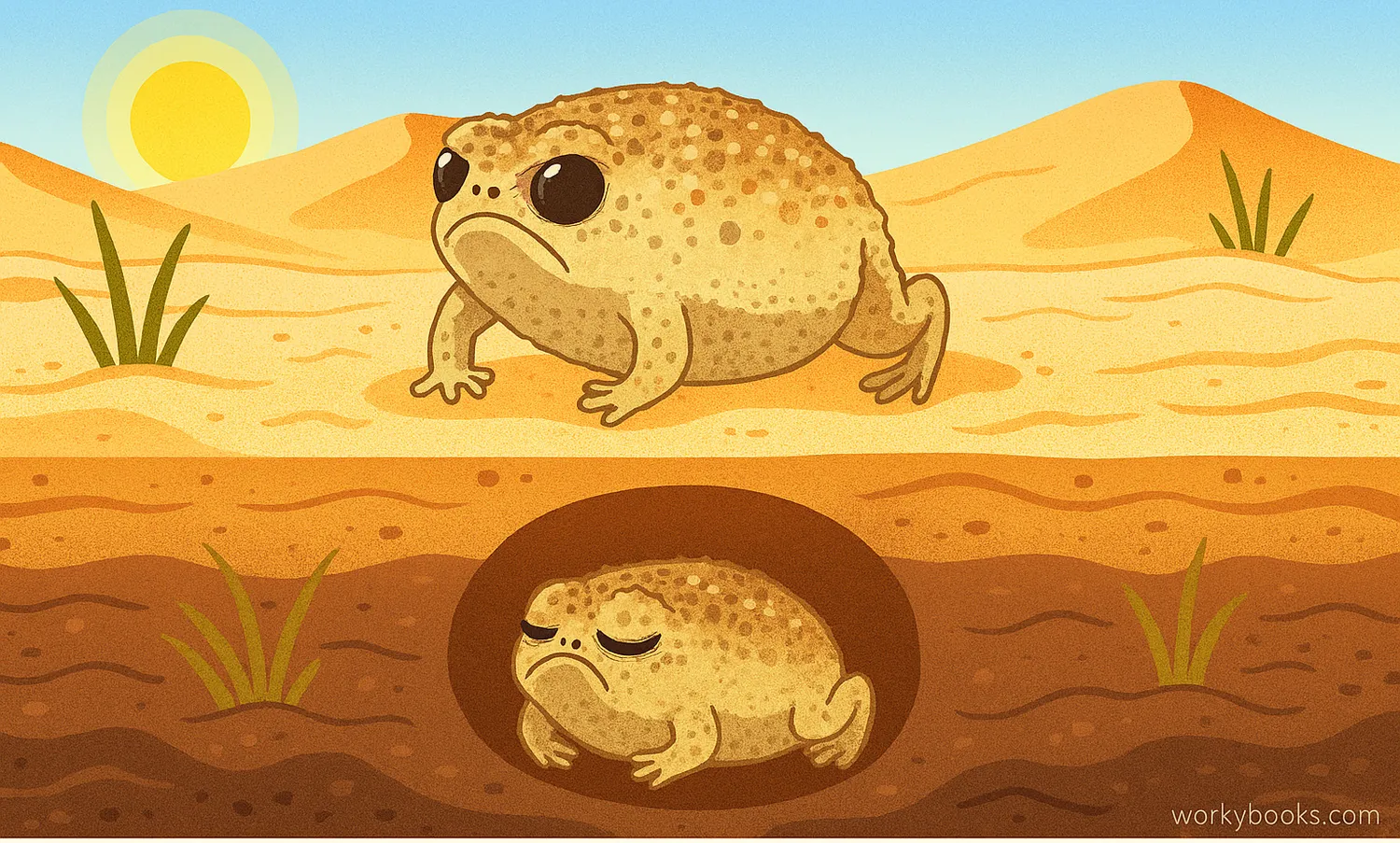
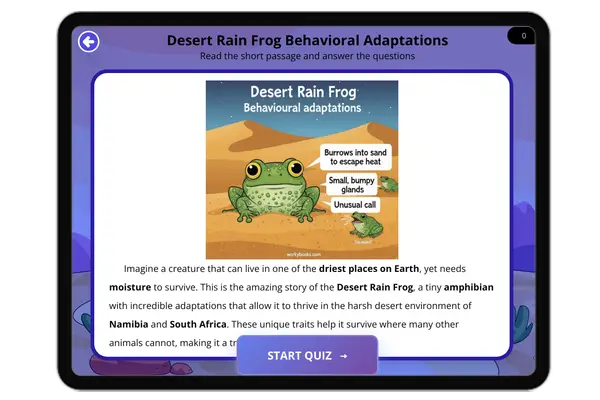
Desert rain frog escapes heat by burrowing underground to stay moist and cool.
Meet the Desert Rain Frog
The desert rain frog is a tiny, round frog that lives only in the coastal deserts of Namibia and South Africa. It grows to just about 2 inches long—small enough to fit in your palm! Even though its home is one of the driest places on Earth, this little frog has developed amazing ways to survive.
Special Adaptations
The desert rain frog uses several adaptations to handle its tough environment. First, it is a burrowing animal. During the hot, dry days, it digs deep into the cool, moist sand to hide from the sun and keep its body from drying out.
This frog is also nocturnal, which means it sleeps during the day and comes out at night. At night, fog from the ocean rolls over the sand dunes. The frog absorbs water right through its skin from the fog. It does not need ponds or rain to drink—just the moist air!
Its round body helps it store water and fat, like a tiny camel. The frog’s belly skin is almost see-through, so it can soak up water from damp sand. Even its babies are special—they hatch as tiny frogs, skipping the tadpole stage, so they don’t need water puddles to grow up.
Famous Squeaky Call and Habitat
The desert rain frog is famous for its loud, squeaky call. It sounds like a squeaky toy and helps scare away predators. This frog only lives in a narrow strip of sandy dunes where the ocean fog is common. If the fog disappears, the frog could be in trouble.
Why It Matters
The desert rain frog shows how animals can turn a harsh desert into a cozy home. It uses fog like we use a water fountain! But with climate change, the fog may not come as often, which could hurt the frog’s home.
Interesting Fact: Scientists call the desert rain frog "the world’s cutest frog" because of its round body and big eyes!
Where does the desert rain frog live?
Namibia and South AfricaAmazon rainforestAustraliaArctic tundra
How does the frog get water?
Absorbs fog through skinDrinks from pondsEats insectsLicks morning dew
What sound does the frog make?
A squeaky toy soundA loud croakA high whistleA deep buzz
Why does the frog burrow during the day?
To stay cool and moistTo find foodTo see the sunTo chase insects
How does the round body help the frog?
Stores water and fatMakes it jump highHelps it swim fastLets it fly
What might happen if fog disappears?
Frog could be in troubleMore food for the frogFrogs will grow largerFrog's call will change
The frog is nocturnal. True or false?
TrueFalse
What does adaptation mean?
A special feature for survivalA type of foodA desert plantA kind of weather
Perfect For:
👩🏫 Teachers
• Reading comprehension practice
• Auto-graded assessments
• Literacy skill development
👨👩👧👦 Parents
• Reading practice at home
• Comprehension improvement
• Educational reading time
🏠 Homeschoolers
• Reading curriculum support
• Independent reading practice
• Progress monitoring
Reading Features:
📖
Reading Passage
Engaging fiction or nonfiction text
❓
Comprehension Quiz
Auto-graded questions
📊
Instant Feedback
Immediate results and scoring
📄
Printable Version
Download for offline reading
🔊
Read Aloud
Voice-over with word highlighting
Reviews & Ratings
No reviews yet. Be the first to share your experience!
Related Content
The Nature of Life Science
This passage, aligned with NGSS MS-LS1-1, introduces students in grades 6-8 to the foundational concepts of life science...
MS-LS1-1
Science Vocabulary
This worksheet on domain-specific words will help students learn some science vocabulary. Students will be asked to matc...
L.3.6L.3.4.A
The Science of Hibernation
This educational module, featuring an audio-integrated reading passage titled 'The Science of Hibernation,' is designed ...
Simple Machines Science Report
This science writing task requires students to clearly explain how three simple machines work using precise domain-speci...
W.5.4
Adaptation
This engaging middle school science passage explores adaptation, focusing on how inherited traits enable organisms to su...
MS-LS4-4MS-LS4-6
Desert Rain Frog Behavioral Adaptations
Dive into the fascinating world of the Desert Rain Frog and discover its incredible unique adaptations for survival in a...
Animal Adaptations Word Sort
This engaging word sort activity helps students understand the difference between physical and behavioral adaptations in...
Herbivore Adaptations
This engaging reading passage, integrated with audio, delves into the fascinating world of herbivore adaptations. Studen...
Nocturnal Adaptations of the Strange Aye-Aye
This engaging reading passage, integrated with audio, takes grade 5 students on a journey to discover the fascinating no...
Ocean Animal Adaptations
Students will read a passage that provides information about various adaptations that marine animals have developed to t...
W.4.9.B
Early Life Forms and Their Adaptations
This educational passage focuses on early life forms and their basic adaptations, supporting NGSS standard 3-LS4-2 for e...
RI.3.3RI.4.3RI.5.33-LS4-2
Binturong Adaptations
This engaging, audio-integrated reading passage, 'Binturong Adaptations,' for Grade 6 students delves into the fascinati...
Barnacle Biology and Adaptations
Dive into the intriguing world of barnacles with this engaging Grade 6 reading passage. Students will learn about these ...
Whale Blubber: Function and Adaptation
This engaging, audio-integrated reading passage, 'Whale Blubber Function and Adaptation,' introduces young learners to t...
Amur Leopard Adaptations
This engaging, audio-integrated reading passage, 'Amur Leopard Adaptations,' is designed for Grade 6 science students. I...
Mountain Animal Adaptations
This reading comprehension worksheet focuses on the topic of animal adaptations for survival in mountainous environments...
W.4.9.B
Climate Zone Adaptations Word Sort
This word sort activity examines how plants and animals adapt to different climate conditions. Students sort 12 differen...
Plant Adaptations for Survival
This NGSS-aligned word sort activity, suitable for kindergarten, focuses on plant survival adaptations, helping students...
K-LS1-1
The Pumpkin Life Cycle
This informational worksheet explores the pumpkin lifecycle, guiding students through procedural steps in a scientific t...
RI.2.3RI.2.10
What Is Earth Science?
This engaging middle school science passage introduces students to the field of Earth science, aligning with NGSS standa...