Native American Basket Weaving — Reading Comprehension
Rate this
Premium Resource
Present
Present in classroom. No work saved
Assign
Classroom with student accounts, Track progress
Quick Play
No student accounts, assign with a link
Grades
5
6
7
8
PRINT+DIGITAL RESOURCE
This learning resource is available in interactive and printable formats. The interactive worksheet can be played online and assigned to students. The Printable PDF version can be downloaded and printed for completion by hand.
This passage examines the historical importance of basket weaving among Indigenous Americans, highlighting how different regions developed unique basket types adapted to their environment and needs. Students will learn about the various techniques like coiling, twining, and plaiting, and discover how baskets served as essential containers before the widespread use of pottery. The passage discusses archaeological findings, regional variations, and the connection between basketry and daily life—including how some California baskets could even hold water. Designed for middle school history students, this resource is aligned with the CA HSS 6.1 and Common Core standards RH.6-8.1 and RH.6-8.4. It includes a robust glossary, Spanish translation, differentiated version, comprehension activities, and graphic organizers, with read aloud audio for accessibility. The passage encourages students to analyze primary sources and understand the enduring cultural significance of basket weaving.
CONTENT PREVIEW
Expand content preview
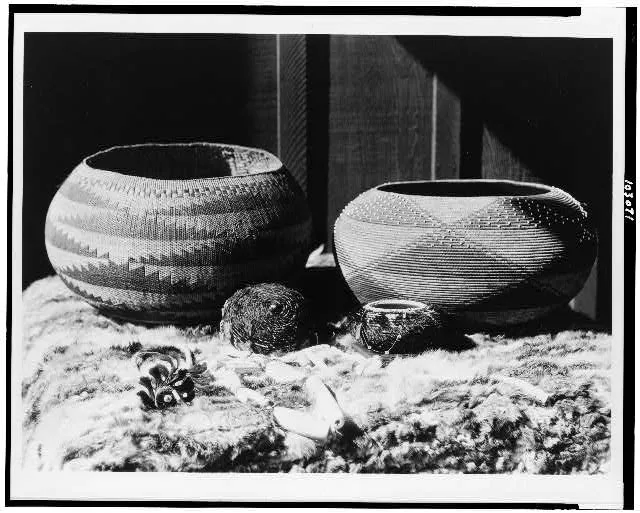
"Pomo baskets and magnesite beads" by Curtis, Edward S., 1868-1952 / Library of Congress.
Indigenous Americans developed basket weaving as a key technology thousands of years ago. In many regions across North America, baskets were essential for daily survival before the invention of pottery. Each community created basketry techniques that reflected the local environment, available resources, and cultural traditions.
Basket weaving among Indigenous Americans involved a variety of methods, including coiling, twining, and plaiting. Coiling uses long strands wrapped in spirals, while twining weaves flexible materials around upright supports, and plaiting involves crossing flat strips over and under each other. Archaeological evidence shows that basketry in the American Southwest dates back over 8,000 years. For example, ancient baskets found in Nevada’s Spirit Cave were made with techniques similar to those still used today. Basket makers selected materials such as willow, sumac, or grasses based on what grew nearby, showing a deep connection to their geographic context.
Some of the most famous Native American baskets come from California. The Pomo, Chumash, and Yokuts peoples became renowned for their intricate designs and technical skill. California baskets were so tightly woven that some could hold water—a feature documented in 19th-century accounts and preserved in museum collections. In the Eastern Woodlands, tribes like the Cherokee and Ojibwe used birch bark and river cane to create sturdy storage and cooking containers. In the Great Plains, lightweight baskets made from grasses and reeds were ideal for nomadic life. The diversity of basketry styles across North America demonstrates how Indigenous people adapted their inventions to meet the needs of their social and environmental surroundings.
Baskets were not only practical but also held cultural and spiritual significance. They were used for gathering food, storing seeds, cooking, and even ceremonial purposes. Basket making was often passed down through generations, with certain designs or patterns indicating family or tribal identity. Sometimes, the best basket makers held special roles or status within their communities. In some cases, changes in available resources or contact with Europeans led to new styles or materials, but the core traditions of basketry continued.
The invention and evolution of basket weaving among Indigenous Americans reflects a broader theme in world history: how humans adapt to their environment and develop technologies to solve everyday challenges. Understanding basketry helps us appreciate the creativity, resilience, and knowledge of Native peoples throughout history.
Interesting Fact: Some ancient California baskets were so well-crafted that they could be used to boil water by placing hot stones inside.
Which region is famous for water-holding baskets?
CaliforniaGreat PlainsEastern WoodlandsSouthwest
What is coiling in basketry?
Wrapping in spiralsCrossing flat stripsPainting basketsTying knots
How old are baskets from Nevada's Spirit Cave?
Over 8,000 yearsAbout 500 years2,000 yearsLess than 100 years
Why did basket styles differ by region?
Different resourcesSame weather everywhereCopied from booksRequired by law
What effect did European contact have?
Brought new materialsStopped basket makingNo changesStarted pottery
What does ceremonial mean in this context?
For special eventsFor eating onlyFor animalsFor trade only
Baskets could hold water. True or false?
TrueFalse
What is 'plaiting' in basketry?
Weaving strips over-underPainting basketsTying with knotsBurning designs
Perfect For:
👩🏫 Teachers
• Reading comprehension practice
• Auto-graded assessments
• Literacy skill development
👨👩👧👦 Parents
• Reading practice at home
• Comprehension improvement
• Educational reading time
🏠 Homeschoolers
• Reading curriculum support
• Independent reading practice
• Progress monitoring
Reading Features:
📖
Reading Passage
Engaging fiction or nonfiction text
❓
Comprehension Quiz
Auto-graded questions
📊
Instant Feedback
Immediate results and scoring
📄
Printable Version
Download for offline reading
🔊
Read Aloud
Voice-over with word highlighting
Reviews & Ratings
No reviews yet. Be the first to share your experience!
Related Content
Native American Respect for Nature
This engaging history reading passage explores Native American respect for nature, emphasizing the close relationship be...
D2.HIS.2.3-5D2.HIS.3.3-5RI.4.3RI.4.4
Native Americans and Slavery in Early America
This comprehensive U.S. history reading passage explores the complex relationship between Native Americans and slavery d...
D2.HIS.2.3-5D2.HIS.3.3-5RI.4.3RI.4.4
Native American Tribes Across America
This engaging history reading passage introduces students to Native American tribes across America, focusing on their da...
D2.HIS.1.3-5D2.HIS.2.3-5RI.4.1RI.4.2
Traditional Native American Clothing
This engaging history passage explores traditional Native American clothing and how it reflected the environment, values...
D2.HIS.2.3-5D2.HIS.3.3-5RI.4.3RI.4.4
Native American Treaties
This passage examines early Native American treaties, agreements that were meant to establish peace and boundaries betwe...
D2.HIS.2.3-5D2.HIS.3.3-5RI.4.3RI.4.4
Native American Land Sales
This comprehensive history reading passage examines Native American land sales in U.S. history and asks students to cons...
D2.HIS.2.3-5D2.HIS.3.3-5RI.4.3RI.4.4
Disease and Native Americans
This engaging U.S. history reading passage explores the dramatic impact of European diseases on Native American populati...
D2.HIS.2.3-5D2.HIS.3.3-5RI.4.3RI.4.4
The Cherokee Nation: History and Culture
This reading passage explores the rich history and culture of the Cherokee Nation, one of the largest Native American tr...
D2.HIS.2.3-5D2.HIS.14.3-5RI.4.3RI.4.4RI.4.10
Columbian Exchange Impact on Native Americans
This passage examines the complex effects of the Columbian Exchange on Native Americans, analyzing the causes, consequen...
D2.HIS.2.3-5D2.HIS.3.3-5RI.4.3RI.4.4
Native American Allies in Colonial Wars
This passage examines the complex role of Native American nations as allies and adversaries during the colonial wars of ...
D2.HIS.2.3-5D2.HIS.3.3-5RI.4.3RI.4.4
Spanish Missions Impact on Native American
This reading passage explores the complex impact of Spanish missions on Native American culture in what is now the south...
D2.HIS.2.3-5D2.HIS.3.3-5RI.4.3RI.4.4
Native American Civilizations Before European Contact
This engaging U.S. History reading passage explores Native American civilizations before European contact, focusing on t...
D2.HIS.2.3-5D2.HIS.3.3-5RI.4.3RI.4.4
Moccasins: Soft Leather Footwear
This passage explores the history and significance of moccasins—a soft leather footwear invented by Native American nati...
Native vs European Land Views
This passage examines the contrasting beliefs about land between Native American societies and European settlers, highli...
D2.HIS.2.3-5D2.HIS.3.3-5RI.4.3RI.4.4
Native Americans in Revolutionary War
This engaging U.S. history reading passage explores how Native American nations made difficult decisions during the Amer...
D2.HIS.2.3-5D2.HIS.3.3-5RI.4.3RI.4.4
Black History Month Word Search
RF.4.3RF.5.3L.4.4L.5.4
Pemmican: High-Energy Preserved Food
This engaging history reading passage explores the invention and significance of pemmican, a high-energy preserved food ...
The Inuit Kayak
This passage examines the history and significance of the Inuit kayak, an advanced invention developed by Arctic peoples...
American History Word Search
Word search on American History Word Search! Vocabulary practice aligned to Common Core standards!