This learning resource is available in interactive and printable formats. The interactive worksheet can be played online and assigned to students. The Printable PDF version can be downloaded and printed for completion by hand.
This educational passage introduces students to the history of labor unions in the United States during the Progressive Era. Students will learn how workers in factories and mines joined together to form labor unions, leading to important changes like fair pay, safer workplaces, and shorter hours. The passage highlights key events, figures, and the cause-and-effect relationships that shaped this movement. It features vocabulary words such as collective bargaining and strike, and explains their significance in simple terms. The content aligns with history standard HSS 5.9.2 and reading comprehension standard RI.4.3. In addition to the main reading, the resource provides a Spanish translation, a simplified version for emerging readers, multiple-choice questions, writing activities, a timeline, and graphic organizers. A public domain image enriches the lesson, and prompts are included for visual learning. This resource supports English and bilingual classrooms, and encourages students to connect past events to present-day workers' rights. A read aloud audio option is also available for accessibility.
CONTENT PREVIEW
Expand content preview
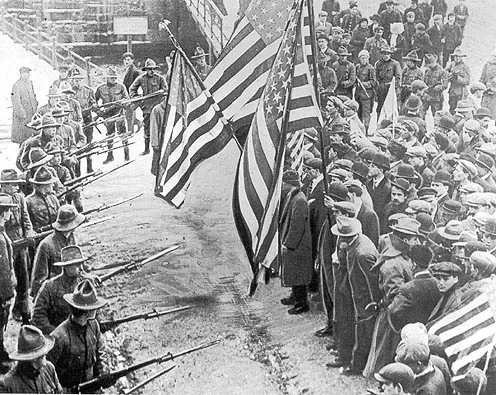
1912 Lawrence Textile Strike. Source: Wikimedia Commons
The history of labor unions in the United States began during the Progressive Era. Factories, mines, and railroads were important to the nation’s growth. Many workers had jobs that were hard and sometimes dangerous. They worked long hours for low pay.
Factory owners wanted to make as much money as possible. To do this, they often paid workers less and made them work more. Many workers felt this was unfair. They wanted better pay, shorter hours, and safer workplaces. Alone, one worker’s voice was small. Together, their voices grew stronger.
Workers started to form labor unions. A labor union is a group of workers who join together to fight for better conditions. Unions used collective bargaining. This means union leaders talked with factory owners to agree on fair rules for everyone. If owners refused to listen, workers sometimes went on strike. A strike is when workers stop working to demand changes.
One famous union was the American Federation of Labor (AFL), started by Samuel Gompers in 1886. The AFL helped many skilled workers win higher wages and safer workplaces. Other unions, like the Knights of Labor, included all types of workers. These groups organized marches and strikes to show their unity and bravery.
Unions faced big challenges. Sometimes, factory owners hired new workers to replace those on strike. Sometimes, police or guards tried to stop strikes. But unions did not give up. They believed in workers' rights. Over time, many laws changed. New rules protected children from working too young and made workplaces safer for everyone.
Today, labor unions still help workers. They show how people can make a difference when they work together for fairness and respect.
Interesting Fact: In 1911, the Triangle Shirtwaist Factory fire in New York City led to new safety laws for workers.
Who started the AFL?
Samuel GompersHenry FordJane AddamsAndrew Carnegie
What is a strike?
Stopping work to demand changeGetting a raiseHiring new workersBuilding a factory
When did the Triangle Shirtwaist fire happen?
1911188619001920
Why did workers form unions?
To get better jobsTo travel moreTo buy factoriesTo become owners
How did unions make their voices stronger?
By joining togetherBy working aloneBy paying lessBy hiring owners
What did collective bargaining mean?
Leaders talked to ownersWorkers quitFactories closedChildren worked
Labor unions started in the Progressive Era. True or false?
TrueFalse
What is the meaning of 'workers' rights'?
Fair treatment for workersMaking more factoriesPaying owners moreBuying new machines
Perfect For:
👩🏫 Teachers
• Reading comprehension practice
• Auto-graded assessments
• Literacy skill development
👨👩👧👦 Parents
• Reading practice at home
• Comprehension improvement
• Educational reading time
🏠 Homeschoolers
• Reading curriculum support
• Independent reading practice
• Progress monitoring
Reading Features:
📖
Reading Passage
Engaging fiction or nonfiction text
❓
Comprehension Quiz
Auto-graded questions
📊
Instant Feedback
Immediate results and scoring
📄
Printable Version
Download for offline reading
🔊
Read Aloud
Voice-over with word highlighting
Reviews & Ratings
No reviews yet. Be the first to share your experience!
Related Content
Women's Suffrage Movement
This reading passage explores the Women's Suffrage Movement, a key period in U.S. history during the Progressive Era. St...
HSS 5.9.2RI.4.4
Informational Text —Healthy Teeth and Gums
RI.4.10RI.4.3RF.4.4RF.4.4.A
Informational Text —Migratory Birds
Engage young minds with this worksheet that delves into the wonders of migratory birds. Learn about their extraordinary ...
RI.4.10RI.4.3RF.4.4RF.4.4.A
Informational Text —All About Dentists
Students read an informational text explaining what dentists do and how they are trained. Aligned to RI.4.3-2
RI.4.10RI.4.3RF.4.4RF.4.4.A
The Role of Pollinators in Nature
Learn about the fascinating world of pollinators and discover their crucial role in the reproductive process of flowerin...
RI.4.2RI.4.3RI.4.4RI.5.1
Pollination: A Crucial Ecosystem Service
Explore the vital role of pollination beyond plant reproduction, as it sustains ecosystems by ensuring food security, pr...
RI.4.2RI.4.3RI.4.4RI.5.1
Seed Dispersal: How Plants Travel
Plants may seem stationary, but their seeds have amazing ways to travel! Explore the fascinating world of seed dispersal...
RI.4.2RI.4.3RI.4.4RI.5.1
The States of Matter: Solid
Discover the differences between solids, liquids and gases by exploring how their particles are arranged and move. This ...
RI.4.2RI.4.3RI.4.4RI.5.1
What is a Simple Machine
Discover the power of simple machines! This informational text explores how basic tools like levers, pulleys and incline...
RI.4.2RI.4.3RI.4.4RI.5.1
Bats in the Night
This informative first-grade reading passage delves into the intriguing world of bats, highlighting their nocturnal natu...
RI.3.1RI.4.4RI.4.3
What is Milky Way
This engaging passage introduces Grade 4-5 students to the Milky Way, our home galaxy. Students will learn that the Milk...
5-ESS1-15-ESS1-2RI.3.1RI.3.4
Andromeda Galaxy
This engaging science passage introduces Grade 4-5 students to the Andromeda Galaxy, our closest large galactic neighbor...
5-ESS1-15-ESS1-2RI.3.1RI.3.4
Malala Yousafzai
This Grade 4-5 science reading passage introduces students to Malala Yousafzai, a courageous young woman from Pakistan w...
NGSSRI.3.1RI.3.2RI.4.3
Understanding Biological Evolution and Diversity
This passage addresses the NGSS standard 3-LS4-2 focusing on biological evolution and the unity and diversity of life. T...
RI.3.3RI.4.3RI.5.33-LS4-2
Early Life Forms and Their Adaptations
This educational passage focuses on early life forms and their basic adaptations, supporting NGSS standard 3-LS4-2 for e...
RI.3.3RI.4.3RI.5.33-LS4-2
What Is a Physical Map?
This Grade 4-5 science passage introduces students to physical maps, explaining how these maps display natural features ...
5-ESS2-1RI.3.1RI.3.4RI.4.3
Simple Machines: How They Work
Students read an informative paragraph on simple machines and fill in key technical vocabulary terms to demonstrate unde...
RI.4.2RI.4.3RI.4.4RI.5.1
Longhouses of the Eastern Woodlands
This engaging U.S. history reading passage explores the longhouses of the Eastern Woodlands, focusing on the Iroquois an...
D2.HIS.1-6.3-5RI.4.1RI.4.3
Traditional Native American Clothing
This engaging history passage explores traditional Native American clothing and how it reflected the environment, values...