Life as a Union or Confederate Soldier
Interactive passage with audio narration, comprehension questions, and printable PDF.
By completing this purchase you agree to our Terms of Use and Privacy Policy. Your subscription renews automatically until you cancel. You can cancel anytime from your account settings. All sales are final and non-refundable. Digital content is available for download in your account immediately upon purchase.
What's included
Part of this bundle

Life as a Union or Confederate Soldier preview and details
About this printable Life as a Union or Confederate Soldier reading passage (Grades 3-5)
Sample passage and quiz from Life as a Union or Confederate Soldier
Reading passage and comprehension quiz preview
Civil War Soldiers
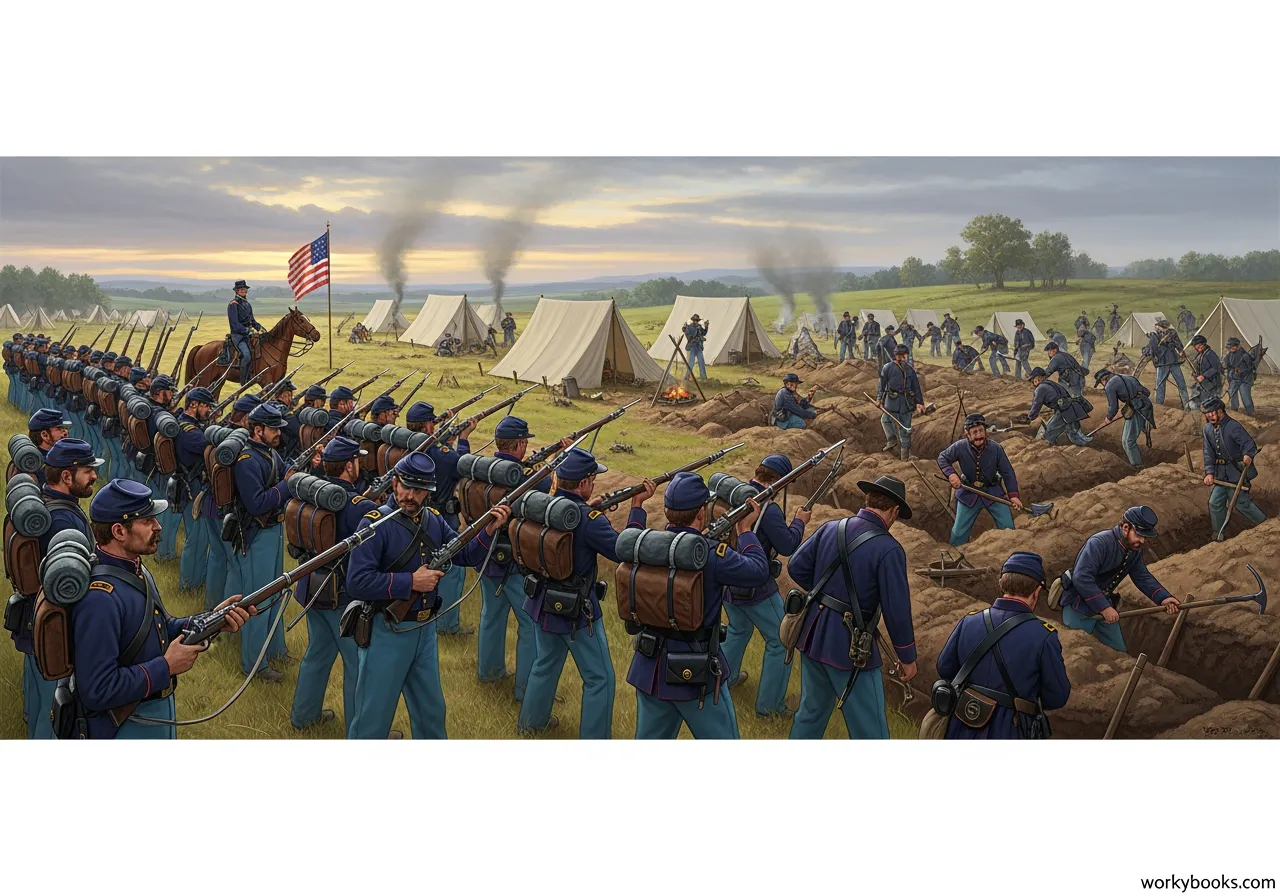
The Civil War was one of the most difficult times in U.S. history. Over 2 million men became soldiers and fought for either the Union or the Confederacy. These men left their homes, families, and jobs to serve in the army. The life of a Civil War soldier was hard and dangerous. Soldiers faced many hardships every day.
Most soldiers were young men, many only teenagers. They wore wool uniforms, which were very hot in the summer and not warm enough in winter. Their equipment included a rifle, a canteen for water, and a backpack. Soldiers carried all their gear during long marches, sometimes walking over 20 miles a day.
Food was a big problem for Civil War soldiers. Meals were simple and often spoiled before they could be eaten. A common meal was "hardtack," a hard, dry biscuit. Soldiers also ate salt pork or beans when they were available. Clean water was hard to find, and many men got sick from drinking dirty water.
One of the biggest dangers was not the enemy, but disease. Living in crowded camps, soldiers shared germs quickly. Illnesses like dysentery, typhoid, and pneumonia spread fast. More soldiers died from disease than from bullets in battle. Doctors did not have the medicines we have today, so even a small cut could become deadly.
Battlefield conditions were terrifying. Cannons and rifles made loud noises. Smoke filled the air. Soldiers had to be brave to fight while hearing the cries of wounded friends. Many battles lasted for hours, and thousands were killed or hurt in a single day.
Even with all these hardships, soldiers found ways to help each other. They wrote letters home, played games, and shared stories to keep their spirits up. Soldiers showed unity and bravery by supporting one another, even in the toughest times.
Interesting Fact: More than 620,000 Americans died during the Civil War—about two-thirds from disease, not from battle wounds.
Comprehension quiz (8 questions)
1. Why did many soldiers get sick?
2. What was 'hardtack'?
3. How did soldiers show unity?
4. Which killed more soldiers?
5. What was a common problem?
6. Why were the camps dangerous?
7. Most soldiers died from battle wounds. True or false?
8. What does 'bravery' mean in the passage?
Common Core standards for Life as a Union or Confederate Soldier
By the end of year, read and comprehend informational texts, including history/social studies, science, and technical texts, in the grades 4–5 text complexity band proficiently, with scaffolding as needed at the high end of the range.
Explain events, procedures, ideas, or concepts in a historical, scientific, or technical text, including what happened and why, based on specific information in the text.
Determine the meaning of general academic and domain-specific words or phrases in a text relevant to a grade 4 topic or subject area.
Perfect for the way you teach
- Build comprehension skills
- Auto-graded quiz
- Differentiated reading
- Read together at home
- Improve fluency
- Quiet reading time
- Reading curriculum support
- Independent practice
- Track Lexile growth