Boomtowns Spring Up Out West — Reading Comprehension
Rate this
Premium Resource
Present
Present in classroom. No work saved
Assign
Classroom with student accounts, Track progress
Quick Play
No student accounts, assign with a link
Grades
3
4
5
Standards
D2.HIS.2.3-5
D2.HIS.14.3-5
RI.4.3
RI.4.4
RI.4.10
PRINT+DIGITAL RESOURCE
This learning resource is available in interactive and printable formats. The interactive worksheet can be played online and assigned to students. The Printable PDF version can be downloaded and printed for completion by hand.
This engaging passage explores the exciting rise of boomtowns in the American West during the 1800s, focusing on the Gold Rush and the people who moved west in search of fortune. Students will learn about the causes and effects of boomtown growth, the daily life of miners and settlers, and the challenges and opportunities faced by these communities. With a clear, chronological narrative, this reading passage supports both U.S. history and literacy skills, featuring key vocabulary, a glossary, and a timeline. The passage is aligned with the C3 Framework history standards and Common Core ELA standards, making it ideal for interdisciplinary learning. Activities include multiple-choice questions, writing prompts, and a Spanish translation, and the resource includes a relevant historical image. Suitable for use in classrooms, homeschooling, or independent study, this passage also features read aloud audio and Spanish translation to support diverse learners.
CONTENT PREVIEW
Expand content preview
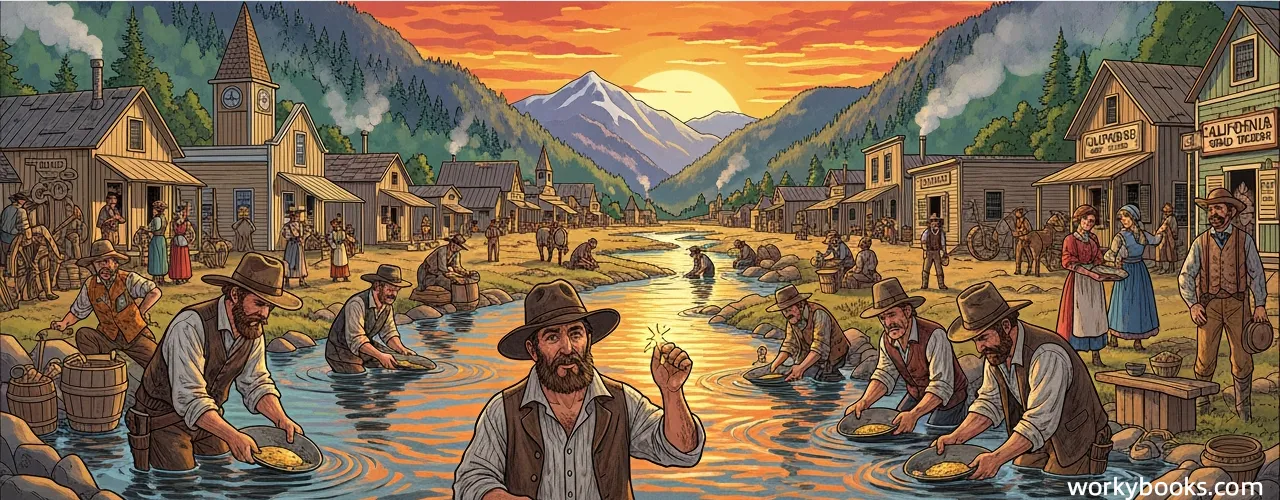
Gold Rush prospectors and the rapidly growing boomtowns that defined the American West.
The American West changed quickly in the 1800s. When gold or silver was discovered, people rushed to the area. Small camps turned into boomtowns almost overnight. These towns grew fast because everyone wanted a chance to get rich or find a good job.
Gold was first found in California in 1848. News spread quickly, and thousands of people traveled by wagon, horse, and even on foot. Camps popped up wherever gold or silver was found. Some people searched for fortune. Others offered services, like running stores, building hotels, or cooking food. Soon, these camps became busy towns filled with people from all over the world.
Mining towns were often crowded and noisy. People needed places to sleep, eat, and work. Builders put up wooden houses, shops, and banks. The streets were busy with miners, shopkeepers, and families. Law and order were sometimes hard to keep. Towns hired sheriffs to help keep the peace. Sometimes, there were problems like fighting or stealing, but many people worked together to solve them.
Railroad towns grew just as quickly. When workers built new railroads across the West, new towns sprang up along the tracks. Workers, called laborers, built homes near the railroad lines. These towns offered jobs and brought in supplies. Railroads helped farmers and miners send goods to other parts of the country fast.
Western boomtowns were places of opportunity and adventure. People from many backgrounds lived and worked together. Some towns lasted only a few years if the gold or silver ran out. Others became big cities that still exist today.
Life in a boomtown was never dull. People faced hard work and danger, but many also found success. These towns helped shape the West and made it a vital part of the United States.
Interesting Fact: In some boomtowns, the population grew from just a few people to thousands in only a few weeks!
When was gold first found in California?
1848186518001900
What is a boomtown?
A town that grows quicklyA town with no peopleA town for only farmersA town by the river
Who helped keep law and order?
SheriffMinerShopkeeperBanker
Why did railroad towns appear?
To build and support railroadsTo dig for goldTo herd cattleTo plant crops
What happened if gold ran out?
Towns became emptyTowns grew biggerMore people arrivedNew gold found always
How did railroads help towns?
Sent goods quicklyBrought more goldGrew cropsStopped all work
Boomtowns always became big cities. True or false?
TrueFalse
What does 'opportunity' mean in the passage?
A chance to succeedA type of trainA big problemA gold mine
Perfect For:
👩🏫 Teachers
• Reading comprehension practice
• Auto-graded assessments
• Literacy skill development
👨👩👧👦 Parents
• Reading practice at home
• Comprehension improvement
• Educational reading time
🏠 Homeschoolers
• Reading curriculum support
• Independent reading practice
• Progress monitoring
Reading Features:
📖
Reading Passage
Engaging fiction or nonfiction text
❓
Comprehension Quiz
Auto-graded questions
📊
Instant Feedback
Immediate results and scoring
📄
Printable Version
Download for offline reading
🔊
Read Aloud
Voice-over with word highlighting
Reviews & Ratings
No reviews yet. Be the first to share your experience!
Related Content
Colonial Trade with England and Africa
This history reading passage explores colonial trade between the American colonies, England, and Africa, focusing on the...
D2.HIS.2.3-5D2.HIS.14.3-5RI.4.3RI.4.4
John Adams: Second President
This engaging U.S. history reading passage introduces students to John Adams, the second President of the United States....
D2.HIS.2.3-5D2.HIS.14.3-5RI.4.3RI.4.4
Building Washington D.C., Our Capital
This history reading passage explores the building of Washington D.C., the capital of the United States. Students will l...
D2.HIS.1-3.3-5D2.HIS.14.3-5RI.4.3RI.4.4
Dolley Madison Saves Washington's Portrait
This engaging history reading passage tells the inspiring story of Dolley Madison and her brave actions during the War o...
D2.HIS.2.3-5D2.HIS.14.3-5RI.4.3RI.4.4
Franklin D. Roosevelt and the New Deal
This engaging history reading passage explores the life and leadership of Franklin D. Roosevelt and his creation of the ...
D2.HIS.2.3-5D2.HIS.14.3-5RI.4.3RI.4.4
Rationing and Life on the Home Front
This history reading passage explores rationing and life on the home front during World War II, focusing on how American...
D2.HIS.2.3-5D2.HIS.14.3-5RI.4.3RI.4.4
D-Day and the End of World War II
This engaging reading passage explores the key events of D-Day and how it helped bring World War II to a close. Students...
D2.HIS.2.3-5D2.HIS.14.3-5RI.4.3RI.4.4
Martin Luther King Jr. and "I Have a Dream"
This engaging history reading passage introduces students to the life and legacy of Martin Luther King Jr., focusing on ...
D2.HIS.2.3-5D2.HIS.14.3-5RI.4.1RI.4.3.
Ruby Bridges and the Little Rock Nine
This engaging history reading passage explores the stories of Ruby Bridges and the Little Rock Nine, two important group...
D2.HIS.2.3-5D2.HIS.14.3-5RI.4.3RI.4.4
Cesar Chavez and Farm Workers' Rights
This engaging history reading passage explores the life and impact of Cesar Chavez, a key leader in the fight for farm w...
D2.HIS.2.3-5D2.HIS.14.3-5RI.4.3RI.4.4
When Mexico Took Over California
This engaging U.S. history reading passage explores the period when Mexico took over California during the era of Westwa...
D2.HIS.2.3-5D2.HIS.3.3-5D2.HIS.14.3-5RI.4.3
Californios Culture
This history reading passage explores the story of the Californios—Spanish and Mexican settlers who shaped California be...
D2.HIS.2.3-5D2.HIS.3.3-5D2.HIS.14.3-5RI.4.3
The 31st State: California Joins the Union
This engaging U.S. history reading passage explores California's journey to becoming the 31st state in 1850. Students le...
D2.HIS.3.3-5D2.HIS.14.3-5RI.4.3RI.4.4
Routes to the Gold Fields
This engaging history reading passage explores the three main routes people took to reach the California gold fields dur...
D2.HIS.2.3-5D2.HIS.14.3-5RI.4.3RI.4.4
The Golden Spike: Connecting California to the Nation
This engaging U.S. history reading passage teaches students about the Golden Spike and how the first transcontinental ra...
D2.HIS.1.3-5D2.HIS.2.3-5D2.HIS.14.3-5RI.4.3
California Women Win the Vote in 1911
This engaging history reading passage explores how women in California fought and won the right to vote in 1911. Aligned...
D2.HIS.2.3-5D2.HIS.14.3-5RI.4.3RI.4.4
The 1965 Immigration Act
Discover the story of the 1965 Immigration Act with this engaging U.S. history reading passage. Perfect for building rea...
D2.HIS.4.3-5D2.HIS.14.3-5RI.5.3RI.5.4
Protecting California's Environment
This engaging U.S. history reading passage explores the story of how California has worked to protect its unique environ...
D2.HIS.2.3-5D2.HIS.14.3-5RI.4.3RI.4.4
Religious Freedom in the Middle Colonies
This engaging U.S. History reading passage explores the theme of religious freedom in the Middle Colonies during colonia...