This learning resource is available in interactive and printable formats. The interactive worksheet can be played online and assigned to students. The Printable PDF version can be downloaded and printed for completion by hand.
This educational history reading passage explores the French and Indian War, a major conflict in North America before the American Revolution. Students learn about the causes, key figures, events, and outcomes of the war, including the roles of British forces, French soldiers, and Native American nations. The passage highlights the bravery and teamwork of those involved and shows how the war changed the future of America. Activities include a multiple-choice quiz, writing prompts, a timeline, and a glossary of key vocabulary. The content is designed to meet the C3 Framework and Common Core standards, supporting both history and literacy learning. A Spanish translation and read aloud audio are included for accessibility. This resource is valuable for building foundational knowledge of U.S. history and improving reading skills through engaging and informative content.
CONTENT PREVIEW
Expand content preview
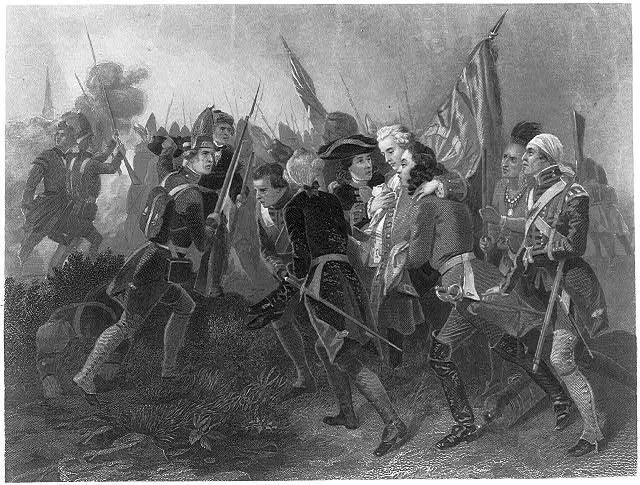
James Wolfe, 1727-1759 - being carried from battlefield Source: Library of Congress
The French and Indian War was a conflict between Britain and France for control of North America. It began in 1754 and lasted until 1763. Both sides wanted more land and power. Native American groups played important roles in the fighting. Some joined the French, while others supported the British.
The war started in the Ohio River Valley. This area was rich in land and resources. The French built forts to protect their claims. The British colonists also wanted to settle there. Tensions grew as both sides competed for land. In 1754, a young British officer named George Washington led an attack on the French. This battle was one of the first in the war.
Soon, fighting spread across the colonies. Britain sent more soldiers and supplies from Europe. The French did the same. Native American warriors fought alongside both armies. They hoped to protect their lands and way of life. Many battles took place in forests and near rivers.
After years of fighting, the British began to win important victories. In 1759, they captured Quebec, a major French city in Canada. This victory helped the British gain control of more territory. By 1763, the war ended with the Treaty of Paris. France lost most of its land in North America. Britain now controlled much of the land east of the Mississippi River.
The war was costly. Britain spent a lot of money on soldiers, weapons, and supplies. To pay for these costs, the British government decided to tax the American colonists. Many colonists felt these taxes were unfair. They believed they should not pay for a war they did not start. The new taxes made colonists angry and led them to protest British rule. This was the beginning of the road to the American Revolution.
The French and Indian War changed the future of North America. It ended French power in the region. It also set the stage for the colonies to fight for their independence from Britain.
Interesting Fact: George Washington gained his first military experience during this war, which later helped him lead the American Revolution.
Who fought in the French and Indian War?
Britain and FranceSpain and MexicoBritain and SpainFrance and Germany
Where did the war begin?
Ohio River ValleyMississippi DeltaNew York CityFlorida
Who captured Quebec in 1759?
The BritishThe FrenchNative AmericansThe Spanish
Why did Britain tax the colonists?
To pay war costsTo buy new shipsTo help FranceTo build roads
What was a result of the war?
Britain gained landFrance got strongerColonists moved to FranceNative Americans won
How did colonists feel about the taxes?
UnfairExcitedHappyThankful
Britain spent little on the war. True or false?
TrueFalse
What does 'treaty' mean?
War ending agreementA new leaderA kind of weaponA place to live
Perfect For:
👩🏫 Teachers
• Reading comprehension practice
• Auto-graded assessments
• Literacy skill development
👨👩👧👦 Parents
• Reading practice at home
• Comprehension improvement
• Educational reading time
🏠 Homeschoolers
• Reading curriculum support
• Independent reading practice
• Progress monitoring
Reading Features:
📖
Reading Passage
Engaging fiction or nonfiction text
❓
Comprehension Quiz
Auto-graded questions
📊
Instant Feedback
Immediate results and scoring
📄
Printable Version
Download for offline reading
🔊
Read Aloud
Voice-over with word highlighting
Reviews & Ratings
No reviews yet. Be the first to share your experience!
Related Content
Trade and Trading Routes Between Tribes
This engaging history reading passage explores the important role of trade and trading routes between Native American tr...
D2.HIS.1-4.3-5RI.4.1RI.4.3RI.4.4
The 13 Original Colonies: An Overview
This engaging U.S. history reading passage introduces students to the 13 original colonies. It presents the story of how...
D2.HIS.1-4.3-5RI.4.3RI.4.4RI.4.10
Unfair Taxes and the Stamp Act
This engaging U.S. history reading passage explores the story of the Stamp Act and unfair taxes in colonial America. Ali...
D2.HIS.1-4.3-5RI.4.1RI.4.3
Paul Revere's Midnight Ride
This U.S. History reading passage explores the famous Midnight Ride of Paul Revere, a key event in the American Revoluti...
D2.HIS.1-4.3-5RI.4.3RI.4.4RI.4.10
The Declaration of Independence and Thomas Jefferson
This engaging passage teaches students about the Declaration of Independence and Thomas Jefferson, one of America's Foun...
D2.HIS.1-4.3-5RI.4.1RI.4.2RI.4.3
Soldiers at Valley Forge in Winter
Explore the inspiring story of the Continental Army at Valley Forge during the harsh winter of 1777-1778. This history r...
D2.HIS.1-4.3-5RI.4.3RI.4.4RI.5.3
The Treaty of Paris 1783
This passage introduces students to the Treaty of Paris 1783, the important agreement that officially ended the American...
D2.HIS.1-4.3-5RI.4.3RI.4.4RI.4.10
The Star-Spangled Banner and War
This reading passage explores the inspiring story of 'The Star-Spangled Banner' and its origins during the War of 1812. ...
D2.HIS.1-4.3-5RI.4.1RI.4.3RI.4.4
Thomas Jefferson and the Louisiana Purchase
This engaging U.S. history reading passage teaches students about Thomas Jefferson and the Louisiana Purchase, one of th...
D2.HIS.1-4.3-5RI.4.3RI.5.3
James Madison and the War of 1812
This engaging U.S. history reading passage focuses on James Madison and the War of 1812. Students learn about key events...
D2.HIS.1-4.3-5RI.4.1RI.4.3RI.4.4
The First Political Parties Form
This engaging passage explores the formation of America's first political parties, highlighting the Federalists and Demo...
D2.HIS.1-4.3-5RI.4.3RI.4.4
James Monroe and the Monroe Doctrine
This engaging U.S. history reading passage introduces students to President James Monroe and the Monroe Doctrine, a key ...
D2.HIS.1-4.3-5RI.4.1RI.4.2RI.4.3
Americans Move West: The Oregon Trail
This engaging history passage explores the Oregon Trail and the westward movement of Americans in the 1800s. Students wi...
D2.HIS.1-4.3-5RI.4.3RI.4.4RI.5.3
Cowboys and Cattle Drives
This engaging U.S. History reading passage introduces students to the world of cowboys and cattle drives, a key part of ...
D2.HIS.1-4.3-5RI.4.3RI.4.4RI.5.3
Life in a Frontier Town
This passage explores the daily life and challenges faced by people living in a frontier town in the early United States...
D2.HIS.1-4.3-5RI.4.3RI.4.4W.4.2
Homestead Act: Free Land for Settlers
This engaging history reading passage explores the Homestead Act and its impact on American settlers moving west. Studen...
D2.HIS.1-4.3-5RI.4.3RI.4.4
Dangers on the Oregon Trail
This reading passage explores the many dangers faced by pioneers on the Oregon Trail, one of the most significant journe...
D2.HIS.1-4.3-5RI.4.1RI.4.3RI.4.4
Native Americans Lose Their Lands: The Trail of Tears
This reading passage explores the story of the Trail of Tears, focusing on the experiences of Native Americans as they l...
D2.HIS.1-4.3-5RI.4.3RI.4.4RI.4.7
Sherman's March to the Sea
This U.S. history reading passage explores Sherman's March to the Sea, a turning point during the Civil War. Students wi...