World War II Begins in Europe — Reading Comprehension
Rate this
Premium Resource
Present
Present in classroom. No work saved
Assign
Classroom with student accounts, Track progress
Quick Play
No student accounts, assign with a link
Grades
3
4
5
Standards
D2.HIS.1-4.3-5RI.4.1
RI.4.3
RI.4.4
RI.4.10
PRINT+DIGITAL RESOURCE
This learning resource is available in interactive and printable formats. The interactive worksheet can be played online and assigned to students. The Printable PDF version can be downloaded and printed for completion by hand.
This engaging reading passage introduces students to the beginning of World War II in Europe. Students will learn how events unfolded in a clear, story-like way, focusing on important people such as Adolf Hitler, the invasion of Poland, and the roles played by the Allies and Axis powers. The passage highlights the bravery and unity of nations that stood up to aggression. Activities include a multiple-choice quiz and writing prompts that help students analyze cause and effect, make connections to today, and compare perspectives. The included timeline summarizes key events, and a glossary helps students master important vocabulary. This history reading passage aligns with the C3 Framework and Common Core standards, and supports literacy development with read aloud audio and a full Spanish translation.
CONTENT PREVIEW
Expand content preview
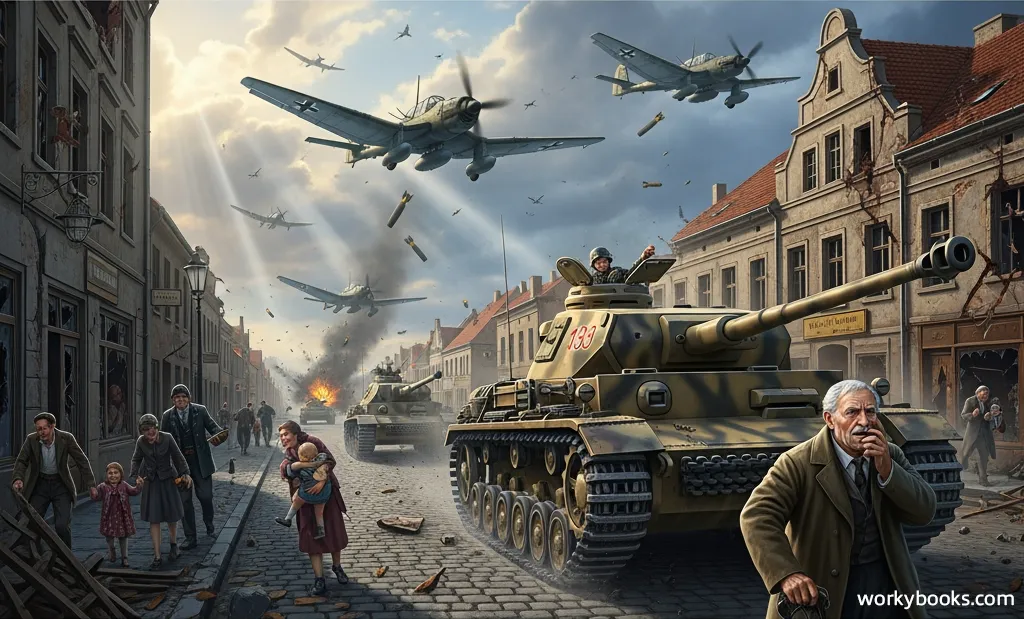
Blitzkrieg! German forces invade Poland, marking the start of World War II in Europe.
World War II started in Europe on September 1, 1939. On this day, Nazi Germany, led by Adolf Hitler, invaded Poland. The German army used a fast and powerful attack called “blitzkrieg,” which means “lightning war.” This invasion shocked the world and marked the beginning of a conflict that would soon involve many countries across the globe.
After Germany invaded Poland, both Great Britain and France declared war on Germany. They wanted to protect Poland and stop Germany from taking over more countries. However, the German army was very strong and quickly took control of Poland. The Soviet Union, another powerful country, also invaded Poland from the east. In just weeks, Poland was divided between Germany and the Soviet Union.
The invasion of Poland showed how dangerous the aggression of Nazi Germany was. Other nations watched with worry as Germany ignored agreements and used force to get what it wanted. This action set off a chain reaction. Soon, many other countries were drawn into the fighting. Battles spread across Europe, Africa, and Asia. The war became the largest and most deadly conflict the world had ever seen.
As the war continued, millions of people were affected. Soldiers from many nations fought bravely. Families had to leave their homes. Many people faced hunger and fear. The United States did not enter the war right away. At first, America watched the events in Europe and tried to stay neutral. But as the conflict grew, it became clear that the whole world was being pulled into war.
World War II brought big changes to the world. People worked together to defeat the Axis Powers, which included Germany, Italy, and Japan. The war showed the importance of standing up to injustice and working with others for peace. The bravery and unity of those who fought and helped during the war became a true example for generations to come.
Interesting Fact: The invasion of Poland was so sudden that Polish people called it the “September Campaign.”
When did World War II start?
September 1, 1939July 4, 1776December 7, 1941May 8, 1945
Who led Nazi Germany?
Adolf HitlerWinston ChurchillFranklin D. RooseveltJoseph Stalin
What is 'blitzkrieg'?
Lightning warPeace treatySlow attackNaval battle
Why did Britain and France declare war?
To protect PolandFor oilTo gain landTo support Germany
What was the effect of Germany's invasion?
World war startedPoland became strongerPeace in EuropeU.S. invaded Poland
What did the war show?
Importance of unityPower of moneyFarming skillsSpace travel
The U.S. joined the war right away. True or false?
TrueFalse
What does 'injustice' mean?
Unfair treatmentBrave actionFast attackWorking together
Perfect For:
👩🏫 Teachers
• Reading comprehension practice
• Auto-graded assessments
• Literacy skill development
👨👩👧👦 Parents
• Reading practice at home
• Comprehension improvement
• Educational reading time
🏠 Homeschoolers
• Reading curriculum support
• Independent reading practice
• Progress monitoring
Reading Features:
📖
Reading Passage
Engaging fiction or nonfiction text
❓
Comprehension Quiz
Auto-graded questions
📊
Instant Feedback
Immediate results and scoring
📄
Printable Version
Download for offline reading
🔊
Read Aloud
Voice-over with word highlighting
Reviews & Ratings
No reviews yet. Be the first to share your experience!
Related Content
The Navajo People: Traditions and Way of Life
This engaging reading passage introduces students to the rich traditions and way of life of the Navajo people, one of th...
D2.HIS.1-4.3-5RI.4.1RI.4.4RI.4.10
Crossing the Delaware River
This engaging history reading passage explores George Washington's daring crossing of the Delaware River during the Amer...
D2.HIS.1-4.3-5RI.4.1RI.4.2RI.4.3W.4.2.
Snorkeling & Scuba Diving
RI.2.2RI.2.6RI.2.10RF.2.4.A
Informational Text —Healthy Teeth and Gums
RI.4.10RI.4.3RF.4.4RF.4.4.A
Informational Text —Migratory Birds
Engage young minds with this worksheet that delves into the wonders of migratory birds. Learn about their extraordinary ...
RI.4.10RI.4.3RF.4.4RF.4.4.A
The Rubik's Cube
RI.2.2RI.2.6RI.2.10RF.2.4.A
Informational Text —All About Dentists
Students read an informational text explaining what dentists do and how they are trained. Aligned to RI.4.3-2
RI.4.10RI.4.3RF.4.4RF.4.4.A
Structures on the Ocean Floor
ESS2.B4-ESS2-2RI.4.10RI.4.7
Desert Jerboa
The Desert Jerboa is a small rodent that thrives in the desert environment. It has long back legs that enable it to jump...
RI.3.1RI.4.4RI.4.10
The Cherokee Nation: History and Culture
This reading passage explores the rich history and culture of the Cherokee Nation, one of the largest Native American tr...
D2.HIS.2.3-5D2.HIS.14.3-5RI.4.3RI.4.4RI.4.10
The 13 Original Colonies: An Overview
This engaging U.S. history reading passage introduces students to the 13 original colonies. It presents the story of how...
D2.HIS.1-4.3-5RI.4.3RI.4.4RI.4.10
The French and Indian War
This educational history reading passage explores the French and Indian War, a major conflict in North America before th...
D2.HIS.1-4.3-5RI.4.1RI.4.3RI.4.4
Paul Revere's Midnight Ride
This U.S. History reading passage explores the famous Midnight Ride of Paul Revere, a key event in the American Revoluti...
D2.HIS.1-4.3-5RI.4.3RI.4.4RI.4.10
The Treaty of Paris 1783
This passage introduces students to the Treaty of Paris 1783, the important agreement that officially ended the American...
D2.HIS.1-4.3-5RI.4.3RI.4.4RI.4.10
Boomtowns Spring Up Out West
This engaging passage explores the exciting rise of boomtowns in the American West during the 1800s, focusing on the Gol...
D2.HIS.2.3-5D2.HIS.14.3-5RI.4.3RI.4.4
Stagecoaches and the Pony Express
This engaging U.S. history reading passage introduces students to the exciting era of stagecoaches and the Pony Express ...
D2.HIS.1-6.3-5RI.4.3RI.4.4RI.4.10
Life as a Union or Confederate Soldier
This engaging history reading passage explores the daily life of Union and Confederate soldiers during the American Civi...
D2.HIS.1-5.3-5RI.4.3RI.4.4RI.4.10
The Civil War Finally Ends
This engaging reading passage explores the end of the Civil War, focusing on the events of 1865 when General Robert E. L...
D2.HIS.1-6.3-5RI.4.3RI.4.4RI.4.10
Franklin D. Roosevelt and the New Deal
This engaging history reading passage explores the life and leadership of Franklin D. Roosevelt and his creation of the ...