This learning resource is available in interactive and printable formats. The interactive worksheet can be played online and assigned to students. The Printable PDF version can be downloaded and printed for completion by hand.
This passage introduces students to the Treaty of Paris 1783, the important agreement that officially ended the American Revolutionary War and recognized the independence of the United States. The reading follows a clear, chronological narrative, focusing on key events, people, and the sequence that led to peace between Britain and the new United States. Vocabulary words are bolded and explained in the glossary. The passage supports the C3 Framework for social studies and Common Core ELA standards, helping students build literacy and historical understanding. Activities include a multiple-choice quiz, writing prompts, and a timeline to reinforce learning. The passage is available with read aloud audio and Spanish translation, making it accessible to a wide range of learners. This resource is designed to inspire students with themes of bravery, unity, and problem-solving from America's founding story.
CONTENT PREVIEW
Expand content preview
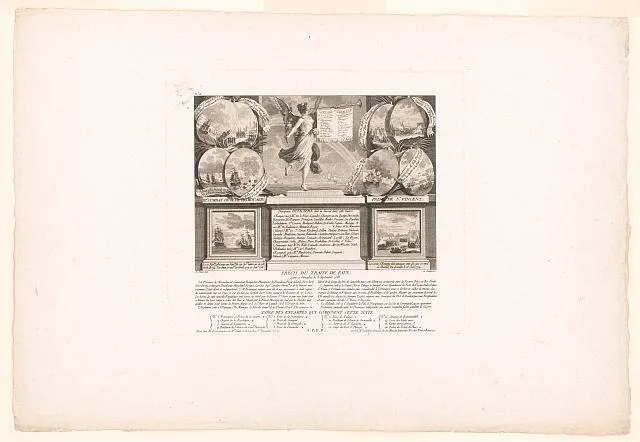
Précis du traité de paix, signé à Versailles le 3 Septembre 1783. Source: Library of Congress - Godefroy, François, 1743?-1819.
The Treaty of Paris in 1783 officially ended the American Revolutionary War. After many years of fighting, both Great Britain and the thirteen American colonies wanted peace. The war had started in 1775 because the colonists wanted freedom from British rule. By 1781, the Americans had won important battles. The British realized they could not win the war.
Leaders from both sides met in Paris, France, to talk about ending the war. The American team included Benjamin Franklin, John Adams, and John Jay. These men were chosen because they were trusted and wise. The British also sent leaders to help create an agreement. The talks were long and sometimes difficult. Both sides wanted the best deal for their countries.
On September 3, 1783, both sides signed the Treaty of Paris. The treaty said that Great Britain would recognize the United States as a free and independent nation. This was a major change. Before this, the colonies had been ruled by the King of England. Now, they could make their own laws and decisions.
The treaty also set new borders for the United States. The land stretched from the Atlantic Ocean to the Mississippi River. It gave Americans the right to fish near Canada and told both sides to return property taken during the war. The treaty helped former enemies become peaceful neighbors.
The Treaty of Paris was very important because it made American freedom official. It showed that a small group of colonies could win their independence from one of the strongest countries in the world. This inspired other people around the world to fight for their own rights and freedom.
The treaty also showed that talking and agreeing on paper could stop a war. Today, countries still use treaties to solve problems and keep the peace.
Interesting Fact: The painting of the treaty signing was never finished, because the British delegates would not sit for their portraits.
When was the Treaty of Paris signed?
1783177618001754
Who helped create the treaty for America?
Benjamin FranklinGeorge WashingtonThomas JeffersonKing George
What did the treaty make official?
American independenceNew laws for BritainA new kingA new flag
Why did the colonists want independence?
To be free from British ruleTo keep fishing rightsTo move to FranceTo meet new leaders
How did the treaty change the United States?
Set new bordersMade a new kingChanged the oceanBanned fishing
Who ruled the colonies before the treaty?
The King of EnglandThe PresidentThe FrenchThe Spanish
The treaty was signed in Paris. True or false?
TrueFalse
What is a treaty?
Agreement between countriesA kind of boatA famous leaderA new law
Perfect For:
👩🏫 Teachers
• Reading comprehension practice
• Auto-graded assessments
• Literacy skill development
👨👩👧👦 Parents
• Reading practice at home
• Comprehension improvement
• Educational reading time
🏠 Homeschoolers
• Reading curriculum support
• Independent reading practice
• Progress monitoring
Reading Features:
📖
Reading Passage
Engaging fiction or nonfiction text
❓
Comprehension Quiz
Auto-graded questions
📊
Instant Feedback
Immediate results and scoring
📄
Printable Version
Download for offline reading
🔊
Read Aloud
Voice-over with word highlighting
Reviews & Ratings
No reviews yet. Be the first to share your experience!
Related Content
Trade and Trading Routes Between Tribes
This engaging history reading passage explores the important role of trade and trading routes between Native American tr...
D2.HIS.1-4.3-5RI.4.1RI.4.3RI.4.4
The 13 Original Colonies: An Overview
This engaging U.S. history reading passage introduces students to the 13 original colonies. It presents the story of how...
D2.HIS.1-4.3-5RI.4.3RI.4.4RI.4.10
The French and Indian War
This educational history reading passage explores the French and Indian War, a major conflict in North America before th...
D2.HIS.1-4.3-5RI.4.1RI.4.3RI.4.4
Unfair Taxes and the Stamp Act
This engaging U.S. history reading passage explores the story of the Stamp Act and unfair taxes in colonial America. Ali...
D2.HIS.1-4.3-5RI.4.1RI.4.3
Paul Revere's Midnight Ride
This U.S. History reading passage explores the famous Midnight Ride of Paul Revere, a key event in the American Revoluti...
D2.HIS.1-4.3-5RI.4.3RI.4.4RI.4.10
The Declaration of Independence and Thomas Jefferson
This engaging passage teaches students about the Declaration of Independence and Thomas Jefferson, one of America's Foun...
D2.HIS.1-4.3-5RI.4.1RI.4.2RI.4.3
Soldiers at Valley Forge in Winter
Explore the inspiring story of the Continental Army at Valley Forge during the harsh winter of 1777-1778. This history r...
D2.HIS.1-4.3-5RI.4.3RI.4.4RI.5.3
The Star-Spangled Banner and War
This reading passage explores the inspiring story of 'The Star-Spangled Banner' and its origins during the War of 1812. ...
D2.HIS.1-4.3-5RI.4.1RI.4.3RI.4.4
Thomas Jefferson and the Louisiana Purchase
This engaging U.S. history reading passage teaches students about Thomas Jefferson and the Louisiana Purchase, one of th...
D2.HIS.1-4.3-5RI.4.3RI.5.3
James Madison and the War of 1812
This engaging U.S. history reading passage focuses on James Madison and the War of 1812. Students learn about key events...
D2.HIS.1-4.3-5RI.4.1RI.4.3RI.4.4
The First Political Parties Form
This engaging passage explores the formation of America's first political parties, highlighting the Federalists and Demo...
D2.HIS.1-4.3-5RI.4.3RI.4.4
James Monroe and the Monroe Doctrine
This engaging U.S. history reading passage introduces students to President James Monroe and the Monroe Doctrine, a key ...
D2.HIS.1-4.3-5RI.4.1RI.4.2RI.4.3
Americans Move West: The Oregon Trail
This engaging history passage explores the Oregon Trail and the westward movement of Americans in the 1800s. Students wi...
D2.HIS.1-4.3-5RI.4.3RI.4.4RI.5.3
Cowboys and Cattle Drives
This engaging U.S. History reading passage introduces students to the world of cowboys and cattle drives, a key part of ...
D2.HIS.1-4.3-5RI.4.3RI.4.4RI.5.3
Life in a Frontier Town
This passage explores the daily life and challenges faced by people living in a frontier town in the early United States...
D2.HIS.1-4.3-5RI.4.3RI.4.4W.4.2
Homestead Act: Free Land for Settlers
This engaging history reading passage explores the Homestead Act and its impact on American settlers moving west. Studen...
D2.HIS.1-4.3-5RI.4.3RI.4.4
Dangers on the Oregon Trail
This reading passage explores the many dangers faced by pioneers on the Oregon Trail, one of the most significant journe...
D2.HIS.1-4.3-5RI.4.1RI.4.3RI.4.4
Native Americans Lose Their Lands: The Trail of Tears
This reading passage explores the story of the Trail of Tears, focusing on the experiences of Native Americans as they l...
D2.HIS.1-4.3-5RI.4.3RI.4.4RI.4.7
Sherman's March to the Sea
This U.S. history reading passage explores Sherman's March to the Sea, a turning point during the Civil War. Students wi...