Life in the Southern Colonies
Interactive passage with audio narration, comprehension questions, and printable PDF.
By completing this purchase you agree to our Terms of Use and Privacy Policy. Your subscription renews automatically until you cancel. You can cancel anytime from your account settings. All sales are final and non-refundable. Digital content is available for download in your account immediately upon purchase.
What's included
Part of this bundle

Life in the Southern Colonies preview and details
About this printable Life in the Southern Colonies reading passage (Grades 3-5)
Sample passage and quiz from Life in the Southern Colonies
Reading passage and comprehension quiz preview
Life in the Southern Colonies
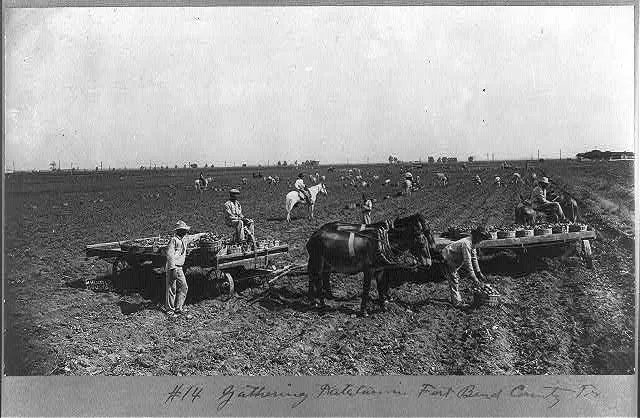
"Gathering potatoes in Fort Bend County, Tx" by Schlueter, Frank J. / Library of Congress.
The Southern Colonies were known for their large plantations and warm, wet climate. These colonies included Virginia, Maryland, North Carolina, South Carolina, and Georgia. The land had rich soil and long growing seasons. This made it perfect for farming. People grew cash crops like tobacco and rice. Cash crops are plants grown to sell for money, not just for food.
Plantations were like small villages. Each one had a big house where the owner lived, and many smaller buildings. These buildings included kitchens, barns, and cabins for workers. The plantations covered hundreds of acres. They needed many workers to plant, care for, and harvest the crops.
Most of the work on plantations was done by enslaved Africans. These people were forced to work and could not leave. Plantation owners bought enslaved people to do hard labor in the fields. They worked from sun up to sun down. Life was very hard for enslaved workers. They had little freedom and few rights.
The warm weather and rich soil of the South made it different from the North. In the North, farms were smaller and grew food for families. In the South, large plantations grew crops to sell. The money from cash crops made some owners very rich. Towns grew near plantations, and ships carried crops to Europe and other places.
Plantation owners depended on enslaved labor to make their farms work. This created a system where a few people had great power. Many people in the South accepted this system, but some spoke out against it. Over time, more people in America would question if slavery was right.
The Southern Colonies shaped American history in many ways. Their crops helped the colonies grow and trade with others. But the use of enslaved labor caused pain and injustice. The story of the Southern Colonies is important to understanding our nation’s past.
Interesting Fact: Some plantations had their own blacksmith shops, schools, and churches, making them feel like small towns.
Comprehension quiz (8 questions)
1. Which crops were grown for money?
2. Who did most of the work on plantations?
3. What made Southern soil special?
4. Why did plantations need many workers?
5. What was one effect of growing cash crops?
6. Why did some people question the system?
7. Plantations had their own schools. True or false?
8. What does 'injustice' mean?
Common Core standards for Life in the Southern Colonies
Explain events, procedures, ideas, or concepts in a historical, scientific, or technical text, including what happened and why, based on specific information in the text.
Determine the meaning of general academic and domain-specific words or phrases in a text relevant to a grade 4 topic or subject area.
Write informative/explanatory texts to examine a topic and convey ideas and information clearly.
Perfect for the way you teach
- Build comprehension skills
- Auto-graded quiz
- Differentiated reading
- Read together at home
- Improve fluency
- Quiet reading time
- Reading curriculum support
- Independent practice
- Track Lexile growth