Religious Freedom in the Middle Colonies — Reading Comprehension
Rate this
Premium Resource
Present
Present in classroom. No work saved
Assign
Classroom with student accounts, Track progress
Quick Play
No student accounts, assign with a link
Grades
3
4
5
Standards
D2.HIS.4.3-5
D2.HIS.14.3-5
RI.4.3
RI.4.4
W.4.2
PRINT+DIGITAL RESOURCE
This learning resource is available in interactive and printable formats. The interactive worksheet can be played online and assigned to students. The Printable PDF version can be downloaded and printed for completion by hand.
This engaging U.S. History reading passage explores the theme of religious freedom in the Middle Colonies during colonial America. Students will learn how people of different backgrounds, such as Quakers, Dutch, and others, helped create colonies where many religions were accepted and respected. Key events and figures, including William Penn and his founding of Pennsylvania, are explained in a chronological, student-friendly narrative. The passage emphasizes the bravery and unity of colonists who sought a place to worship freely and the lasting impact of their choices. Activities include a multiple-choice quiz, writing prompts, and a graphic organizer to support comprehension. The resource includes a Spanish translation and is aligned with C3 Framework D2.His.4.3-5 and RI.4.3 standards. This passage provides an inspiring look at early American values and supports students’ reading and critical thinking skills. Read aloud audio and a glossary of key vocabulary terms are included to enhance accessibility and understanding.
CONTENT PREVIEW
Expand content preview
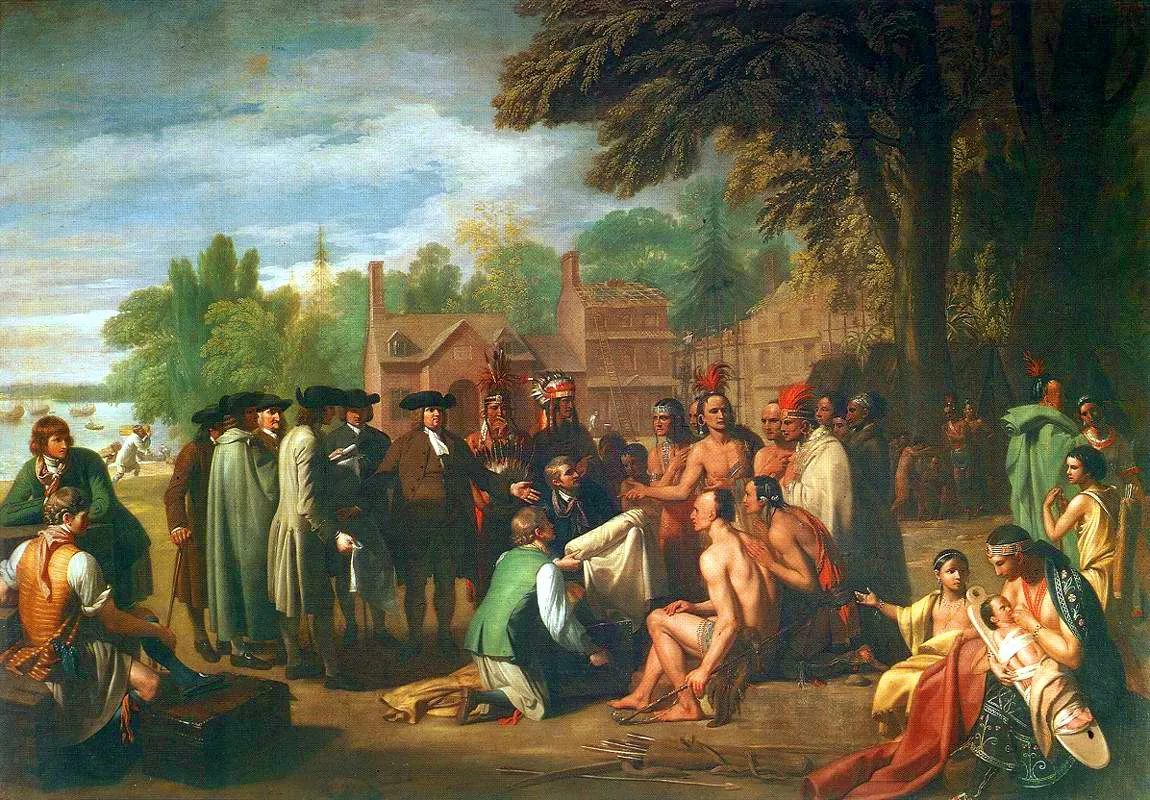
"Treaty of Penn with Indians by Benjamin West" by Benjamin West / Wikimedia Commons.
The Middle Colonies were known for their religious tolerance. People from many different faiths moved to these colonies to find freedom to worship in their own way. The Middle Colonies included New York, New Jersey, Pennsylvania, and Delaware. These areas became a safe home for groups like the Quakers, Catholics, Jews, Lutherans, and many other Protestant groups.
One of the most famous leaders was William Penn, a Quaker who founded Pennsylvania. Penn wanted his colony to welcome everyone. He wrote laws that said people could follow any faith they chose. This was different from some other colonies, where only one religion was allowed. Penn’s idea of religious tolerance attracted many settlers. People who faced persecution in Europe came to the Middle Colonies to find safety.
Religion in the Middle Colonies was very diverse. In one town, you might see a Quaker meeting house, a Catholic church, a Jewish synagogue, and a Lutheran church. People lived together peacefully and learned to respect each other’s beliefs. This diversity helped the colonies grow. It made them strong and open to new ideas.
Freedom of worship was not always easy. Sometimes there were problems and disagreements. But overall, leaders in the Middle Colonies worked hard to protect rights for all. They believed that people should be able to pray and live as they wanted, without fear.
The Middle Colonies taught an important lesson about living together with respect. They showed that people from many backgrounds could build a community if they accepted each other’s differences. This idea helped shape the future laws of the United States, like the First Amendment, which protects freedom of religion.
Interesting Fact: The city of Philadelphia in Pennsylvania was called the “City of Brotherly Love” because it welcomed people of all religions.
Which colonies are the Middle Colonies?
New York, New Jersey, Pennsylvania, DelawareMassachusetts, Virginia, Georgia, MarylandNew Hampshire, Connecticut, Rhode Island, MaineFlorida, Texas, California, Arizona
Who founded Pennsylvania?
William PennGeorge WashingtonBenjamin FranklinJames Oglethorpe
Which group was NOT mentioned in the passage?
BaptistsQuakersCatholicsJews
Why did many people move to the Middle Colonies?
For religious freedomFor goldFor farming onlyTo escape cold weather
What was one effect of religious diversity?
Colonies grew strongerFewer people moved thereOnly one religion was allowedLeaders banned new ideas
What did the leaders work to protect?
People’s rightsOnly one churchTrade routesBuilding laws
The Middle Colonies were known for religious tolerance.
TrueFalse
What does "persecution" mean?
Being treated unfairlyMoving to a new landBuilding a churchCelebrating a holiday
Perfect For:
👩🏫 Teachers
• Reading comprehension practice
• Auto-graded assessments
• Literacy skill development
👨👩👧👦 Parents
• Reading practice at home
• Comprehension improvement
• Educational reading time
🏠 Homeschoolers
• Reading curriculum support
• Independent reading practice
• Progress monitoring
Reading Features:
📖
Reading Passage
Engaging fiction or nonfiction text
❓
Comprehension Quiz
Auto-graded questions
📊
Instant Feedback
Immediate results and scoring
📄
Printable Version
Download for offline reading
🔊
Read Aloud
Voice-over with word highlighting
Reviews & Ratings
No reviews yet. Be the first to share your experience!
Related Content
Colonial Trade with England and Africa
This history reading passage explores colonial trade between the American colonies, England, and Africa, focusing on the...
D2.HIS.2.3-5D2.HIS.14.3-5RI.4.3RI.4.4
John Adams: Second President
This engaging U.S. history reading passage introduces students to John Adams, the second President of the United States....
D2.HIS.2.3-5D2.HIS.14.3-5RI.4.3RI.4.4
Building Washington D.C., Our Capital
This history reading passage explores the building of Washington D.C., the capital of the United States. Students will l...
D2.HIS.1-3.3-5D2.HIS.14.3-5RI.4.3RI.4.4
Dolley Madison Saves Washington's Portrait
This engaging history reading passage tells the inspiring story of Dolley Madison and her brave actions during the War o...
D2.HIS.2.3-5D2.HIS.14.3-5RI.4.3RI.4.4
Boomtowns Spring Up Out West
This engaging passage explores the exciting rise of boomtowns in the American West during the 1800s, focusing on the Gol...
D2.HIS.2.3-5D2.HIS.14.3-5RI.4.3RI.4.4
Franklin D. Roosevelt and the New Deal
This engaging history reading passage explores the life and leadership of Franklin D. Roosevelt and his creation of the ...
D2.HIS.2.3-5D2.HIS.14.3-5RI.4.3RI.4.4
Rationing and Life on the Home Front
This history reading passage explores rationing and life on the home front during World War II, focusing on how American...
D2.HIS.2.3-5D2.HIS.14.3-5RI.4.3RI.4.4
D-Day and the End of World War II
This engaging reading passage explores the key events of D-Day and how it helped bring World War II to a close. Students...
D2.HIS.2.3-5D2.HIS.14.3-5RI.4.3RI.4.4
Martin Luther King Jr. and "I Have a Dream"
This engaging history reading passage introduces students to the life and legacy of Martin Luther King Jr., focusing on ...
D2.HIS.2.3-5D2.HIS.14.3-5RI.4.1RI.4.3.
Ruby Bridges and the Little Rock Nine
This engaging history reading passage explores the stories of Ruby Bridges and the Little Rock Nine, two important group...
D2.HIS.2.3-5D2.HIS.14.3-5RI.4.3RI.4.4
Cesar Chavez and Farm Workers' Rights
This engaging history reading passage explores the life and impact of Cesar Chavez, a key leader in the fight for farm w...
D2.HIS.2.3-5D2.HIS.14.3-5RI.4.3RI.4.4
When Mexico Took Over California
This engaging U.S. history reading passage explores the period when Mexico took over California during the era of Westwa...
D2.HIS.2.3-5D2.HIS.3.3-5D2.HIS.14.3-5RI.4.3
Californios Culture
This history reading passage explores the story of the Californios—Spanish and Mexican settlers who shaped California be...
D2.HIS.2.3-5D2.HIS.3.3-5D2.HIS.14.3-5RI.4.3
The 31st State: California Joins the Union
This engaging U.S. history reading passage explores California's journey to becoming the 31st state in 1850. Students le...
D2.HIS.3.3-5D2.HIS.14.3-5RI.4.3RI.4.4
Routes to the Gold Fields
This engaging history reading passage explores the three main routes people took to reach the California gold fields dur...
D2.HIS.2.3-5D2.HIS.14.3-5RI.4.3RI.4.4
The Golden Spike: Connecting California to the Nation
This engaging U.S. history reading passage teaches students about the Golden Spike and how the first transcontinental ra...
D2.HIS.1.3-5D2.HIS.2.3-5D2.HIS.14.3-5RI.4.3
California Women Win the Vote in 1911
This engaging history reading passage explores how women in California fought and won the right to vote in 1911. Aligned...
D2.HIS.2.3-5D2.HIS.14.3-5RI.4.3RI.4.4
The 1965 Immigration Act
Discover the story of the 1965 Immigration Act with this engaging U.S. history reading passage. Perfect for building rea...
D2.HIS.4.3-5D2.HIS.14.3-5RI.5.3RI.5.4
Protecting California's Environment
This engaging U.S. history reading passage explores the story of how California has worked to protect its unique environ...