This learning resource is available in interactive and printable formats. The interactive worksheet can be played online and assigned to students. The Printable PDF version can be downloaded and printed for completion by hand.
Dive into the fascinating world of the platypus and discover how its unique external structure, webbed feet, plays a vital role in its survival. This engaging reading passage, designed for a 4th-grade science class, explains the function of these amazing feet for swimming and finding food in the water. Students will learn about **animal structures** and how these **adaptations** help creatures thrive in their **habitat**, aligning with NGSS 4-LS1-1. The passage also touches on the platypus's **behavior** and how its body parts allow it to forage effectively. This content is audio-integrated to support diverse learners and includes relevant SEO keywords like 'platypus webbed feet' and 'animal survival'.
CONTENT PREVIEW
Expand content preview
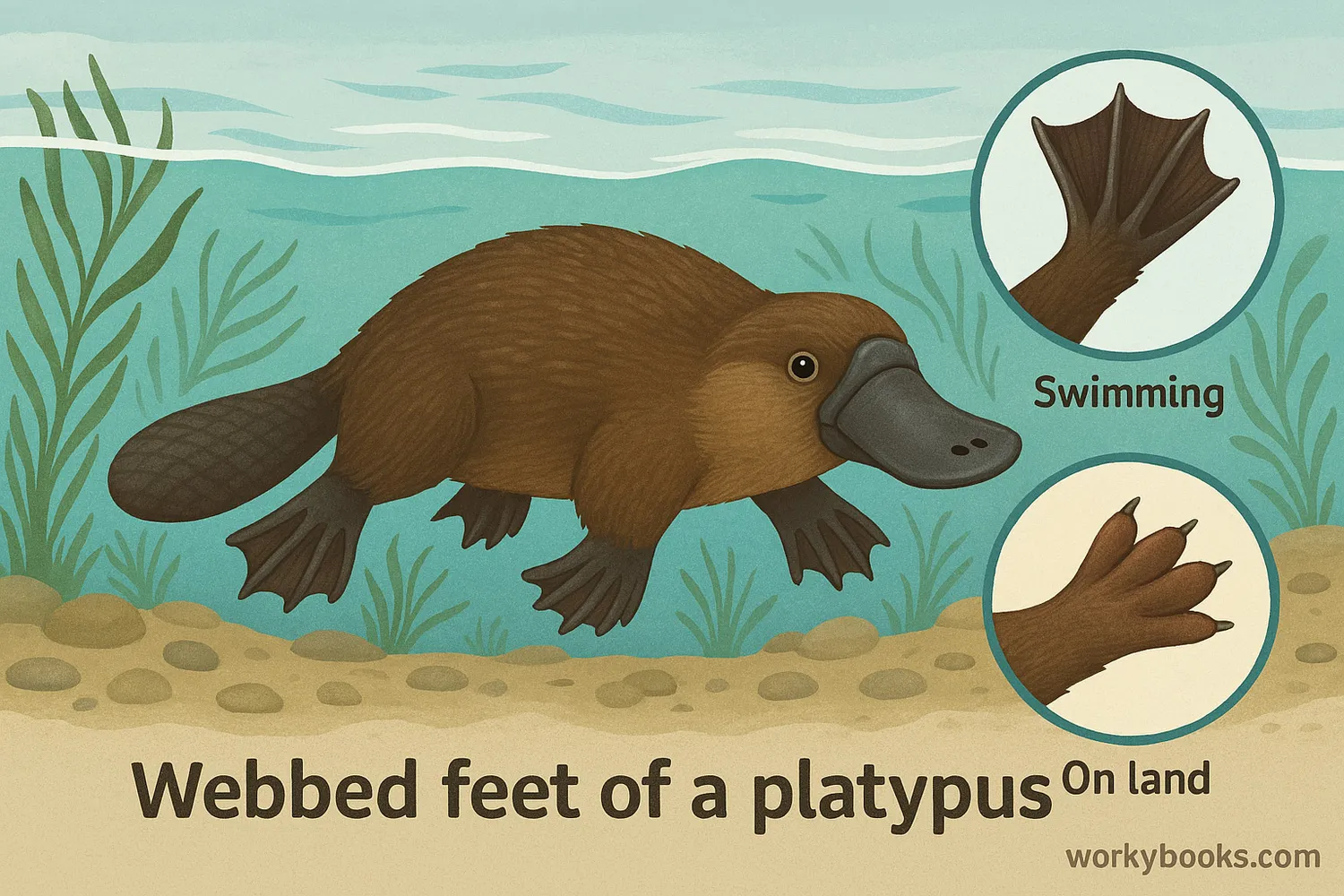
Platypus uses webbed feet to swim, dig for food, and walk on land.
Platypuses are one of the most unique animals in the world. They are mammals that live in rivers and streams in Australia. Platypuses are famous for their duck-like bills, but their webbed feet are just as amazing.
The platypus has two different kinds of feet. Its front feet have large webs that stretch out past the claws. These webs work like paddles, helping the platypus swim quickly through the water. The webbing is soft and wide, letting the platypus glide and turn easily as it hunts for food underwater. When the platypus comes out of the water, the webbing folds back, so the sharp claws are free. The claws help the platypus dig burrows in the muddy riverbanks, where it sleeps and stays safe.
The back feet are different. They have smaller webs and strong claws. Males have a special feature: a venomous spur on their back feet. This spur can release venom to protect the platypus from predators. The platypus is one of the few mammals in the world that is venomous!
Platypuses are semi-aquatic. This means they spend time in water and on land. Their webbed feet help them swim and dig, showing how one animal can live in both places. Platypuses dive underwater to find food like worms, shrimp, and insects. They use their bills to sense tiny electricity signals from their prey. When underwater, they close their eyes and ears and rely on their special bill to hunt.
Interesting Fact: Platypuses can lay eggs, even though they are mammals. This makes them very unique in the animal world!
Where do platypuses live?
Australian rivers and streamsAfrican desertsArctic iceNorth American forests
What are platypus front feet used for?
Swimming like paddlesFlyingClimbing treesMaking sounds
What do male platypuses have on back feet?
Venomous spurWingsLong tailExtra webbing
Why does webbing fold back on land?
To use claws for diggingFor jumpingFor flyingTo hide from predators
How do platypuses find food underwater?
Sensing electricity with their billsUsing their eyesListening for soundsFollowing other animals
What does semi-aquatic mean?
Lives in water and on landLives only on landLives only in treesCan fly in the sky
Platypuses are birds. True or false?
FalseTrue
What is a burrow?
A hole or tunnel for shelterA type of foodA body partA river in Australia
Perfect For:
👩🏫 Teachers
• Reading comprehension practice
• Auto-graded assessments
• Literacy skill development
👨👩👧👦 Parents
• Reading practice at home
• Comprehension improvement
• Educational reading time
🏠 Homeschoolers
• Reading curriculum support
• Independent reading practice
• Progress monitoring
Reading Features:
📖
Reading Passage
Engaging fiction or nonfiction text
❓
Comprehension Quiz
Auto-graded questions
📊
Instant Feedback
Immediate results and scoring
📄
Printable Version
Download for offline reading
🔊
Read Aloud
Voice-over with word highlighting
Reviews & Ratings
No reviews yet. Be the first to share your experience!
Related Content
The Nature of Life Science
This passage, aligned with NGSS MS-LS1-1, introduces students in grades 6-8 to the foundational concepts of life science...
MS-LS1-1
Science Vocabulary
This worksheet on domain-specific words will help students learn some science vocabulary. Students will be asked to matc...
L.3.6L.3.4.A
The Science of Hibernation
This educational module, featuring an audio-integrated reading passage titled 'The Science of Hibernation,' is designed ...
Simple Machines Science Report
This science writing task requires students to clearly explain how three simple machines work using precise domain-speci...
W.5.4
Adaptation
This engaging middle school science passage explores adaptation, focusing on how inherited traits enable organisms to su...
MS-LS4-4MS-LS4-6
Desert Rain Frog Behavioral Adaptations
Dive into the fascinating world of the Desert Rain Frog and discover its incredible unique adaptations for survival in a...
Animal Adaptations Word Sort
This engaging word sort activity helps students understand the difference between physical and behavioral adaptations in...
Herbivore Adaptations
This engaging reading passage, integrated with audio, delves into the fascinating world of herbivore adaptations. Studen...
Ocean Animal Adaptations
Students will read a passage that provides information about various adaptations that marine animals have developed to t...
W.4.9.B
Nocturnal Adaptations of the Strange Aye-Aye
This engaging reading passage, integrated with audio, takes grade 5 students on a journey to discover the fascinating no...
Early Life Forms and Their Adaptations
This educational passage focuses on early life forms and their basic adaptations, supporting NGSS standard 3-LS4-2 for e...
RI.3.3RI.4.3RI.5.33-LS4-2
Binturong Adaptations
This engaging, audio-integrated reading passage, 'Binturong Adaptations,' for Grade 6 students delves into the fascinati...
Barnacle Biology and Adaptations
Dive into the intriguing world of barnacles with this engaging Grade 6 reading passage. Students will learn about these ...
Whale Blubber: Function and Adaptation
This engaging, audio-integrated reading passage, 'Whale Blubber Function and Adaptation,' introduces young learners to t...
Amur Leopard Adaptations
This engaging, audio-integrated reading passage, 'Amur Leopard Adaptations,' is designed for Grade 6 science students. I...
Mountain Animal Adaptations
This reading comprehension worksheet focuses on the topic of animal adaptations for survival in mountainous environments...
W.4.9.B
Climate Zone Adaptations Word Sort
This word sort activity examines how plants and animals adapt to different climate conditions. Students sort 12 differen...
Plant Adaptations for Survival
This NGSS-aligned word sort activity, suitable for kindergarten, focuses on plant survival adaptations, helping students...
K-LS1-1
The Pumpkin Life Cycle
This informational worksheet explores the pumpkin lifecycle, guiding students through procedural steps in a scientific t...
RI.2.3RI.2.10
What Is Earth Science?
This engaging middle school science passage introduces students to the field of Earth science, aligning with NGSS standa...