Sanskrit and Indian Literature
Interactive passage with audio narration, comprehension questions, and printable PDF.
By completing this purchase you agree to our Terms of Use and Privacy Policy. Your subscription renews automatically until you cancel. You can cancel anytime from your account settings. All sales are final and non-refundable. Digital content is available for download in your account immediately upon purchase.
What's included
Sanskrit and Indian Literature preview and details
About this printable Sanskrit and Indian Literature reading passage (Grades 5-8)
Sample passage and quiz from Sanskrit and Indian Literature
Reading passage and comprehension quiz preview
Sanskrit and Indian Literature
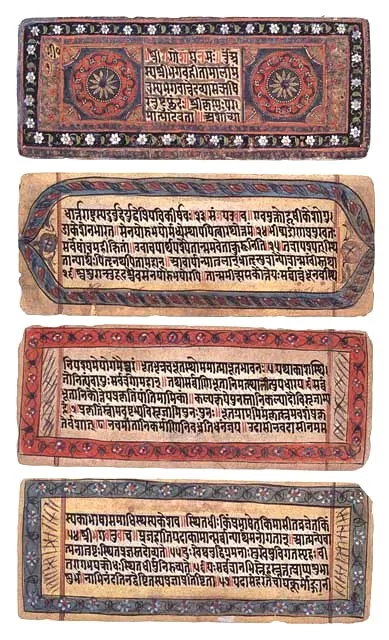
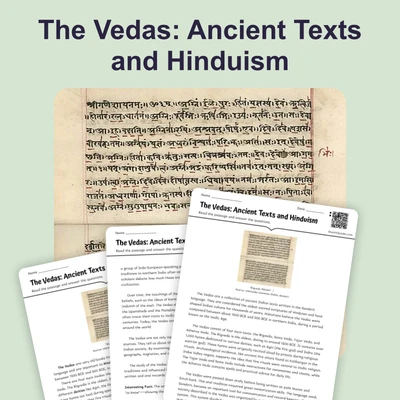
"Bhagavad Gita, a 19th century manuscript" / Wikimedia Commons (Public domain).
Sanskrit is one of the world’s oldest known languages and was the primary literary and scholarly language of ancient India. For thousands of years, Sanskrit played a crucial role in the development of South Asian civilization, especially in religion, literature, and education. The earliest evidence of Sanskrit appears in the Rigveda, a sacred collection of hymns composed around 1500 BCE in the region that is now northern India and Pakistan. This language helped shape the culture, beliefs, and social structure of ancient Indian societies.
The Vedas, which are a group of ancient religious texts, were composed and transmitted orally in Sanskrit before being written down. These texts provided guidance for rituals, daily life, and moral conduct, and they influenced later religious traditions like Hinduism and Buddhism. Sanskrit was also the language of great literary works, including the Mahabharata and Ramayana. These epic poems contain stories about gods, heroes, and wars, and they continue to be important in Indian culture today. The Mahabharata, for example, is one of the longest poems ever written and contains the famous Bhagavad Gita—a philosophical dialogue about duty and life.
During the Gupta Empire (about 320 to 550 CE), Sanskrit reached its golden age. This period is often called the “Classical Age” of India, when art, mathematics, science, and literature flourished. Sanskrit became the official language of the royal court and scholarly learning. Many famous plays and poems, such as those by the playwright Kalidasa, were written during this time. Archaeological discoveries, like inscriptions carved on stone pillars or temple walls, show how rulers used Sanskrit to record achievements and laws. For example, the Allahabad Pillar inscription lists the victories of the Gupta emperor Samudragupta, providing evidence of Sanskrit’s official use.
Sanskrit was also important in education. Ancient universities, such as Nalanda and Takshashila, taught philosophy, medicine, astronomy, and more using Sanskrit texts. Although Sanskrit was mostly used by the upper classes—priests, scholars, and rulers—it influenced many local languages, including Hindi, Bengali, and Nepali. Over time, spoken Sanskrit became less common, but its written form remained central in religious and scholarly life. Its grammar, carefully described by the ancient scholar Panini, set standards for other languages and is still studied today.
The legacy of Sanskrit continues as it shapes modern Indian languages, religious practices, and cultural traditions. It demonstrates how language both reflects and shapes a society’s values, beliefs, and achievements. Studying Sanskrit helps historians understand the connections between language, power, and culture in the ancient world.
This study of Sanskrit connects to broader course themes such as the influence of language on culture and the development of civilizations in South Asia.
Interesting Fact: Sanskrit is so precise that NASA scientists have explored using it for computer programming because of its logical grammar.
Comprehension quiz (8 questions)
1. When was the Rigveda composed?
2. Which empire is known for Sanskrit's golden age?
3. Who wrote Sanskrit grammar rules?
4. Why were the Vedas important?
5. How did Sanskrit affect daily life?
6. What evidence shows Sanskrit’s official use?
7. Sanskrit is a modern language. True or false?
8. What is the Mahabharata?
Perfect for the way you teach
- Build comprehension skills
- Auto-graded quiz
- Differentiated reading
- Read together at home
- Improve fluency
- Quiet reading time
- Reading curriculum support
- Independent practice
- Track Lexile growth