The Chola Empire Rules Southern India
Interactive passage with audio narration, comprehension questions, and printable PDF.
By completing this purchase you agree to our Terms of Use and Privacy Policy. Your subscription renews automatically until you cancel. You can cancel anytime from your account settings. All sales are final and non-refundable. Digital content is available for download in your account immediately upon purchase.
What's included
The Chola Empire Rules Southern India preview and details
About this printable The Chola Empire Rules Southern India reading passage (Grades 5-8)
Sample passage and quiz from The Chola Empire Rules Southern India
Reading passage and comprehension quiz preview
The Chola Empire Rules Southern India
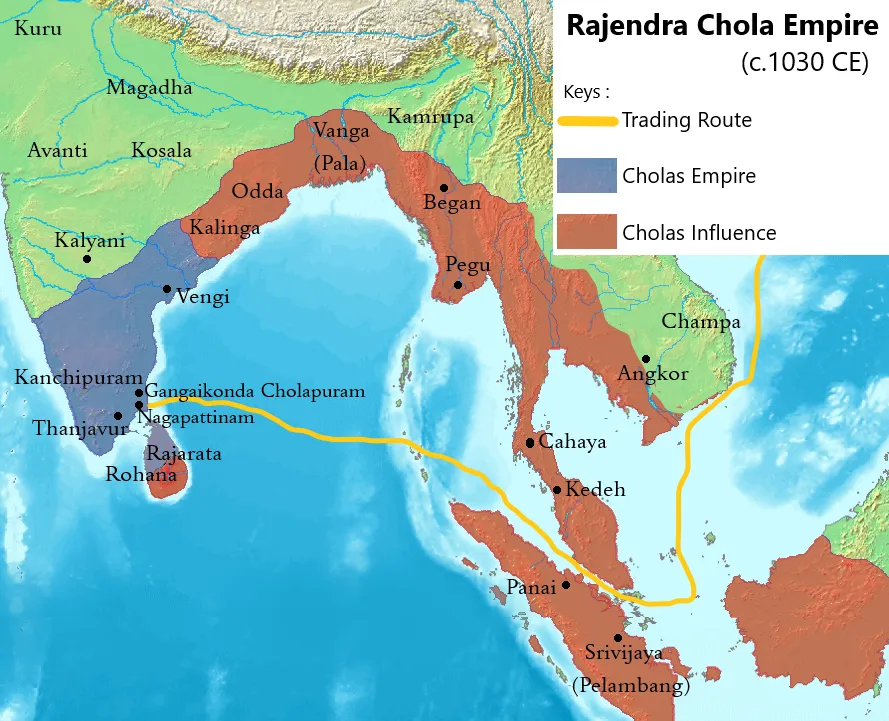
"Chola Empire" by Levakpitam / Wikimedia Commons (CC0).
The Chola Empire was one of the most powerful kingdoms in ancient India. From the 9th to the 13th centuries CE, the Cholas controlled much of southern India, including the fertile lands of the Tamil region and important coastal cities. The Cholas developed a strong government, advanced art and architecture, and created a lasting impact on South Asian history.
The Chola dynasty began to rise in power under King Vijayalaya Chola in the mid-9th century CE. However, it was under Rajaraja I (reigned 985–1014 CE) and his son Rajendra I (reigned 1014–1044 CE) that the empire reached its greatest extent. Rajaraja I expanded the kingdom by conquering neighboring lands and building a powerful navy. Archaeological evidence, such as inscriptions at the great Brihadeeswarar Temple in Thanjavur, records his military victories. The Chola navy even sailed across the Bay of Bengal to conquer parts of Sri Lanka and Southeast Asia, showing advanced maritime skills and ambition.
The Cholas are famous for their innovations in administration. They divided their territory into districts called mandalams, governed by local officials. Village assemblies, known as sabhas, allowed people to participate in local decisions, which is recorded in stone inscriptions from the period. Chola society was organized by a rigid social hierarchy, with kings and nobles at the top, followed by priests, warriors, merchants, and farmers. Although most people were farmers, cities like Kanchipuram and Thanjavur became centers of trade and culture. Bronze sculptures, such as the famous statue of the Hindu god Shiva as Nataraja, show the Cholas’ skill in metalwork and their devotion to Hinduism. These artifacts, found in temples and museums today, are primary sources that help historians understand Chola achievements.
The empire’s wealth grew through agriculture, trade, and tribute from conquered lands. The Cholas controlled important trade routes across the Indian Ocean, exchanging goods like spices, textiles, and precious stones with merchants from Arabia, China, and Southeast Asia. This helped spread Tamil language and culture beyond India. The construction of massive temples, such as the Brihadeeswarar Temple built by Rajaraja I, required advanced engineering and organization. These temples were not only religious centers but also economic and social hubs.
The Chola Empire declined after the 13th century due to invasions and internal conflicts, but its legacy continued in South Asian art, architecture, and local government practices. The Cholas demonstrated how a regional power could influence a wider world through military strength, cultural achievements, and maritime trade.
This story of the Chola Empire connects to broader themes of how geography, government, and culture shape civilizations throughout history.
Interesting Fact: The Chola navy was among the earliest in history to use long-distance sea voyages for both trade and conquest!
Comprehension quiz (8 questions)
1. Who was Rajaraja I?
2. When did the Chola Empire begin to rise?
3. Which city is famous for Chola temples?
4. What was a sabha?
5. Why did the Chola Empire decline?
6. How did the Cholas spread Tamil culture?
7. The Chola navy sailed to Sri Lanka. (True/False)
8. What is an artifact?
Perfect for the way you teach
- Build comprehension skills
- Auto-graded quiz
- Differentiated reading
- Read together at home
- Improve fluency
- Quiet reading time
- Reading curriculum support
- Independent practice
- Track Lexile growth