Aorta Artery
Interactive passage with audio narration, comprehension questions, and printable PDF.
By completing this purchase you agree to our Terms of Use and Privacy Policy. Your subscription renews automatically until you cancel. You can cancel anytime from your account settings. All sales are final and non-refundable. Digital content is available for download in your account immediately upon purchase.
What's included
Aorta Artery preview and details
About this printable Aorta Artery science reading passage, NGSS-aligned (Grade 6)
Sample passage and quiz from Aorta Artery
Reading passage and comprehension quiz preview
The Aorta: Molecules to Organisms of the Body's Largest Artery
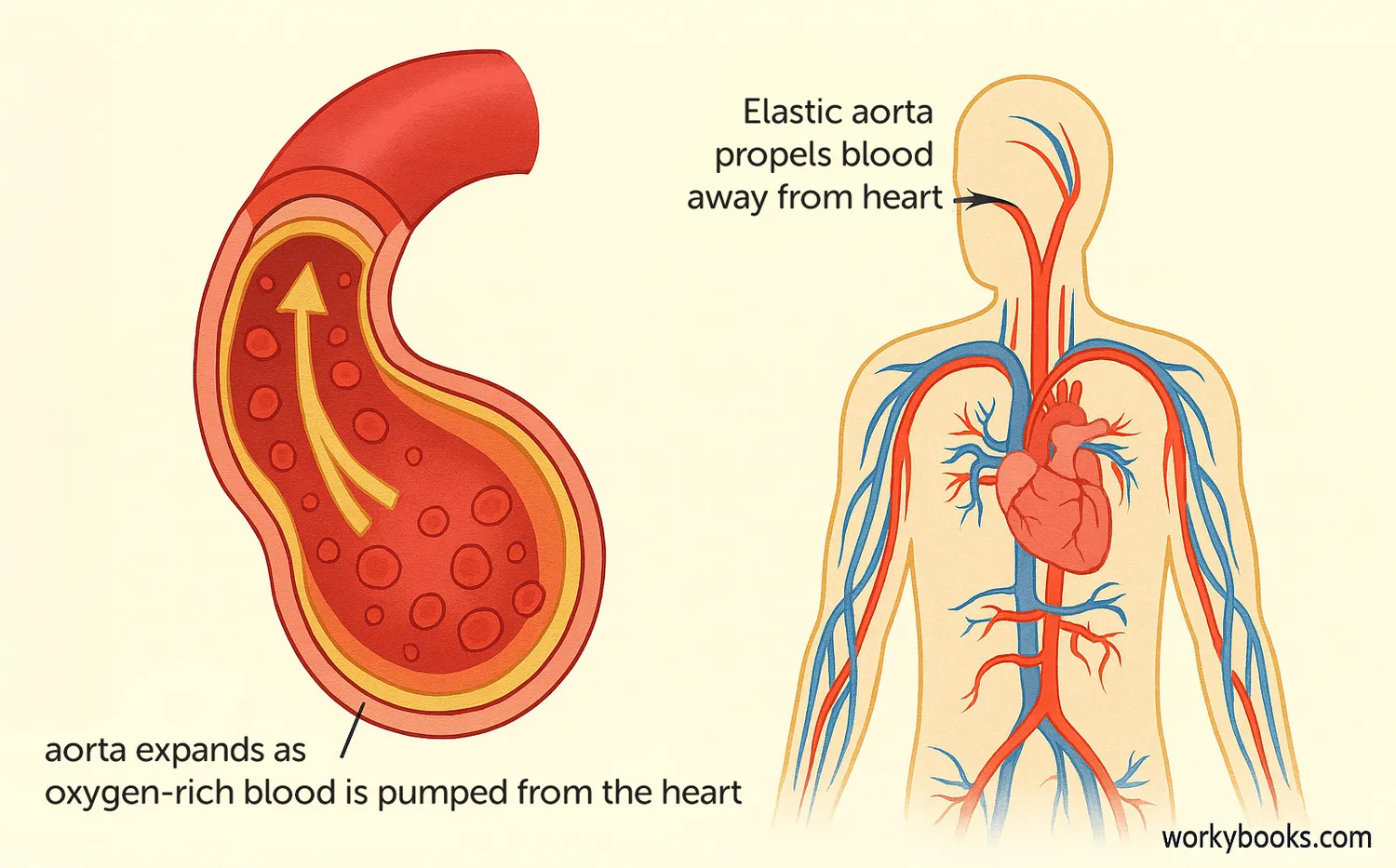
Imagine a superhighway for blood, the main route that takes precious oxygen and nutrients from your heart to every part of your body. This incredible vessel is called the aorta. It's the largest artery in your entire body, and its job is absolutely critical for your survival. When your heart beats, it pumps blood with a lot of force, and the aorta is built perfectly to handle this high pressure.
The aorta starts right at the top of your heart, specifically from the left ventricle, which is the heart's strongest pumping chamber. From there, it curves upwards, then arches over your heart, and finally travels down through your chest and abdomen. Along its path, many smaller arteries branch off from the aorta, carrying blood to your head, arms, legs, and all your internal organs. This vast network ensures that no part of your body is left without the vital supplies it needs.
What makes the aorta so special? Its walls are incredibly strong and elastic. Think of it like a durable rubber band. When the heart pushes blood into the aorta, the walls stretch to absorb the force of the blood. Then, as the heart relaxes, the elastic walls snap back, helping to push the blood forward and maintain a steady flow throughout your body. This elasticity is key to its function, allowing it to expand and contract with each heartbeat, making sure blood pressure doesn't get too high and blood keeps moving smoothly.
The aorta's structure, from its thick, muscular walls to its elastic properties, is perfectly designed for its function of carrying high-pressure, oxygen-rich blood. Without this amazing artery, your body wouldn't get the constant supply of blood it needs to stay healthy and active. Understanding the aorta helps us appreciate the intricate design of the human circulatory system, where every part, from tiny molecules in the blood to the largest artery, works together to keep us alive. The structure of the aorta, as a large, elastic artery, is directly related to its function of carrying high-pressure blood away from the heart.
Interesting Fact: An adult's aorta is about the diameter of a garden hose, roughly 2-3 centimeters wide!
Comprehension quiz (10 questions)
1. Which part of the heart does the aorta start from?
2. What is the primary job of the aorta?
3. The aorta's walls are strong and elastic. True or False?
4. Based on the passage, what does 'elastic' mean in the context of the aorta?
5. How does the aorta help maintain steady blood flow?
6. Why is the aorta's elasticity important?
7. What would happen if the aorta wasn't elastic?
8. The aorta carries oxygen-rich blood. What does this mean for the body?
9. How does the aorta's role connect to the idea of a 'superhighway' for blood?
10. If a doctor examines a patient's large artery to check blood flow, which vessel are they most likely examining based on the passage?
Perfect for the way you teach
- Build comprehension skills
- Auto-graded quiz
- Differentiated reading
- Read together at home
- Improve fluency
- Quiet reading time
- Reading curriculum support
- Independent practice
- Track Lexile growth