The Arctic Fox's Winter Coat Camouflage — Reading Comprehension
Rate this
Premium Resource
Present
Present in classroom. No work saved
Assign
Classroom with student accounts, Track progress
Quick Play
No student accounts, assign with a link
Grades
6
PRINT+DIGITAL RESOURCE
This learning resource is available in interactive and printable formats. The interactive worksheet can be played online and assigned to students. The Printable PDF version can be downloaded and printed for completion by hand.
This engaging reading passage, featuring audio integration, introduces students to the fascinating world of the Arctic fox and its incredible winter coat camouflage. Students will learn how this adaptive trait, changing from brown in summer to white in winter, is crucial for its survival in the snowy Arctic. The passage explains the concepts of predator and prey, and how camouflage helps the Arctic fox hunt for food and hide from dangers. It aligns with the NGSS Disciplinary Core Idea LS4.C: Adaptation, demonstrating how adaptive traits like camouflage determine an organism's ability to survive in its environment. Key terms like 'camouflage' and 'adaptation' are defined, making complex scientific concepts accessible for fifth-grade readers. This passage is perfect for understanding animal adaptations and arctic ecosystems.
CONTENT PREVIEW
Expand content preview
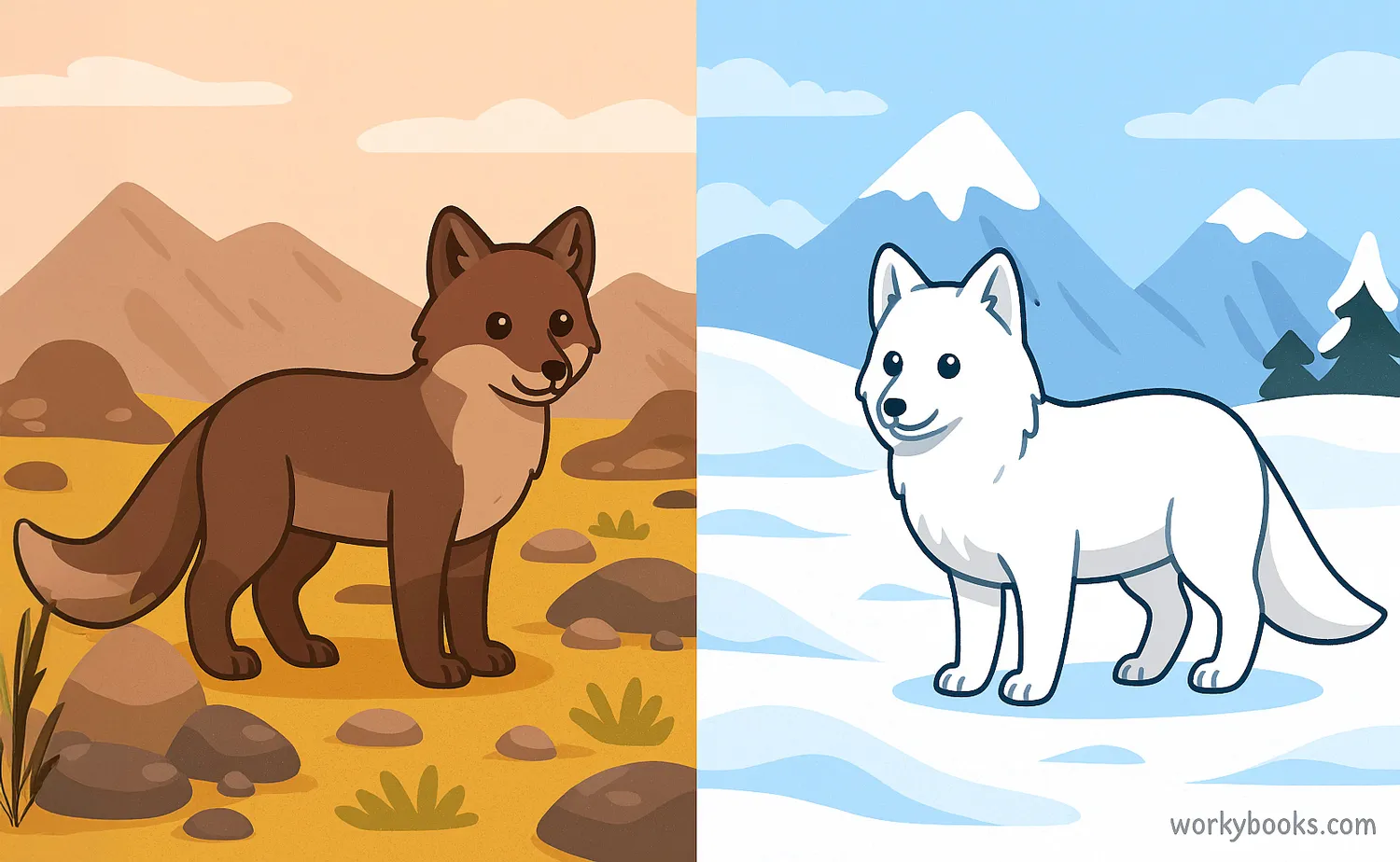
Arctic fox adapts its coat color to blend into summer and winter environments.
Arctic Fox Camouflage
The Arctic fox is a small animal that lives in the cold, snowy tundra of the far north. One of nature’s coolest color-changing tricks belongs to this clever fox. The Arctic fox’s fur is its secret tool for survival. It changes color and thickness with the seasons, which helps the fox blend in and stay safe.
Winter and Summer Coats
In winter, the Arctic fox grows a thick, pure white coat. This white fur acts as camouflage so the fox can disappear into the snow and ice. The thick fur also keeps the fox warm during freezing Arctic nights. When summer arrives, the snow melts and the land turns brown and gray. The Arctic fox’s fur becomes thinner and changes to brown or gray, matching rocks, plants, and soil. This helps the fox stay hidden all year round.
How and Why the Change Happens
The fur color and thickness don’t change overnight. In fall and spring, the change happens slowly over 6-8 weeks. When days get shorter, the fox’s body makes special hormones that tell old fur to fall out. This process is called molting. New fur grows in with a color that matches the season.
Camouflage for Survival
Camouflage helps the Arctic fox in two ways. As a predator, the fox can sneak up on prey like lemmings and birds without being seen. As prey, it can hide from hungry wolves, polar bears, and golden eagles. Not being seen means not being caught!
Special Blue Morph and Other Animals
Some Arctic foxes have a rare blue morph. These foxes turn blue-gray in winter instead of white, which is helpful in coastal areas where snow is patchy. The Arctic fox is like a living mood ring—wearing white pajamas in winter and brown clothes in summer to always blend in! Snowshoe hares and ptarmigans use the same color-changing trick in the Arctic tundra.
Interesting Fact: The Arctic fox’s winter fur is so thick that it can survive temperatures as low as -50°C (-58°F) without shivering!
What color is the Arctic fox in winter?
WhiteBrownGrayBlue only
What is camouflage?
Blending in with surroundingsRunning fastMaking loud soundsSleeping all day
What is molting?
Fur falling out and new growingRunning through snowHunting for foodSleeping in a den
Why does the fox's fur change color?
To blend in with the seasonTo look prettyTo scare predatorsTo find a mate
How long does the fur change take?
6-8 weeks1 dayA year1 hour
What does camouflage help the fox do?
Catch prey and avoid predatorsEat plantsBuild densMake loud noises
Only Arctic foxes change fur color. True or false?
FalseTrue
What is a predator?
Animal that hunts othersPlantType of snowColor of fur
Perfect For:
👩🏫 Teachers
• Reading comprehension practice
• Auto-graded assessments
• Literacy skill development
👨👩👧👦 Parents
• Reading practice at home
• Comprehension improvement
• Educational reading time
🏠 Homeschoolers
• Reading curriculum support
• Independent reading practice
• Progress monitoring
Reading Features:
📖
Reading Passage
Engaging fiction or nonfiction text
❓
Comprehension Quiz
Auto-graded questions
📊
Instant Feedback
Immediate results and scoring
📄
Printable Version
Download for offline reading
🔊
Read Aloud
Voice-over with word highlighting
Reviews & Ratings
No reviews yet. Be the first to share your experience!
Related Content
The Nature of Life Science
This passage, aligned with NGSS MS-LS1-1, introduces students in grades 6-8 to the foundational concepts of life science...
MS-LS1-1
Science Vocabulary
This worksheet on domain-specific words will help students learn some science vocabulary. Students will be asked to matc...
L.3.6L.3.4.A
The Science of Hibernation
This educational module, featuring an audio-integrated reading passage titled 'The Science of Hibernation,' is designed ...
Adaptation
This engaging middle school science passage explores adaptation, focusing on how inherited traits enable organisms to su...
MS-LS4-4MS-LS4-6
Simple Machines Science Report
This science writing task requires students to clearly explain how three simple machines work using precise domain-speci...
W.5.4
Desert Rain Frog Behavioral Adaptations
Dive into the fascinating world of the Desert Rain Frog and discover its incredible unique adaptations for survival in a...
Animal Adaptations Word Sort
This engaging word sort activity helps students understand the difference between physical and behavioral adaptations in...
Herbivore Adaptations
This engaging reading passage, integrated with audio, delves into the fascinating world of herbivore adaptations. Studen...
Ocean Animal Adaptations
Students will read a passage that provides information about various adaptations that marine animals have developed to t...
W.4.9.B
Nocturnal Adaptations of the Strange Aye-Aye
This engaging reading passage, integrated with audio, takes grade 5 students on a journey to discover the fascinating no...
Early Life Forms and Their Adaptations
This educational passage focuses on early life forms and their basic adaptations, supporting NGSS standard 3-LS4-2 for e...
RI.3.3RI.4.3RI.5.33-LS4-2
Binturong Adaptations
This engaging, audio-integrated reading passage, 'Binturong Adaptations,' for Grade 6 students delves into the fascinati...
Barnacle Biology and Adaptations
Dive into the intriguing world of barnacles with this engaging Grade 6 reading passage. Students will learn about these ...
Whale Blubber: Function and Adaptation
This engaging, audio-integrated reading passage, 'Whale Blubber Function and Adaptation,' introduces young learners to t...
Mountain Animal Adaptations
This reading comprehension worksheet focuses on the topic of animal adaptations for survival in mountainous environments...
W.4.9.B
Amur Leopard Adaptations
This engaging, audio-integrated reading passage, 'Amur Leopard Adaptations,' is designed for Grade 6 science students. I...
Climate Zone Adaptations Word Sort
This word sort activity examines how plants and animals adapt to different climate conditions. Students sort 12 differen...
Plant Adaptations for Survival
This NGSS-aligned word sort activity, suitable for kindergarten, focuses on plant survival adaptations, helping students...
K-LS1-1
The Pumpkin Life Cycle
This informational worksheet explores the pumpkin lifecycle, guiding students through procedural steps in a scientific t...
RI.2.3RI.2.10
Blobfish Adaptations to Extreme Pressure
This engaging passage explores the fascinating world of the blobfish and its unique adaptations to the extreme pressure ...