The Emancipation Proclamation — Reading Comprehension
Rate this
Premium Resource
Present
Present in classroom. No work saved
Assign
Classroom with student accounts, Track progress
Quick Play
No student accounts, assign with a link
Grades
3
4
5
Standards
D2.HIS.1-6.3-5
RI.4.3
RI.5.3
PRINT+DIGITAL RESOURCE
This learning resource is available in interactive and printable formats. The interactive worksheet can be played online and assigned to students. The Printable PDF version can be downloaded and printed for completion by hand.
This engaging U.S. history reading passage explores the Emancipation Proclamation, a key event during the American Civil War. Students will learn about President Abraham Lincoln’s important decision to free enslaved people in the Confederate states, the events leading up to the proclamation, and its impact on the nation. The passage uses clear, simple language and includes bolded vocabulary to build reading skills. Activities such as multiple-choice questions, writing prompts, and a timeline help students deepen their understanding of cause and effect and analyze historical significance. The passage aligns with the C3 Framework for Social Studies and Common Core ELA standards. A Spanish translation and read aloud audio are included to support diverse learners. This resource is perfect for classrooms studying the Civil War, Abraham Lincoln, or the history of freedom and equality in the United States.
CONTENT PREVIEW
Expand content preview
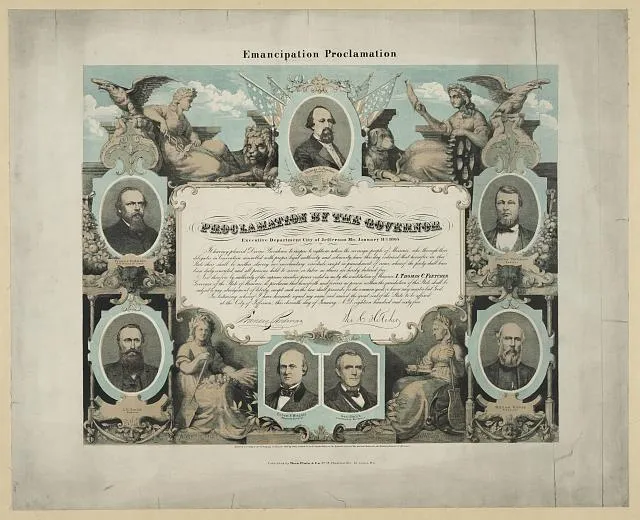
Emancipation Proclamation. Proclamation by the governor Source: Library of Congress - Knobel, E.
The Emancipation Proclamation was an important order during the American Civil War. President Abraham Lincoln signed this document on January 1, 1863. The proclamation said that all enslaved people in the Confederate states were now free. This was a big step towards ending slavery in the United States.
At the start of the Civil War, the main goal of the Union was to keep the country together. The North wanted to stop the Southern states, known as the Confederacy, from leaving the United States. Many people in the North also believed that slavery was wrong. But at first, President Lincoln did not say the war was about ending slavery. He wanted to keep the country united and did not want to lose the support of states that still allowed slavery.
As the war continued, Lincoln saw that freeing enslaved people could help the Union win. Enslaved people in the South did much of the work that helped the Confederate Army. If they were freed, the Confederacy would be weaker. Lincoln also knew that making the war about freedom would stop other countries from helping the South.
On September 22, 1862, Lincoln announced his plan for the Emancipation Proclamation. He told the Confederate states they had until January 1, 1863, to rejoin the Union or their enslaved people would be declared free. When they did not return, Lincoln issued the order.
The Emancipation Proclamation did not free all enslaved people. It only applied to states that were fighting against the Union. But it was still a powerful decree. It showed that the Union was fighting for freedom as well as unity.
The proclamation also allowed Black men to join the Union Army. Nearly 180,000 Black soldiers fought for the North after the order. Their help was important to winning the war.
The Emancipation Proclamation changed the meaning of the Civil War. It was no longer just about keeping the United States together. Now, it was also about ending slavery and giving people their freedom.
Interesting Fact: After the Emancipation Proclamation, many enslaved people escaped to Union lines, and freedom celebrations became common in the United States, leading to traditions like Juneteenth.
Who signed the Emancipation Proclamation?
Abraham LincolnGeorge WashingtonUlysses S. GrantThomas Jefferson
What year did the Emancipation Proclamation take effect?
1861186317761870
Which group did the Proclamation free?
All enslaved peopleConfederate statesUnion statesWomen
Why did Lincoln issue the Proclamation?
To end slavery in the ConfederacyTo punish the NorthTo start a new warTo help the Confederacy
What effect did the Proclamation have?
It united the ConfederacyIt changed the war's meaningIt stopped the Civil WarIt freed Union soldiers
Who could join the Union Army after the Proclamation?
WomenBlack menChildrenConfederate generals
The Emancipation Proclamation was signed in 1863.
TrueFalse
What does 'decree' mean?
A secretA law or orderA battleA celebration
Perfect For:
👩🏫 Teachers
• Reading comprehension practice
• Auto-graded assessments
• Literacy skill development
👨👩👧👦 Parents
• Reading practice at home
• Comprehension improvement
• Educational reading time
🏠 Homeschoolers
• Reading curriculum support
• Independent reading practice
• Progress monitoring
Reading Features:
📖
Reading Passage
Engaging fiction or nonfiction text
❓
Comprehension Quiz
Auto-graded questions
📊
Instant Feedback
Immediate results and scoring
📄
Printable Version
Download for offline reading
🔊
Read Aloud
Voice-over with word highlighting
Reviews & Ratings
No reviews yet. Be the first to share your experience!
Related Content
Longhouses of the Eastern Woodlands
This engaging U.S. history reading passage explores the longhouses of the Eastern Woodlands, focusing on the Iroquois an...
D2.HIS.1-6.3-5RI.4.1RI.4.3
Celebrating the Fourth of July
This engaging history reading passage explores the origins and importance of the Fourth of July, known as Independence D...
D2.HIS.1-6.3-5RI.4.1RI.4.3RI.4.4
Stagecoaches and the Pony Express
This engaging U.S. history reading passage introduces students to the exciting era of stagecoaches and the Pony Express ...
D2.HIS.1-6.3-5RI.4.3RI.4.4RI.4.10
The Texas Revolution and the Alamo
This engaging history reading passage introduces students to the Texas Revolution and the Battle of the Alamo, key momen...
D2.HIS.1-6.3-5RI.4.1RI.4.3W.4.2
The Civil War Finally Ends
This engaging reading passage explores the end of the Civil War, focusing on the events of 1865 when General Robert E. L...
D2.HIS.1-6.3-5RI.4.3RI.4.4RI.4.10
The 13th Amendment Ends Slavery
This passage explores the history and impact of the 13th Amendment, which ended slavery in the United States. Students w...
D2.HIS.1-6.3-5RI.4.1RI.4.3RI.5.1
The Industrial Revolution in America
This engaging history reading passage explores the Industrial Revolution in America, a time of great change and innovati...
D2.HIS.1-6.3-5RI.4.3RI.4.4
Alexander Graham Bell's Telephone
This engaging U.S. history reading passage explores the story of Alexander Graham Bell and his invention of the telephon...
D2.HIS.1-6.3-5RI.4.3RI.5.3
The Wright Brothers Take Flight
This engaging history reading passage explores the inspiring story of the Wright brothers and their journey to make the ...
D2.HIS.1-6.3-5RI.4.3RI.4.4W.4.2
American Soldiers Fight Overseas
This engaging reading passage explores the experiences of American soldiers who fought overseas, focusing on World War I...
D2.HIS.1-6.3-5RI.4.3RI.4.4RI.5.3
Voting Rights for African Americans
This passage explores the important history of voting rights for African Americans in the United States, following a cle...
D2.HIS.1-6.3-5RI.4.1RI.4.3RI.4.4
Computers Change Our Lives
This engaging passage explores the history of computers and how they have transformed the way people live, work, and lea...
D2.HIS.1-6.3-5RI.4.3RI.5.3
Informational Text —Healthy Teeth and Gums
RI.4.10RI.4.3RF.4.4RF.4.4.A
Informational Text —Migratory Birds
Engage young minds with this worksheet that delves into the wonders of migratory birds. Learn about their extraordinary ...
RI.4.10RI.4.3RF.4.4RF.4.4.A
Informational Text —All About Dentists
Students read an informational text explaining what dentists do and how they are trained. Aligned to RI.4.3-2
RI.4.10RI.4.3RF.4.4RF.4.4.A
The Role of Pollinators in Nature
Learn about the fascinating world of pollinators and discover their crucial role in the reproductive process of flowerin...
RI.4.2RI.4.3RI.4.4RI.5.1
Pollination: A Crucial Ecosystem Service
Explore the vital role of pollination beyond plant reproduction, as it sustains ecosystems by ensuring food security, pr...
RI.4.2RI.4.3RI.4.4RI.5.1
Seed Dispersal: How Plants Travel
Plants may seem stationary, but their seeds have amazing ways to travel! Explore the fascinating world of seed dispersal...
RI.4.2RI.4.3RI.4.4RI.5.1
The States of Matter: Solid
Discover the differences between solids, liquids and gases by exploring how their particles are arranged and move. This ...