This learning resource is available in interactive and printable formats. The interactive worksheet can be played online and assigned to students. The Printable PDF version can be downloaded and printed for completion by hand.
This engaging U.S. history reading passage introduces students to the Puritan way of life in Colonial America, specifically focusing on their experiences in the New England Colonies. The passage uses clear, age-appropriate language and a chronological structure to help students understand the challenges, beliefs, and community spirit that defined Puritan society. It highlights the causes of Puritan migration, their daily routines, strict rules, and the importance of unity and faith. Students will learn about key vocabulary words, answer comprehension questions, and complete a timeline to reinforce their understanding. The passage supports C3 Framework and Common Core standards, making it ideal for building foundational historical knowledge and literacy skills. Additional activities include a glossary, multiple-choice quiz, writing prompts, and Spanish translation. The passage is accompanied by a relevant public domain image, a coloring page prompt, and interactive graphic organizer activities. This resource also features a read aloud audio option to support diverse learners.
CONTENT PREVIEW
Expand content preview
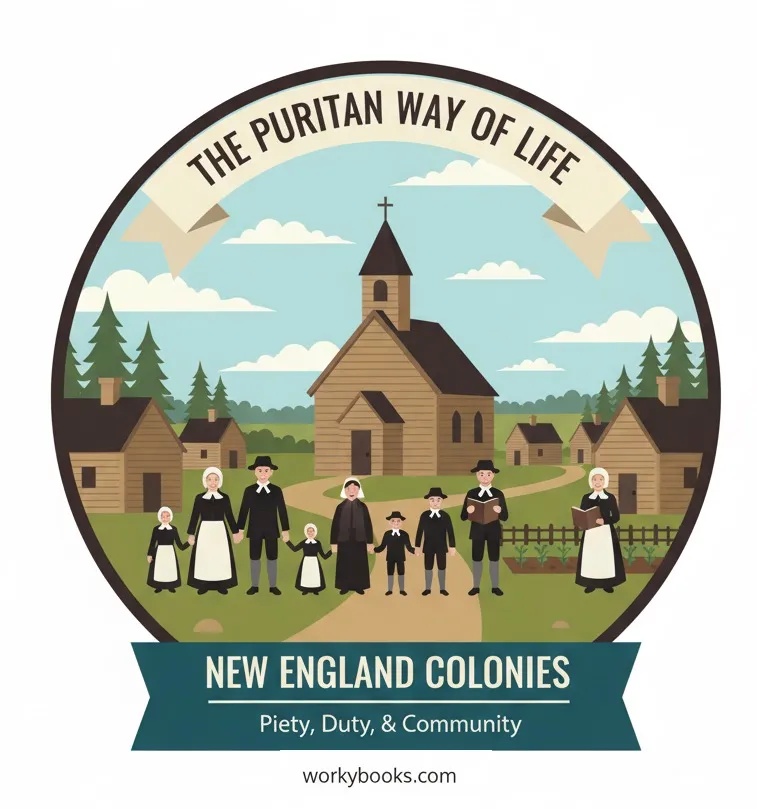
Strict faith, hard work, plain living, and community focus were Puritan values.
The Puritans were a group of people who moved to New England in the 1600s. They wanted to build a community based on their strict religious beliefs. Puritans believed that God watched everything they did. They thought it was important to live a simple and honest life so they could please God.
Every day, Puritans worked hard. Men farmed the land, chopped wood, and built homes. Women cooked, made clothes, and cared for children. Children helped with chores, like gathering eggs or carrying water. The Puritans thought that hard work was a way to serve God. They believed laziness and wasting time were sins. If someone was lazy or had too much fun, people thought God might punish them or the whole community.
Clothing was very simple for Puritans. They wore plain dresses, coats, and hats. Bright colors and fancy decorations were not allowed. Puritans believed that showing off with fancy clothes was wrong. They wanted everyone to look the same and focus on their faith, not their appearance.
The most important day for Puritans was Sunday, called the Sabbath. On the Sabbath, all work stopped. Families got up early, dressed in their best plain clothes, and walked to the meeting house. Church services lasted all day. People listened to the minister read from the Bible and preach about living a good life. Even children had to sit very still and quiet for hours. If anyone broke the Sabbath rules, they could be punished by the community.
Puritans had strict rules for many parts of life. They did not allow dancing, playing cards, or even singing songs that were not about God. These rules helped keep the community focused on their faith. The Puritans believed that following rules made them strong and united. They worked together to build schools, farms, and towns.
Puritan life was not easy, but it helped shape the New England colonies. Their beliefs in hard work, honesty, and strong community lasted for many years. Some of these ideas are still part of American culture today.
Interesting Fact: Some Puritan children learned to read using the Bible as their first book, because reading was important for understanding God’s word.
Who were the Puritans?
A group with strict religious rulesNative AmericansSpanish explorersFrench traders
What was the Puritan Sabbath?
A day of rest and churchA work festivalA market dayA day for games
What did Puritans believe about God?
God watched everythingGod ignored themGod wanted fun onlyGod lived in England
Why did Puritans wear simple clothes?
To focus on faithFor fashionTo show offTo stay warm
Why did Puritans avoid fun activities?
They thought fun was sinfulThey had no timeThey disliked othersThey loved to sleep
What happened if someone broke Sabbath rules?
They could be punishedThey got a prizeThey went home earlyThey played games
Puritan life was easy. True or false?
TrueFalse
What does 'minister' mean?
Religious leaderFarmerBuilderChild
Perfect For:
👩🏫 Teachers
• Reading comprehension practice
• Auto-graded assessments
• Literacy skill development
👨👩👧👦 Parents
• Reading practice at home
• Comprehension improvement
• Educational reading time
🏠 Homeschoolers
• Reading curriculum support
• Independent reading practice
• Progress monitoring
Reading Features:
📖
Reading Passage
Engaging fiction or nonfiction text
❓
Comprehension Quiz
Auto-graded questions
📊
Instant Feedback
Immediate results and scoring
📄
Printable Version
Download for offline reading
🔊
Read Aloud
Voice-over with word highlighting
Reviews & Ratings
No reviews yet. Be the first to share your experience!
Related Content
Native American Tribes Across America
This engaging history reading passage introduces students to Native American tribes across America, focusing on their da...
D2.HIS.1.3-5D2.HIS.2.3-5RI.4.1RI.4.2
The Sioux: Warriors and Tribal Leaders
This history reading passage explores the Sioux Nation, focusing on their roles as warriors and tribal leaders. Students...
D2.HIS.1.3-5D2.HIS.2.3-5RI.4.1RI.4.3
Jamestown: The First Permanent English Colony
This engaging history passage explores the founding of Jamestown, the first permanent English colony in America. Aligned...
D2.HIS.1.3-5D2.HIS.2.3-5RI.4.3RI.4.4
Pocahontas and the Powhatan People
This engaging reading passage explores the life of Pocahontas and the Powhatan people and their important role in early ...
D2.HIS.1.3-5D2.HIS.2.3-5RI.4.1RI.4.3
Colonial Games and Entertainment
This engaging history reading passage explores the types of games and entertainment enjoyed by children and families in ...
D2.HIS.1.3-5RI.4.3RI.4.4
Colonial Towns and Village Life
This engaging history reading passage explores the daily life, work, and unity found in colonial towns and villages. Ali...
D2.HIS.1.3-5D2.HIS.2.3-5RI.4.3RI.4.4
George Washington Leads the Army
This engaging history reading passage explores how George Washington bravely led the Continental Army during the America...
D2.HIS.1.3-5D2.HIS.2.3-5RI.4.3RI.4.4
The Battle of Yorktown Ends War
This engaging U.S. history reading passage explores the Battle of Yorktown, a key event that ended the American Revoluti...
D2.HIS.1.3-5D2.HIS.2.3-5RI.4.1RI.4.3
Life as a Continental Soldier
This passage explores the daily life of a Continental Soldier during the American Revolutionary War, highlighting challe...
D2.HIS.1.3-5RI.4.1RI.4.3
Loyalists vs. Patriots: Divided Families
This engaging U.S. history reading passage explores the division between Loyalists and Patriots during the American Revo...
D2.HIS.1.3-5D2.HIS.2.3-5RI.4.3RI.4.4
Manifest Destiny: Coast to Coast
This engaging U.S. history reading passage explores Manifest Destiny and the westward expansion of the United States. St...
D2.HIS.1.3-5D2.HIS.2.3-5RI.4.3RI.4.4
Abraham Lincoln Becomes President
This engaging U.S. history reading passage introduces students to the story of Abraham Lincoln’s rise to the presidency....
D2.HIS.1.3-5D2.HIS.2.3-5RI.4.3RI.4.4
The Southern States Leave the Union
This engaging reading passage explores the key events leading up to the Southern states leaving the Union before the Civ...
D2.HIS.1.3-5D2.HIS.2.3-5RI.4.3RI.4.4
Lincoln Assassinated at Ford's Theatre
This history reading passage explores the events of President Abraham Lincoln's assassination at Ford's Theatre in 1865....
D2.HIS.1.3-5D2.HIS.2.3-5RI.4.3RI.4.4
Juan Cabrillo Explores California
This engaging U.S. history reading passage introduces students to Juan Cabrillo, the first European explorer to reach Ca...
D2.HIS.1.3-5D2.HIS.2.3-5D2.HIS.3.3-5RI.4.3
California's Early Spanish Settlements
This engaging U.S. history reading passage explores life during the early Spanish settlements in America, highlighting t...
D2.HIS.1.3-5D2.HIS.2.3-5D2.HIS.3.3-5RI.4.1
Discovery of Gold in 1848 by James Marshall
This engaging U.S. History passage introduces students to the discovery of gold in 1848 by James Marshall and the beginn...
D2.HIS.1.3-5D2.HIS.2.3-5D2.HIS.3.3-5RI.4.1
The Gold Rush Changes California Forever
This engaging U.S. History reading passage explores how the Gold Rush changed California forever. Students will learn ab...
D2.HIS.1.3-5D2.HIS.2.3-5D2.HIS.16.3-5RI.4.3
The Golden Spike: Connecting California to the Nation
This engaging U.S. history reading passage teaches students about the Golden Spike and how the first transcontinental ra...
D2.HIS.1.3-5D2.HIS.2.3-5D2.HIS.14.3-5RI.4.3
Farms, Factories, and Growing Cities
This engaging U.S. history reading passage explores the dramatic changes in America during the Progressive Era, focusing...