The Southern Colonies: An Introduction — Reading Comprehension
Rate this|
6
Premium Resource
Present
Present in classroom. No work saved
Assign
Classroom with student accounts, Track progress
Quick Play
No student accounts, assign with a link
Grades
3
4
5
Standards
D2.HIS.1.3-5
D2.HIS.2.3-5
D2.GEO.2.3-5
RI.4.3
RI.4.4
W.4.2
PRINT+DIGITAL RESOURCE
This learning resource is available in interactive and printable formats. The interactive worksheet can be played online and assigned to students. The Printable PDF version can be downloaded and printed for completion by hand.
This reading passage introduces students to the Southern Colonies of Colonial America, focusing on key events, important figures, and the development of early settlements such as Jamestown. Students will learn about the geography, economy, and society of the Southern Colonies, including the roles of plantations, slavery, and the relationships with Native Americans. The passage is written for elementary students and features grade-appropriate vocabulary, clear cause-and-effect explanations, and concrete historical examples. Activities include a multiple-choice quiz, a writing activity, a timeline, and a graphic organizer, all designed to build historical understanding and literacy skills. The passage is aligned with C3 Framework and Common Core standards and also includes a full Spanish translation and read aloud audio, making it accessible for a wide range of learners interested in United States history.
CONTENT PREVIEW
Expand content preview
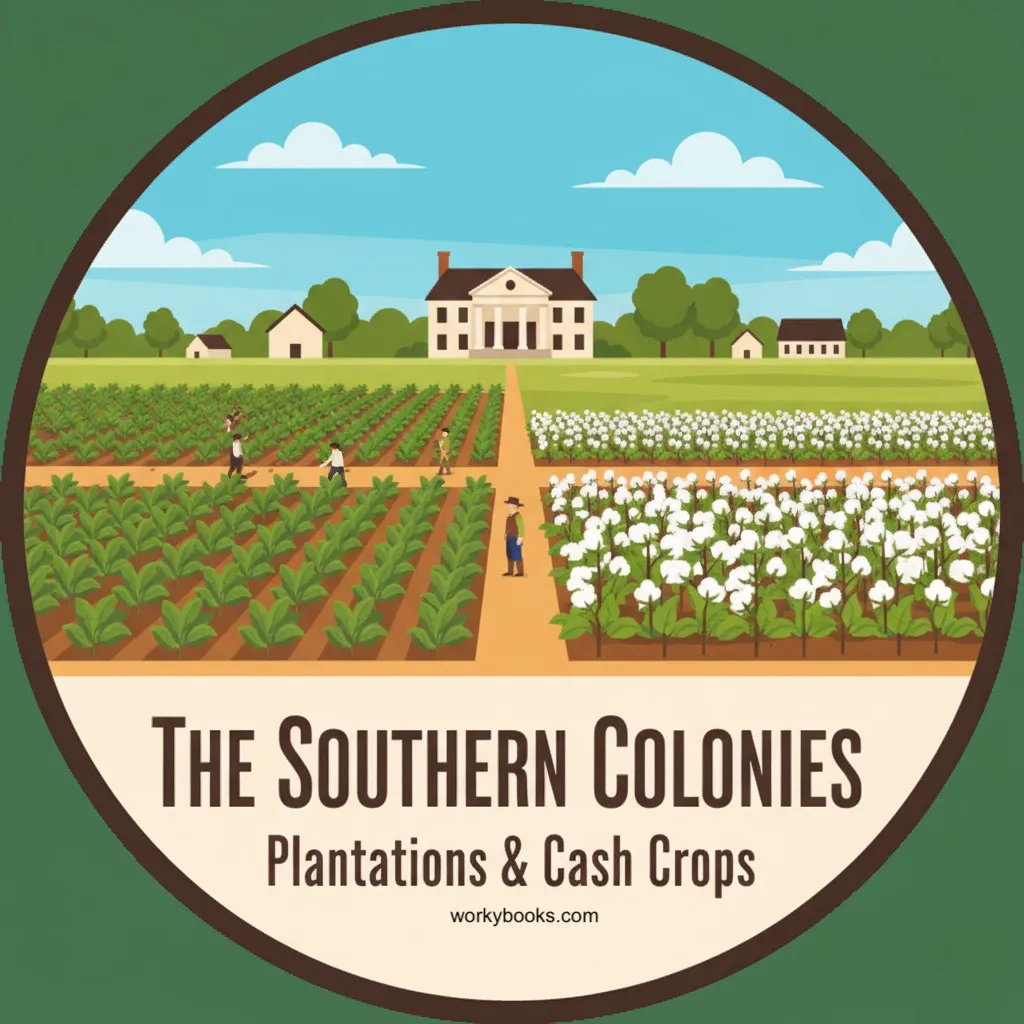
The Southern Colonies were made up of Virginia, Maryland, North Carolina, South Carolina, and Georgia. These colonies were located in the southern part of what became the United States. Their land stretched from the Atlantic Ocean in the east to the Appalachian Mountains in the west. The region was known for its warm weather and long growing season.
The Southern Colonies had rich, fertile soil. This was perfect for farming. The warm climate and plenty of rain made it easier to grow crops. As a result, the region became famous for its plantations. A plantation is a large farm where a single crop is grown for sale. In the Southern Colonies, the most important crops were tobacco, rice, and indigo. These were called cash crops because they were sold for money, not just for food.
Large plantations needed many workers. At first, some workers were indentured servants. These people worked for a certain number of years to pay off debts or the cost of their trip to America. Over time, plantation owners began to use enslaved Africans to do the hard work in the fields. This created a society where a few landowners were very rich, and many workers had hard lives.
The Southern Colonies were different from the colonies up North. In the North, there were more towns, smaller farms, and factories. Life in the South was spread out. People lived far from each other on big pieces of land. Plantations were like small villages with houses, barns, and fields. The plantation owners often controlled local government and made important decisions for the area.
The Southern Colonies also had port cities like Charleston and Savannah. These cities were important for shipping crops to Europe. Ships would carry tobacco, rice, and indigo across the ocean. In return, the colonies received goods from Europe. This trade helped the Southern Colonies grow wealthy.
Over time, the differences between the Southern and Northern Colonies grew. The plantation economy made the South unique in American history. The warm weather, fertile land, and focus on cash crops shaped the way people lived and worked.
Interesting Fact: South Carolina was the first colony to grow indigo as a major crop. Indigo was used to make blue dye for cloth.
Which colony was NOT in the South?
New YorkGeorgiaMarylandSouth Carolina
What is a plantation?
A large farmA small houseA city marketA river boat
Which was a cash crop?
IndigoCornPotatoesApples
Why did plantations need many workers?
Large farmsCold weatherMany townsNo crops
How was life different in the South?
People lived far apartMany factoriesSmall gardensLots of snow
Why were port cities important?
For shipping cropsFor planting treesFor building bridgesFor learning dance
The climate was warm in the Southern Colonies.
TrueFalse
What does 'fertile' mean?
Good for growingVery dryFull of rocksCold and snowy
Perfect For:
👩🏫 Teachers
• Reading comprehension practice
• Auto-graded assessments
• Literacy skill development
👨👩👧👦 Parents
• Reading practice at home
• Comprehension improvement
• Educational reading time
🏠 Homeschoolers
• Reading curriculum support
• Independent reading practice
• Progress monitoring
Reading Features:
📖
Reading Passage
Engaging fiction or nonfiction text
❓
Comprehension Quiz
Auto-graded questions
📊
Instant Feedback
Immediate results and scoring
📄
Printable Version
Download for offline reading
🔊
Read Aloud
Voice-over with word highlighting
Reviews & Ratings
No reviews yet. Be the first to share your experience!
Related Content
Barriers to Reaching California
This engaging U.S. history reading passage explores the challenges that mountains, deserts, and oceans created for early...
D2.HIS.2.3-5D2.GEO.2.3-5RI.4.3RI.4.4
New York and Philadelphia: Middle Colonies Cities
This engaging U.S. history reading passage explores the rise of New York and Philadelphia as major cities during Colonia...
D2.HIS.2.3-5D2.GEO.2.3-5RI.4.3RI.4.4
Native American Tribes Across America
This engaging history reading passage introduces students to Native American tribes across America, focusing on their da...
D2.HIS.1.3-5D2.HIS.2.3-5RI.4.1RI.4.2
The Sioux: Warriors and Tribal Leaders
This history reading passage explores the Sioux Nation, focusing on their roles as warriors and tribal leaders. Students...
D2.HIS.1.3-5D2.HIS.2.3-5RI.4.1RI.4.3
Jamestown: The First Permanent English Colony
This engaging history passage explores the founding of Jamestown, the first permanent English colony in America. Aligned...
D2.HIS.1.3-5D2.HIS.2.3-5RI.4.3RI.4.4
Pocahontas and the Powhatan People
This engaging reading passage explores the life of Pocahontas and the Powhatan people and their important role in early ...
D2.HIS.1.3-5D2.HIS.2.3-5RI.4.1RI.4.3
Colonial Games and Entertainment
This engaging history reading passage explores the types of games and entertainment enjoyed by children and families in ...
D2.HIS.1.3-5RI.4.3RI.4.4
Colonial Towns and Village Life
This engaging history reading passage explores the daily life, work, and unity found in colonial towns and villages. Ali...
D2.HIS.1.3-5D2.HIS.2.3-5RI.4.3RI.4.4
George Washington Leads the Army
This engaging history reading passage explores how George Washington bravely led the Continental Army during the America...
D2.HIS.1.3-5D2.HIS.2.3-5RI.4.3RI.4.4
The Battle of Yorktown Ends War
This engaging U.S. history reading passage explores the Battle of Yorktown, a key event that ended the American Revoluti...
D2.HIS.1.3-5D2.HIS.2.3-5RI.4.1RI.4.3
Life as a Continental Soldier
This passage explores the daily life of a Continental Soldier during the American Revolutionary War, highlighting challe...
D2.HIS.1.3-5RI.4.1RI.4.3
Loyalists vs. Patriots: Divided Families
This engaging U.S. history reading passage explores the division between Loyalists and Patriots during the American Revo...
D2.HIS.1.3-5D2.HIS.2.3-5RI.4.3RI.4.4
Manifest Destiny: Coast to Coast
This engaging U.S. history reading passage explores Manifest Destiny and the westward expansion of the United States. St...
D2.HIS.1.3-5D2.HIS.2.3-5RI.4.3RI.4.4
Abraham Lincoln Becomes President
This engaging U.S. history reading passage introduces students to the story of Abraham Lincoln’s rise to the presidency....
D2.HIS.1.3-5D2.HIS.2.3-5RI.4.3RI.4.4
The Southern States Leave the Union
This engaging reading passage explores the key events leading up to the Southern states leaving the Union before the Civ...
D2.HIS.1.3-5D2.HIS.2.3-5RI.4.3RI.4.4
Lincoln Assassinated at Ford's Theatre
This history reading passage explores the events of President Abraham Lincoln's assassination at Ford's Theatre in 1865....
D2.HIS.1.3-5D2.HIS.2.3-5RI.4.3RI.4.4
Juan Cabrillo Explores California
This engaging U.S. history reading passage introduces students to Juan Cabrillo, the first European explorer to reach Ca...
D2.HIS.1.3-5D2.HIS.2.3-5D2.HIS.3.3-5RI.4.3
California's Early Spanish Settlements
This engaging U.S. history reading passage explores life during the early Spanish settlements in America, highlighting t...
D2.HIS.1.3-5D2.HIS.2.3-5D2.HIS.3.3-5RI.4.1
Discovery of Gold in 1848 by James Marshall
This engaging U.S. History passage introduces students to the discovery of gold in 1848 by James Marshall and the beginn...