What Are the Cascade Range Volcanoes
Interactive passage with audio narration, comprehension questions, and printable PDF.
By completing this purchase you agree to our Terms of Use and Privacy Policy. Your subscription renews automatically until you cancel. You can cancel anytime from your account settings. All sales are final and non-refundable. Digital content is available for download in your account immediately upon purchase.
What's included
What Are the Cascade Range Volcanoes preview and details
About this printable What Are the Cascade Range Volcanoes science reading passage, NGSS-aligned (Grades 5-8)
Sample passage and quiz from What Are the Cascade Range Volcanoes
Reading passage and comprehension quiz preview
What Are the Cascade Range Volcanoes
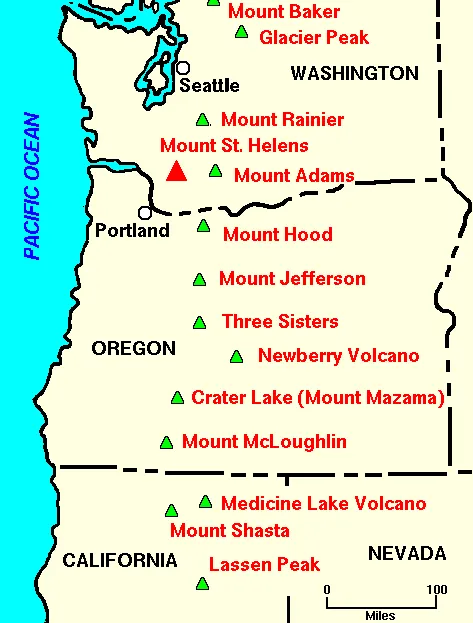
"Cascade Range map" by Lyn Topinka, USGS; modified from Tilling, et al., 1990 / Wikimedia Commons.
The Cascade Range is a chain of tall, steep volcanoes stretching from northern California through Oregon and Washington into Canada. These mountains include famous peaks such as Mount Rainier, Mount Hood, Mount Shasta, and Mount St. Helens. Scientists classify these volcanoes as composite volcanoes, which are cone-shaped mountains built from layers of lava and ash. The Cascade volcanoes form a line roughly parallel to the Pacific coast, and they exist because of powerful forces beneath Earth's surface.
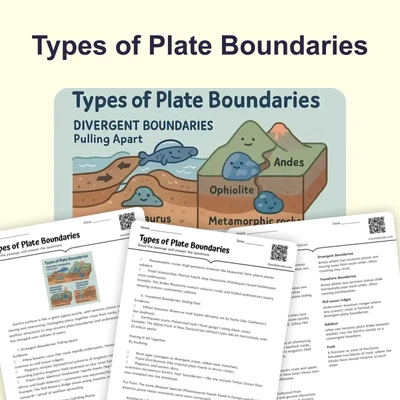
The Cascade Range volcanoes form because of plate tectonics, the movement of giant slabs of Earth's outer layer. Just off the Pacific Northwest coast, a small piece of ocean floor called the Juan de Fuca plate slowly moves eastward. This oceanic plate collides with the much larger North American plate, which carries the continent. Because the oceanic plate is denser and heavier, it bends downward and slides beneath the continental plate. Scientists call this process subduction. As the Juan de Fuca plate descends into Earth's hot interior, temperatures and pressures increase. Water trapped in the oceanic plate's rocks lowers the melting point of surrounding material. This process creates magma, which is molten rock beneath Earth's surface. The magma is less dense than surrounding rock, so it rises slowly upward through cracks in the overlying plate. When magma reaches the surface and erupts, it builds composite volcanoes over thousands of years.
The Cascade volcanoes may look peaceful, but evidence shows they remain dangerous. Mount St. Helens erupted violently in 1980, killing 57 people and destroying hundreds of square miles of forest. The eruption sent ash across multiple states and demonstrated that Cascade volcanoes are not extinct. Scientists monitor these peaks carefully because many are dormant, not dead. Mount Rainier towers over the Seattle metropolitan area, where more than three million people live. An eruption there could trigger massive lahars, which are fast-moving flows of volcanic mud and debris. These lahars can travel down river valleys for dozens of miles, threatening communities far from the volcano itself.
Understanding the Cascade Range matters because millions of people live near these volcanoes. The same subduction process that created these mountains continues today. The Juan de Fuca plate still pushes beneath North America at about the same rate your fingernails grow. This means the Cascade volcanoes will erupt again, though scientists cannot predict exactly when. Studying these volcanoes helps communities prepare for future eruptions and reduces risks to human life and property.
Interesting Fact: Mount Rainier is considered one of the most dangerous volcanoes in the United States, not because it erupts frequently, but because it is covered in glaciers that could melt rapidly during an eruption and create catastrophic lahars.
Comprehension quiz (10 questions)
1. What type of volcanoes make up the Cascade Range?
2. Which tectonic plate is subducting beneath the North American plate to create the Cascade volcanoes?
3. What does the term 'subduction' mean in the context of plate tectonics?
4. Why does magma form when the Juan de Fuca plate subducts?
5. What are lahars?
6. Why is Mount Rainier considered particularly dangerous?
7. Which volcano erupted in 1980, demonstrating that Cascade volcanoes remain active?
8. How does the density of magma compare to the surrounding solid rock?
9. True or False: The Cascade volcanoes are extinct and will never erupt again.
10. True or False: The Juan de Fuca plate is still moving and subducting beneath North America today.
Perfect for the way you teach
- Build comprehension skills
- Auto-graded quiz
- Differentiated reading
- Read together at home
- Improve fluency
- Quiet reading time
- Reading curriculum support
- Independent practice
- Track Lexile growth