Seafloor Spreading
Interactive passage with audio narration, comprehension questions, and printable PDF.
By completing this purchase you agree to our Terms of Use and Privacy Policy. Your subscription renews automatically until you cancel. You can cancel anytime from your account settings. All sales are final and non-refundable. Digital content is available for download in your account immediately upon purchase.
What's included
Seafloor Spreading preview and details
About this printable Seafloor Spreading science reading passage, NGSS-aligned (Grades 5-8)
Sample passage and quiz from Seafloor Spreading
Reading passage and comprehension quiz preview
Seafloor Spreading
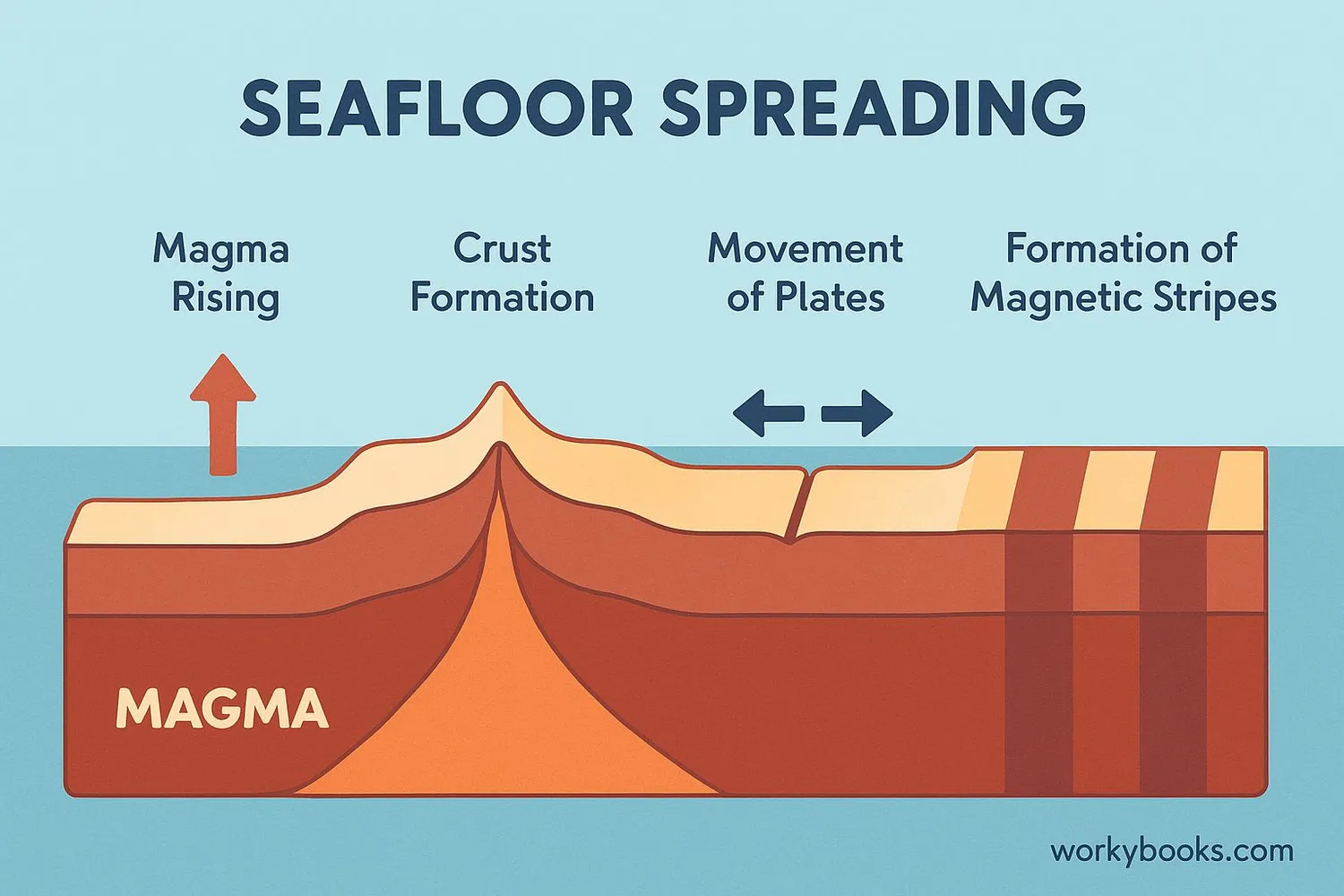
Seafloor spreading is the process that forms new oceanic crust at underwater mountain chains called mid-ocean ridges. This process is important because it explains how continents can move over time and why the ocean floor looks the way it does. In the 1960s, geologist Harry Hess studied the patterns of the ocean floor and provided key evidence for how Earth's surface changes. His discovery helped solve the mystery of continental drift, a theory that continents have shifted positions over millions of years.
How New Seafloor Forms
At the center of the world's oceans, vast mid-ocean ridges stretch for thousands of kilometers. At these ridges, magma from Earth's mantle rises upward through cracks in the oceanic crust. As the magma reaches the surface, it cools and hardens to form new crust. This new crust gradually pushes the older crust away from the ridge at a rate of about 2 to 10 centimeters per year. The youngest rocks are found closest to the ridge, while older rocks lie farther away. This movement is a key part of plate tectonics, the scientific theory explaining the movement of Earth's plates.
Evidence for Seafloor Spreading
Scientists found two main types of evidence for seafloor spreading. First, drilling samples revealed that the age of the oceanic crust increases with distance from the mid-ocean ridge. The rocks at the ridge are only a few million years old, while those near deep ocean trenches can be over 180 million years old. Second, rocks on either side of the ridge show a pattern of magnetic striping. When magma cools, magnetic minerals inside the rock align with Earth's magnetic field. Over time, Earth's magnetic field has reversed many times. This creates alternating bands of normal and reversed magnetic orientation, which appear as stripes that are symmetrical on both sides of the ridge. This symmetry provides strong evidence that new crust forms at the ridge and moves outward equally in both directions.
Destruction of Oceanic Crust
As new crust forms and moves away from the mid-ocean ridge, it eventually reaches a deep ocean trench. Here, the oceanic crust sinks back into the mantle in a process called subduction. This recycling of crust means that Earth's surface is always changing, with old crust being destroyed and new crust being created. Seafloor spreading and subduction are both crucial to the theory of plate tectonics. They help explain earthquakes, volcanic activity, and the movement of continents.
Seafloor spreading has transformed our understanding of Earth's surface. By studying ocean floors, scientists can track plate movement, predict geological events, and learn more about our planet's history. The process also connects to larger scientific ideas about cycles, energy flow, and the dynamic nature of Earth's systems.
Interesting Fact: The entire Atlantic Ocean floor is less than 200 million years old, while some continental rocks are over 4 billion years old!
Comprehension quiz (10 questions)
1. What is seafloor spreading?
2. Who provided key evidence for seafloor spreading in the 1960s?
3. Where are the youngest oceanic rocks found?
4. What happens to old oceanic crust at deep ocean trenches?
5. What is the meaning of 'magnetic striping' as used in the passage?
6. What does 'symmetry' mean in the context of seafloor spreading?
7. Why is seafloor spreading important for understanding earthquakes?
8. If oceanic crust is constantly created and destroyed, what does this suggest about Earth's surface?
9. True or False: The rocks at the mid-ocean ridge are among the oldest on Earth.
10. True or False: Subduction is the process where one tectonic plate sinks beneath another.
Perfect for the way you teach
- Build comprehension skills
- Auto-graded quiz
- Differentiated reading
- Read together at home
- Improve fluency
- Quiet reading time
- Reading curriculum support
- Independent practice
- Track Lexile growth