How Do Cinder Cone Volcanoes Form
Interactive passage with audio narration, comprehension questions, and printable PDF.
By completing this purchase you agree to our Terms of Use and Privacy Policy. Your subscription renews automatically until you cancel. You can cancel anytime from your account settings. All sales are final and non-refundable. Digital content is available for download in your account immediately upon purchase.
What's included
How Do Cinder Cone Volcanoes Form preview and details
About this printable How Do Cinder Cone Volcanoes Form science reading passage, NGSS-aligned (Grades 5-8)
Sample passage and quiz from How Do Cinder Cone Volcanoes Form
Reading passage and comprehension quiz preview
How Do Cinder Cone Volcanoes Form
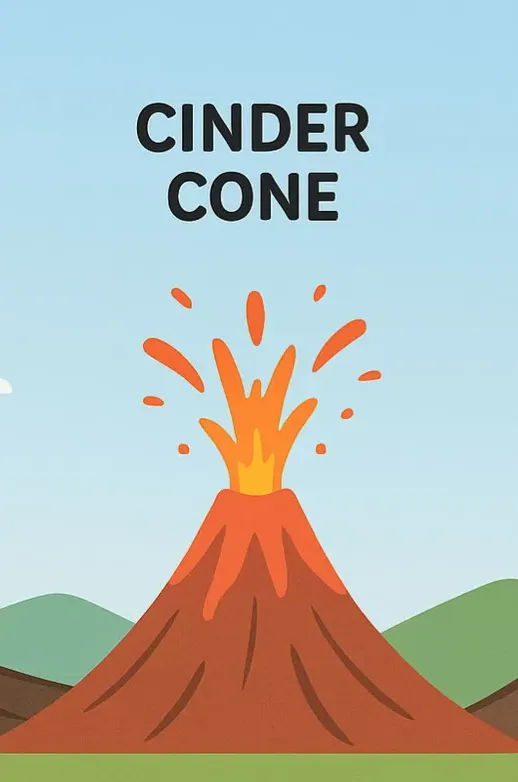
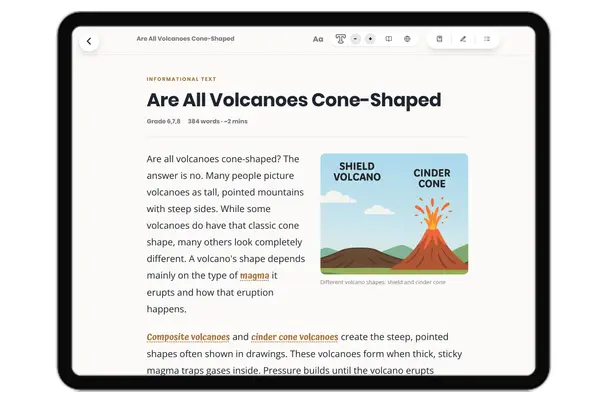
Cinder cone volcanoes form when gas-rich lava erupts explosively from a single opening in Earth's surface. This opening, called a vent, releases molten rock mixed with volcanic gases. The gases cause the lava to burst violently into the air during eruption. As the lava shoots upward, it breaks apart into small chunks. These pieces cool rapidly as they fly through the air and harden into lightweight bits of rock called cinders.
The cinders fall back to the ground around the vent under the pull of gravity. Scientists observe that these fragments pile up in layers, one eruption after another. Because the pieces are loose rather than welded together, they create very steep slopes. The cone grows taller with each eruption as more cinders accumulate. Most cinder cones develop a bowl-shaped crater at the summit where the vent opens. This process can happen relatively quickly compared to other volcano types.
Evidence shows that cinder cone volcanoes are typically the smallest type of volcano. Many reach only tens to a few hundred meters in height. Their small size results from the way they form. Unlike shield volcanoes built by flowing lava, cinder cones consist entirely of loose fragments. These fragments cannot spread out widely, so the cone stays compact. The steep sides, often angled at 30 to 40 degrees, give cinder cones their distinctive cone shape. Scientists explain that many cinder cones form during a single eruptive period and then become inactive.
A remarkable real-world example is Paricutin volcano in Mexico. In 1943, this cinder cone began forming in a farmer's cornfield. Witnesses watched as the ground cracked open and cinders started erupting. Within one year, Paricutin grew to 336 meters tall. The volcano remained active for nine years before going quiet in 1952. This rapid growth demonstrates how quickly cinder cones can form. Paricutin provided scientists with rare opportunities to observe and document a volcano's complete life cycle from birth to dormancy.
Understanding how cinder cone volcanoes form helps scientists predict volcanic activity and assess hazards. These volcanoes may be small, but they can still affect nearby communities. Falling cinders can bury fields and buildings, as happened around Paricutin. By studying the formation process, researchers learn about Earth's internal heat and how molten rock reaches the surface. This knowledge connects to the broader rock cycle and helps explain how Earth's materials constantly change form through volcanic processes.
Interesting Fact: Some cinder cones form as parasitic vents on the sides of larger volcanoes. Sunset Crater in Arizona formed this way about 900 years ago and still has colorful red and orange cinders near its summit.
Comprehension quiz (10 questions)
1. What causes gas-rich lava to burst violently into the air during a cinder cone eruption?
2. Where do cinders fall after they are ejected into the air?
3. What does the term 'vent' mean in the context of volcanoes?
4. What does 'fragments' refer to in the passage?
5. Why do cinder cone volcanoes have steep sides?
6. Based on the passage, what can scientists learn by studying how cinder cones form?
7. How does the formation of cinder cones differ from shield volcanoes?
8. If a new vent opened on a farmer's land today and began erupting cinders, what would most likely happen over the next year?
9. Cinder cone volcanoes are typically the largest type of volcano.
10. Paricutin volcano in Mexico formed in a farmer's cornfield in 1943.
Perfect for the way you teach
- Build comprehension skills
- Auto-graded quiz
- Differentiated reading
- Read together at home
- Improve fluency
- Quiet reading time
- Reading curriculum support
- Independent practice
- Track Lexile growth