Are All Volcanoes Cone-Shaped
Interactive passage with audio narration, comprehension questions, and printable PDF.
By completing this purchase you agree to our Terms of Use and Privacy Policy. Your subscription renews automatically until you cancel. You can cancel anytime from your account settings. All sales are final and non-refundable. Digital content is available for download in your account immediately upon purchase.
What's included
Are All Volcanoes Cone-Shaped preview and details
About this printable Are All Volcanoes Cone-Shaped science reading passage, NGSS-aligned (Grades 5-8)
Sample passage and quiz from Are All Volcanoes Cone-Shaped
Reading passage and comprehension quiz preview
Are All Volcanoes Cone-Shaped
Are all volcanoes cone-shaped? The answer is no. Many people picture volcanoes as tall, pointed mountains with steep sides. While some volcanoes do have that classic cone shape, many others look completely different. A volcano's shape depends mainly on the type of magma it erupts and how that eruption happens.
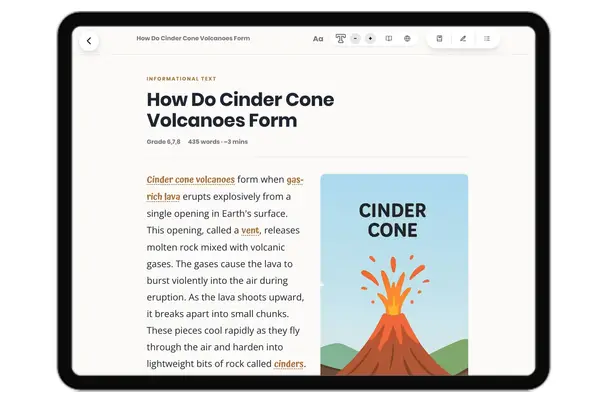
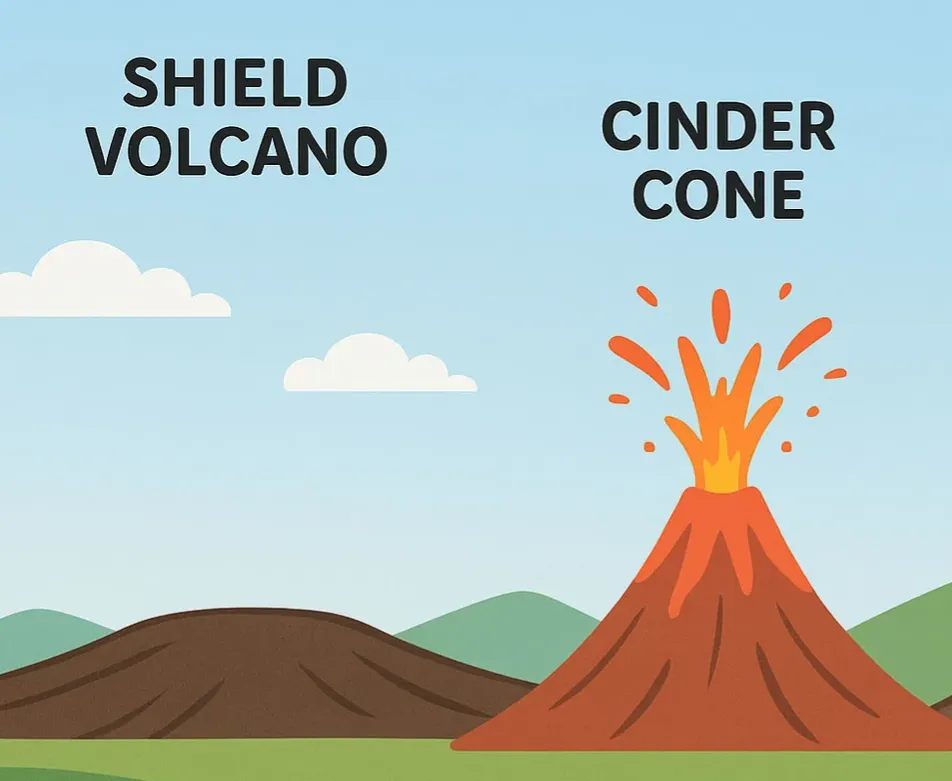
Composite volcanoes and cinder cone volcanoes create the steep, pointed shapes often shown in drawings. These volcanoes form when thick, sticky magma traps gases inside. Pressure builds until the volcano erupts explosively. Ash, rock fragments, and lava pile up in layers around the opening. Each eruption adds another layer, building a tall cone over time. However, not all volcanic eruptions work this way.
Shield volcanoes have a completely different appearance. They form broad, gently sloping domes that can stretch for many miles. These volcanoes erupt runny, fluid lava that flows easily across the ground. The lava spreads out in thin layers rather than piling up steeply. Shield volcanoes can grow enormous, but they look more like low hills than pointed peaks. Mauna Loa in Hawaii is a shield volcano that rises from the ocean floor. It is one of Earth's largest volcanoes by volume.
Some volcanic eruptions don't build any cone at all. Fissure eruptions occur when lava oozes out of long cracks in Earth's crust. The lava spreads across the land in flat sheets. These eruptions create vast areas of solid rock with no central mountain. Scientists observe this type of eruption along mid-ocean ridges where tectonic plates pull apart.
After a massive eruption, a volcano can even collapse inward. When a volcano's magma chamber empties during an eruption, the ground above may sink. This creates a huge bowl-shaped depression called a caldera. Calderas are the opposite of pointed peaks. Yellowstone Caldera in Wyoming formed this way. Evidence shows it measures about 30 miles across.
Understanding volcano shapes matters because it helps scientists predict eruption styles. Different shapes indicate different hazards. Steep composite volcanoes can produce explosive eruptions and fast-moving ash clouds. Shield volcanoes typically produce slower lava flows. This knowledge helps communities near volcanoes prepare for possible eruptions and stay safe.
Interesting Fact: Most of Earth's volcanoes sit hidden underwater along the ocean floor. These underwater volcanoes often have shapes we never see from land.
Comprehension quiz (10 questions)
1. What mainly determines a volcano's shape?
2. Which type of volcano has a broad, gently sloping shape?
3. What is a caldera?
4. What does the term 'magma chamber' mean in the passage?
5. Based on the passage, what can you infer about fissure eruptions?
6. Why does understanding volcano shapes help scientists?
7. If a volcano has thick, sticky magma that traps gases, what shape will it likely form?
8. How would you apply knowledge of volcano shapes to assess danger in a new volcanic area?
9. True or False: All volcanoes have a steep, cone-shaped appearance.
10. True or False: Shield volcanoes form from runny lava that flows easily across the ground.
Perfect for the way you teach
- Build comprehension skills
- Auto-graded quiz
- Differentiated reading
- Read together at home
- Improve fluency
- Quiet reading time
- Reading curriculum support
- Independent practice
- Track Lexile growth