This learning resource is available in interactive and printable formats. The interactive worksheet can be played online and assigned to students. The Printable PDF version can be downloaded and printed for completion by hand.
This NGSS-aligned middle school science reading passage explores how rainbows form through the bending and reflection of sunlight in water droplets. Students will learn how sunlight contains all colors and how each color bends at a slightly different angle through the process of refraction. The passage also explains how rainbows appear as arcs and why they are seen when the sun is behind the observer. This activity supports NGSS standard MS-PS4-2, helping students understand light behavior and visible phenomena in nature while improving science reading comprehension.
CONTENT PREVIEW
Expand content preview
A rainbow is one of the most colorful and beautiful sights in the sky. It appears when sunlight shines through water droplets in the air, usually after it rains. But how does light turn into a rainbow of colors? The answer lies in how light bends and reflects.
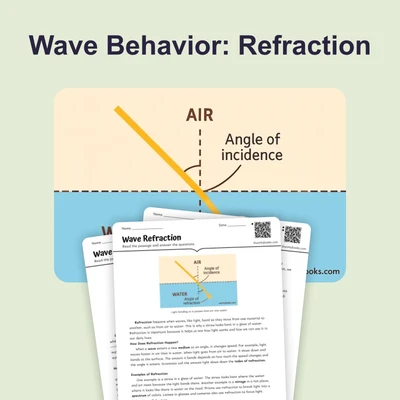
Sunlight may look white, but it is actually made up of many different colors—red, orange, yellow, green, blue, indigo, and violet. When sunlight enters a water droplet, it slows down and bends. This bending of light is called refraction. Each color bends a little differently because of its wavelength, which is why the colors spread out.
Inside the droplet, the light bounces off the back and travels back out, bending again as it leaves the droplet. This second bending helps separate the colors even more. The process of light bouncing inside the droplet is called reflection.
When millions of water droplets reflect and bend sunlight at the same time, a circular arc of colors appears in the sky. The colors always follow the same order: red on the outside, and violet on the inside.
You can only see a rainbow if the sun is behind you and the rain is in front of you. Rainbows are most common in the morning or late afternoon, when the sun is lower in the sky.
Fun Fact: A rainbow is actually a full circle, but from the ground, we can only see the top half. From an airplane, you might see the whole circle!
When does a rainbow usually appear?
During the nightOn snowy daysAfter it rains and the sun shinesWhen the wind is strong
What is sunlight made of?
Only red and blue lightAll the colors of the rainbowJust white lightWater and air
What causes light to bend when it enters a droplet?
Heat from the sunWind pushing itRefractionEvaporation
What happens to the light inside the droplet?
It disappearsIt reflects off the backIt freezes into iceIt turns into color
Why do the colors spread out in a rainbow?
Because water is heavyBecause each color bends differentlyBecause light travels in circlesBecause the air is hot
Why is the sun's position important for seeing a rainbow?
The sun has to be directly aboveThe sun must be behind youThe sun should be hiddenThe sun must be next to you
What is the main idea of the passage?
Rainbows form from wind and fogRainbows are rare and magicalRainbows are caused by light bending and reflecting in raindropsRainbows are just colored clouds
Why might someone in an airplane see a full circle rainbow?
They are closer to the cloudsThey are above the ground and can see the whole shapeThe airplane makes the rainbowThe sun is brighter in the sky
Perfect For:
👩🏫 Teachers
• Reading comprehension practice
• Auto-graded assessments
• Literacy skill development
👨👩👧👦 Parents
• Reading practice at home
• Comprehension improvement
• Educational reading time
🏠 Homeschoolers
• Reading curriculum support
• Independent reading practice
• Progress monitoring
Reading Features:
📖
Reading Passage
Engaging fiction or nonfiction text
❓
Comprehension Quiz
Auto-graded questions
📊
Instant Feedback
Immediate results and scoring
📄
Printable Version
Download for offline reading
🔊
Read Aloud
Voice-over with word highlighting
Reviews & Ratings
No reviews yet. Be the first to share your experience!
Related Content
Waves Carry Information
This 250-word reading passage introduces fourth-grade students to the fundamental concept that waves carry information f...
NGSS 4-PS4-3
How Waves Bounce – Reflection
This engaging 250-word reading passage introduces fourth-grade students to the concept of wave reflection aligned with N...
Waves and Communication
This comprehensive passage for grades 6-8 explores how waves enable communication in our modern world, in alignment with...
MS-PS4-3
Transverse and Longitudinal Waves
This passage introduces middle school students to the fundamental concepts of transverse and longitudinal waves, in alig...
MS-PS4-1
Informational Text — Penguins
This informational text on penguins is a great way to practice reading comprehension. Students will read the short passa...
RI.2.1RI.2.10
Informational Text — Armadillos
This informational text on armadillos is a great way to practice reading comprehension. Students will read the short pas...
RI.2.1RI.2.10
Reading for Main Details—Birds
This informational text on birds is a great way to practice main idea. Students will read the passage, then give the mai...
RI.2.6RI.2.8
Straight Wave Pattern
This engaging reading passage introduces fourth-grade students to the concept of straight wave patterns as outlined in N...
NGSS 4-PS4-1
Informational Text — Habitats
This short informational text on habitats will teach your students what a habitat is, as well as provide some examples o...
RF.3.4.A
Reading for Main Details—Beavers Teeth
This informational text on beavers is a great way to practice main idea. Students will read the passage, then give the m...
RI.2.6RI.2.10
Patterns in Water Waves
This Grade 4 physical science reading passage introduces students to the concept of patterns in water waves, aligned wit...
NGSS PS4.A
What Are Waves
This comprehensive reading passage on waves is specifically designed for Grade 4 students and aligns with NGSS standard ...
NGSS 4-PS4-1
Why Do Big Waves Knock You Over
This engaging reading passage introduces fourth-grade students to the relationship between wave amplitude and energy, al...
NGSS PS4.A
Why Do Pools Have Waves When You Jump In
This engaging 250-word reading passage introduces fourth-grade students to the fundamental concept of wave energy transf...
NGSS PS4.A
Wave Amplitude and Energy
This comprehensive middle school science passage explores the connection between wave amplitude and energy, aligned with...
MS-PS4-1
Informational Text — Astronauts
Practice this second grade context clues worksheet with this informational text on astronauts. Students will read the te...
RI.2.4RI.2.10RI.3.4RI.3.10
How Waves Move Objects
This engaging 250-word reading passage introduces fourth-grade students to the fundamental concept of how waves move obj...
NGSS 4-PS4-1
Reading for Main Details—Veternarians
Practie summarizing paragraphs with this fun informational text on veternarians! Students will give the main idea of eac...
RI.2.2RI.2.10
Informational Text —Importance of Sound
This Reading Informational Text Common Core standards calls for 4th graders to be able to effectively describe and analy...