Wave Amplitude
Interactive passage with audio narration, comprehension questions, and printable PDF.
By completing this purchase you agree to our Terms of Use and Privacy Policy. Your subscription renews automatically until you cancel. You can cancel anytime from your account settings. All sales are final and non-refundable. Digital content is available for download in your account immediately upon purchase.
What's included
Wave Amplitude preview and details
About this printable Wave Amplitude science reading passage, NGSS-aligned (Grades 5-8)
Sample passage and quiz from Wave Amplitude
Reading passage and comprehension quiz preview
Wave Amplitude and Energy

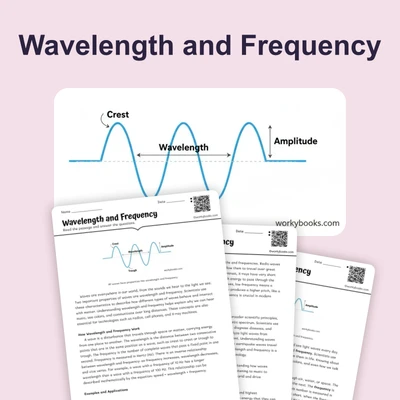
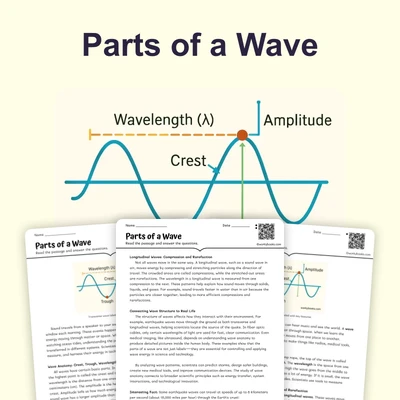
Wave amplitude is a key concept in understanding how energy travels through different systems. In the ocean, waves with higher crests crash with greater force onto the shore, while softer, smaller waves make gentle sounds. Scientists define amplitude as the distance from a wave’s rest position to its highest or lowest point, known as the crest or trough. This measurement is vital because it reveals how much energy a wave carries, whether it is a sound wave, a light wave, or a water wave.
Amplitude as a Measure of Energy
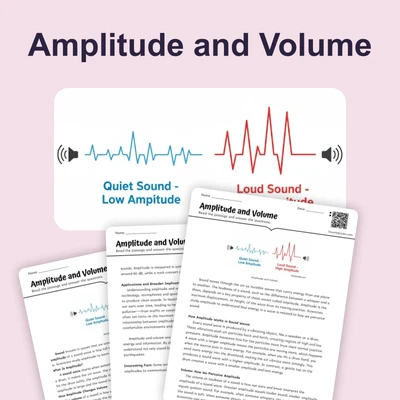
The mechanism that links amplitude and energy is rooted in physics. When a wave’s amplitude increases, the energy it transports increases as well. For example, a sound wave with a larger amplitude is heard as a louder sound, while a smaller amplitude produces a quieter sound. In light waves, greater amplitude means brighter light, and lower amplitude produces dimmer light. The relationship is not just qualitative; it is quantitative. For instance, if the amplitude of a wave doubles, the energy it carries increases by four times, because energy is proportional to the square of the amplitude. However, amplitude does not affect the frequency (how often a wave repeats) or the speed at which the wave moves. This distinction helps scientists analyze and compare different types of waves accurately.
Applications in Everyday Life
Amplitude and energy play crucial roles in many aspects of daily life and technology. In music, the volume of a note depends on the amplitude of the sound waves produced by an instrument. Engineers designing speakers or headphones manipulate amplitude to provide the desired loudness. In nature, the amplitude of ocean waves can determine the power of a tsunami or the gentleness of ripples. Similarly, in lighting, amplitude controls the brightness of bulbs and screens. These examples illustrate how amplitude, while invisible to the naked eye, has a direct impact on our environment and experiences.
Scientific Principles and Broader Implications
Understanding amplitude is essential for broader scientific inquiries. For example, seismologists study the amplitude of seismic waves to assess earthquake strength, which can inform building codes and disaster preparedness. In medical technology, devices like ultrasound machines use wave amplitude to create images of internal organs. The principle that energy increases with amplitude, but not with frequency or speed, is foundational in physics and connects to other core ideas, such as conservation of energy and systems thinking. By studying amplitude, scientists and engineers can design safer structures, advance communication technology, and predict natural events.
Interesting Fact:
Did you know that the most powerful ocean waves ever recorded reached amplitudes over 30 meters (almost 100 feet)? These monster waves carry enough energy to move massive ships and reshape coastlines!
Comprehension quiz (10 questions)
1. What does amplitude measure in a wave?
2. Which of the following increases when the amplitude of a wave increases?
3. How does amplitude affect the loudness of a sound?
4. If the amplitude of a wave doubles, how does the energy change?
5. In the passage, which term describes the lowest point of a wave?
6. What is true about amplitude and wave speed?
7. Why do seismologists study amplitude?
8. Which real-world example does NOT involve amplitude?
9. True or False: Amplitude changes the frequency of a wave.
10. True or False: Amplitude is important in both natural and technological systems.
Perfect for the way you teach
- Build comprehension skills
- Auto-graded quiz
- Differentiated reading
- Read together at home
- Improve fluency
- Quiet reading time
- Reading curriculum support
- Independent practice
- Track Lexile growth