Transverse and Longitudinal Waves — Reading Comprehension
Rate this|
16
Present
Present in classroom. No work saved
Assign
Classroom with student accounts, Track progress
Quick Play
No student accounts, assign with a link
Grades
5
6
7
8
Standards
MS-PS4-1
PRINT+DIGITAL RESOURCE
This learning resource is available in interactive and printable formats. The interactive worksheet can be played online and assigned to students. The Printable PDF version can be downloaded and printed for completion by hand.
This passage introduces middle school students to the fundamental concepts of transverse and longitudinal waves, in alignment with NGSS standard MS-PS4-1. Students will explore the mechanisms by which particles move in relation to the wave's direction, using relatable examples like slinkies, sound, and light. The passage explains how these waves operate, provides real-world contexts such as ocean waves and sound in air, and highlights the importance of understanding wave behavior in technology and daily life. Key science vocabulary is clearly explained, and students are supported with differentiated reading levels and Spanish translations. Activities include quizzes, writing prompts, and graphic organizers to reinforce comprehension and application. Ideal for grades 6-8, this resource is audio integrated and supports diverse learners in mastering core physical science concepts.
CONTENT PREVIEW
Expand content preview
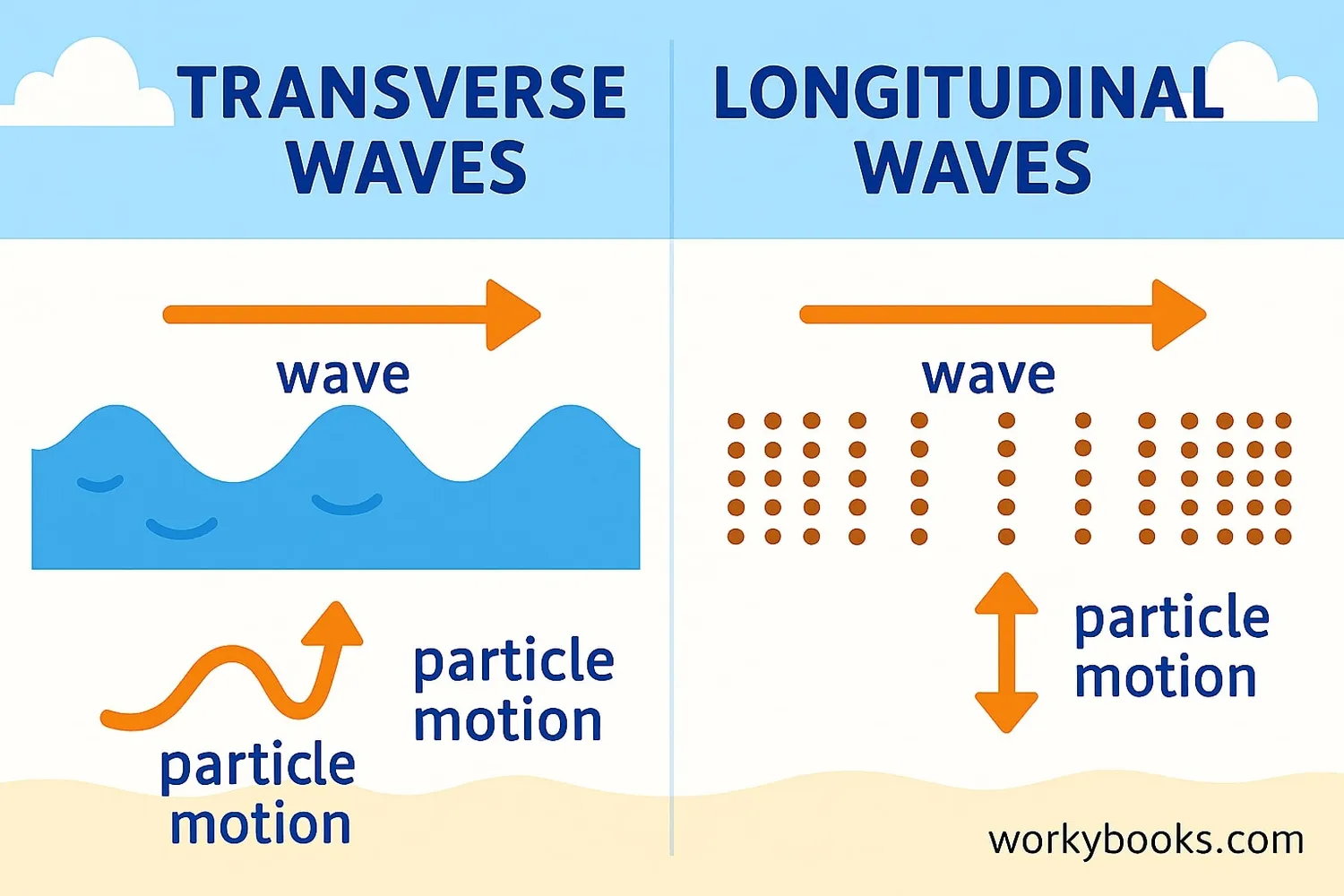
Diagram showing transverse and longitudinal wave motion
Waves are patterns of energy that travel through matter or space, often carrying information or causing movement. In classrooms and laboratories, one of the most observable wave phenomena is the motion created when a slinky is moved in different ways. The way the slinky’s coils move helps scientists classify waves by how particles move relative to the direction of the wave. Understanding the mechanisms behind two main types—transverse and longitudinal waves—reveals how energy travels through various materials and forms the basis for much of modern technology.
Mechanisms of Transverse and Longitudinal Waves
Transverse waves occur when the motion of the particles is perpendicular to the direction the wave travels. For example, if you shake one end of a slinky up and down, the coils move vertically while the wave travels horizontally along the slinky. This perpendicular movement is seen in ocean surface waves, where water particles move up and down as the wave moves forward. Another example is light, which moves as a transverse wave and does not require a medium. In contrast, longitudinal waves involve particles moving parallel to the direction of the wave. When you push and pull the slinky lengthwise, the coils compress and expand in the same direction as the wave. Sound is a classic longitudinal wave: air particles compress and rarefy in the direction the sound travels, creating regions of high and low pressure.
Interaction of Waves and Real-World Applications
Both types of waves can transfer energy without moving matter over long distances. In a transverse wave, the amplitude (height) of the wave relates to its energy; in a longitudinal wave, the energy depends on how compressed the particles become. Applications of these wave types are found everywhere. Seismic waves from earthquakes travel through the Earth as both longitudinal (P-waves) and transverse (S-waves), helping scientists locate earthquake epicenters. Engineers design buildings to withstand these different wave motions. In medicine, ultrasound (a type of longitudinal wave) is used to create images of the inside of the body, while light waves are essential for vision and optical technologies.
Systems, Patterns, and Broader Connections
Studying waves also demonstrates broader scientific principles, such as the conservation of energy and the transfer of information. The speed of waves depends on the properties of the medium—sound travels about 340 meters per second in air, but much faster in solids. Some waves, like light, can travel through a vacuum, while sound waves require a medium. Understanding these patterns helps scientists develop new materials and technologies, from fiber-optic communication to earthquake detection. The study of waves connects physical science to fields like engineering, medicine, and environmental science.
Waves are not just a topic in science class; they shape the world around us and touch every part of modern life. By learning how transverse and longitudinal waves work, students can better understand everything from music to natural disasters and advanced technology.
Interesting Fact: Some animals, such as elephants, use low-frequency longitudinal waves to communicate over distances of several kilometers through the ground!
What is the main difference between transverse and longitudinal waves?
The direction particles move compared to the wave's direction.Transverse waves only occur in water.Longitudinal waves cannot transfer energy.Transverse waves are slower than longitudinal waves.
Which of the following is an example of a longitudinal wave?
LightSoundOcean surface waveRadio wave
In a slinky, how do you create a transverse wave?
Move the slinky up and down at one end.Push and pull the slinky lengthwise.Spin the slinky in circles.Hold the slinky still.
What does the term 'amplitude' mean in the context of waves?
The speed of the wave.The height of the wave from its rest position.The length of the wave.The pressure of the wave.
According to the passage, why do sound waves need a medium?
Because particles must move to transfer energy.Because sound waves are visible.Because sound needs light to travel.Because sound waves travel faster in a vacuum.
What is the main function of seismic waves discussed in the passage?
They help scientists locate earthquake epicenters.They create light in the ground.They help animals communicate.They make the ocean move.
What can you infer about the importance of studying waves, based on the passage?
Studying waves only matters for scientists.Understanding waves helps us in technology, safety, and communication.Waves are only important for music.Waves are not connected to real life.
True or False: Light waves require a medium to travel.
TrueFalse
True or False: In longitudinal waves, particles move in the same direction as the wave.
TrueFalse
Which statement best describes how energy is transferred in waves?
Energy moves through the wave, but matter mostly stays in place.Both energy and matter move far together.Only matter moves, not energy.Waves do not transfer any energy.
Perfect For:
👩🏫 Teachers
• Reading comprehension practice
• Auto-graded assessments
• Literacy skill development
👨👩👧👦 Parents
• Reading practice at home
• Comprehension improvement
• Educational reading time
🏠 Homeschoolers
• Reading curriculum support
• Independent reading practice
• Progress monitoring
Reading Features:
📖
Reading Passage
Engaging fiction or nonfiction text
❓
Comprehension Quiz
Auto-graded questions
📊
Instant Feedback
Immediate results and scoring
📄
Printable Version
Download for offline reading
🔊
Read Aloud
Voice-over with word highlighting
Reviews & Ratings
No reviews yet. Be the first to share your experience!
Related Content
Wavelength and Frequency
This engaging middle school science passage explores the concepts of wavelength and frequency, aligning with NGSS standa...
MS-PS4-1
Remote Sensing
This middle school science passage introduces students to the concept of remote sensing—the collection of information ab...
MS-ESS3-3MS-PS4-2MS-ETS1-1MS-ETS1-3
The Electromagnetic Spectrum
This comprehensive science reading passage introduces middle school students (grades 6-8) to the electromagnetic spectru...
MS-PS4-1MS-PS4-2
Parts of a Wave
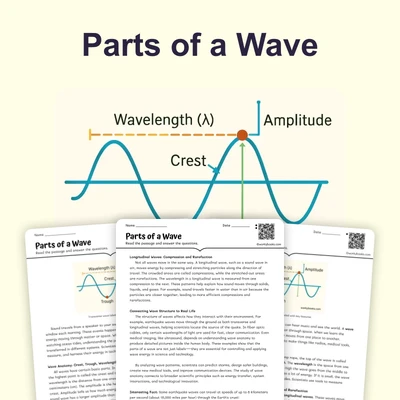
This informational passage, aligned with NGSS MS-PS4-1, introduces middle school students (grades 6-8) to the anatomy of...
MS-PS4-1
Wave Amplitude and Energy
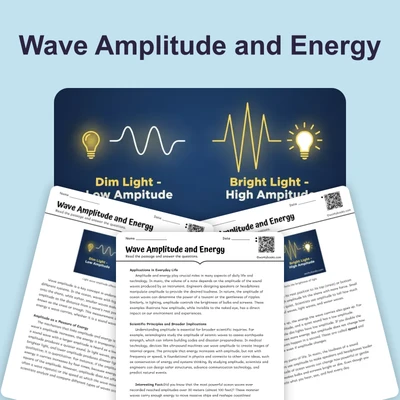
This comprehensive middle school science passage explores the connection between wave amplitude and energy, aligned with...
MS-PS4-1
Wave Speed
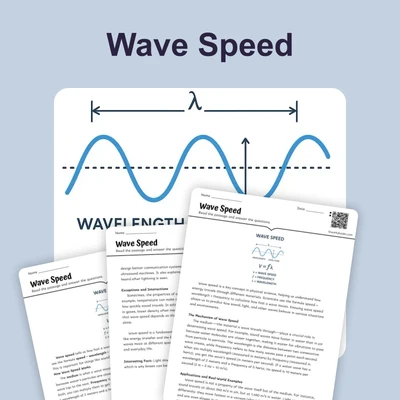
This comprehensive middle school science passage explores the concept of wave speed, aligned with NGSS MS-PS4-1. Student...
MS-PS4-1
How Sound Is Produced
This comprehensive middle school science passage explores the fundamental question of how sound is produced, perfectly a...
MS-PS4-1
What Is Sound?
This passage explores the science of sound for middle school students, aligned with NGSS standards MS-PS4-1 and MS-PS4-2...
MS-PS4-1MS-PS4-2
Frequency and Pitch
This comprehensive passage for grades 6-8 introduces students to the concepts of frequency and pitch, aligned to NGSS st...
MS-PS4-1
Amplitude and Volume
This comprehensive middle school science reading passage introduces students to the concepts of amplitude and volume in ...
MS-PS4-1
Speed of Sound
This comprehensive passage for grades 6-8 explores the science behind the speed of sound and how it varies depending on ...
MS-PS4-1MS-PS4-2
Measuring Sound in Decibels
This science reading passage introduces middle school students to the concept of measuring sound using decibels (dB). Al...
MS-PS4-1
Ultrasound and Infrasound
This engaging middle school science passage introduces students to the concepts of ultrasound and infrasound, frequencie...
MS-PS4-1
Musical Instruments and Sound
This comprehensive science passage for grades 6-8 explores how musical instruments create sound through vibration, align...