How Waves Bounce – Reflection — Reading Comprehension
Rate this
Premium Resource
Present
Present in classroom. No work saved
Assign
Classroom with student accounts, Track progress
Quick Play
No student accounts, assign with a link
Grades
3
4
5
PRINT+DIGITAL RESOURCE
This learning resource is available in interactive and printable formats. The interactive worksheet can be played online and assigned to students. The Printable PDF version can be downloaded and printed for completion by hand.
This engaging 250-word reading passage introduces fourth-grade students to the concept of wave reflection aligned with NGSS standard PS4.A. Students learn what happens when waves encounter surfaces and bounce back through familiar examples like echoes in gymnasiums and water waves in swimming pools. The passage uses age-appropriate language to explain how reflection occurs with different types of waves including sound and water. Audio-integrated features support diverse learners by providing text-to-speech functionality. The passage avoids complex terminology while building foundational understanding of wave behavior. Students explore why we hear echoes, how dolphins use reflected sound waves for navigation, and why water waves bounce off pool walls. Accompanying activities include multiple-choice comprehension questions, short-answer writing prompts, and graphic organizers that help students organize their understanding of cause-and-effect relationships in wave reflection. The simplified differentiated version ensures all students can access core science concepts regardless of reading level. Spanish translations support English language learners. This comprehensive resource prepares students for hands-on investigations and deeper discussions about wave properties and behaviors in physical science.
CONTENT PREVIEW
Expand content preview
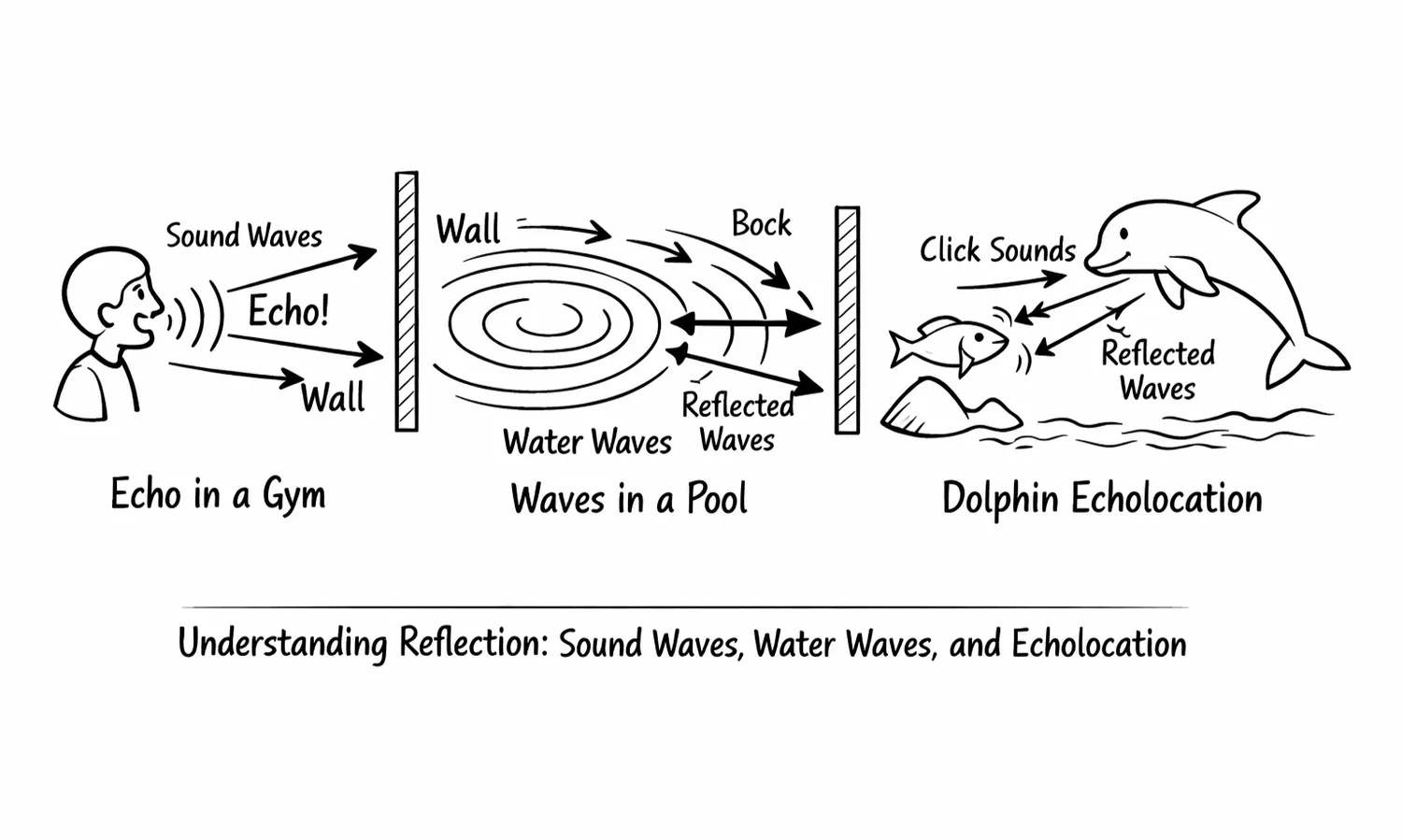
Simple diagram showing sound water waves reflecting from walls surfaces clearly.
Reflection is what happens when a wave hits a surface and bounces back. A wave is energy that travels through space or matter. Understanding reflection helps us explain many things we experience every day, like hearing echoes or seeing our image in a mirror.
When you shout in a large gym, you often hear your voice again a moment later. This is called an echo. The sound waves from your voice travel through the air until they hit a hard surface like a wall. Then the waves bounce back toward you. The wall acts like a barrier that sends the sound waves back in the opposite direction.
Reflection happens with many types of waves, not just sound. When you drop a ball into a swimming pool, water waves spread out in circles. When these waves reach the side of the pool, they bounce back. You can see the waves change direction and travel back across the water. The pool wall reflects the water waves just like a gym wall reflects sound waves.
Animals use reflection too. Dolphins make clicking sounds that travel through ocean water. When these sound waves hit a fish or rock, they bounce back to the dolphin. The dolphin listens to the reflected sounds to find food and avoid obstacles. This is similar to how you hear an echo, but dolphins use it to "see" underwater.
What is reflection?
When waves pass through surfacesWhen waves hit and bounce backWhen waves stop moving completelyWhen waves get louder
What is an echo?
A type of water waveSound that bounces back to youA loud noise in gymEnergy traveling through matter
What happens to water waves at pool walls?
They disappear completelyThey get bigger and biggerThey bounce back across waterThey turn into sound waves
Why do dolphins use reflected sounds?
To find food and avoid obstaclesTo make loud noises onlyTo sleep underwater safelyTo swim faster in ocean
What acts as barrier for sound waves?
Air in the roomYour voice when you shoutThe wall in a gymWater in a pool
How are echoes and dolphin clicks similar?
Both happen only in waterBoth use reflected sound wavesBoth make very loud noisesBoth happen only on land
Reflection only happens with sound waves.
TrueFalse
What does the word 'wave' mean?
Energy that travels through spaceA sound you hear twiceWater in a swimming poolA hard surface like wall
Perfect For:
👩🏫 Teachers
• Reading comprehension practice
• Auto-graded assessments
• Literacy skill development
👨👩👧👦 Parents
• Reading practice at home
• Comprehension improvement
• Educational reading time
🏠 Homeschoolers
• Reading curriculum support
• Independent reading practice
• Progress monitoring
Reading Features:
📖
Reading Passage
Engaging fiction or nonfiction text
❓
Comprehension Quiz
Auto-graded questions
📊
Instant Feedback
Immediate results and scoring
📄
Printable Version
Download for offline reading
🔊
Read Aloud
Voice-over with word highlighting
Reviews & Ratings
No reviews yet. Be the first to share your experience!
Related Content
Waves Carry Information
This 250-word reading passage introduces fourth-grade students to the fundamental concept that waves carry information f...
NGSS 4-PS4-3
Transverse and Longitudinal Waves
This passage introduces middle school students to the fundamental concepts of transverse and longitudinal waves, in alig...
MS-PS4-1
Straight Wave Pattern
This engaging reading passage introduces fourth-grade students to the concept of straight wave patterns as outlined in N...
NGSS 4-PS4-1
Why Do Big Waves Knock You Over
This engaging reading passage introduces fourth-grade students to the relationship between wave amplitude and energy, al...
NGSS PS4.A
Wave Amplitude and Energy
This comprehensive middle school science passage explores the connection between wave amplitude and energy, aligned with...
MS-PS4-1
What Are Waves
This comprehensive reading passage on waves is specifically designed for Grade 4 students and aligns with NGSS standard ...
NGSS 4-PS4-1
Patterns in Water Waves
This Grade 4 physical science reading passage introduces students to the concept of patterns in water waves, aligned wit...
NGSS PS4.A
Why Do Pools Have Waves When You Jump In
This engaging 250-word reading passage introduces fourth-grade students to the fundamental concept of wave energy transf...
NGSS PS4.A
How Waves Move Objects
This engaging 250-word reading passage introduces fourth-grade students to the fundamental concept of how waves move obj...
NGSS 4-PS4-1
Waves and Communication
This comprehensive passage for grades 6-8 explores how waves enable communication in our modern world, in alignment with...
MS-PS4-3
Light Waves
This middle school science passage introduces students in grades 6-8 to the concept of light as an electromagnetic wave,...
MS-PS4-2
Wave Crests and Troughs
This engaging 250-word passage introduces Grade 4-5 students to the fundamental parts of transverse waves: crests and tr...
NGSS 4-PS4-1
Parts of a Wave
This informational passage, aligned with NGSS MS-PS4-1, introduces middle school students (grades 6-8) to the anatomy of...
MS-PS4-1
What Is Wave Amplitude
This engaging 250-word reading passage introduces fourth-grade students to the concept of wave amplitude as outlined in ...
NGSS 4-PS4-1
Wave Refraction
This comprehensive science passage introduces middle school students to the concept of refraction, a key phenomenon in w...
MS-PS4-2
Wave Speed
This comprehensive middle school science passage explores the concept of wave speed, aligned with NGSS MS-PS4-1. Student...
MS-PS4-1
Circular Wave Patterns
This engaging 250-word science passage introduces Grade 4-5 students to circular wave patterns and how they behave in na...
NGSS 4-PS4-1
What Are Parts of a Wave
This comprehensive Grade 4 physical science reading passage introduces students to the fundamental parts of a wave, alig...
NGSS 4-PS4-1
Wave Absorption
This engaging science passage for grades 6-8 explores the mechanism of wave absorption, where waves transfer energy to m...