Why Do Barnacles Attach To Whales
Interactive passage with audio narration, comprehension questions, and printable PDF.
What's included
Why Do Barnacles Attach To Whales preview and details
About this printable Why Do Barnacles Attach To Whales science reading passage, NGSS-aligned (Grade 6)
Sample passage and quiz from Why Do Barnacles Attach To Whales
Reading passage and comprehension quiz preview
Why Do Barnacles Attach To Whales?
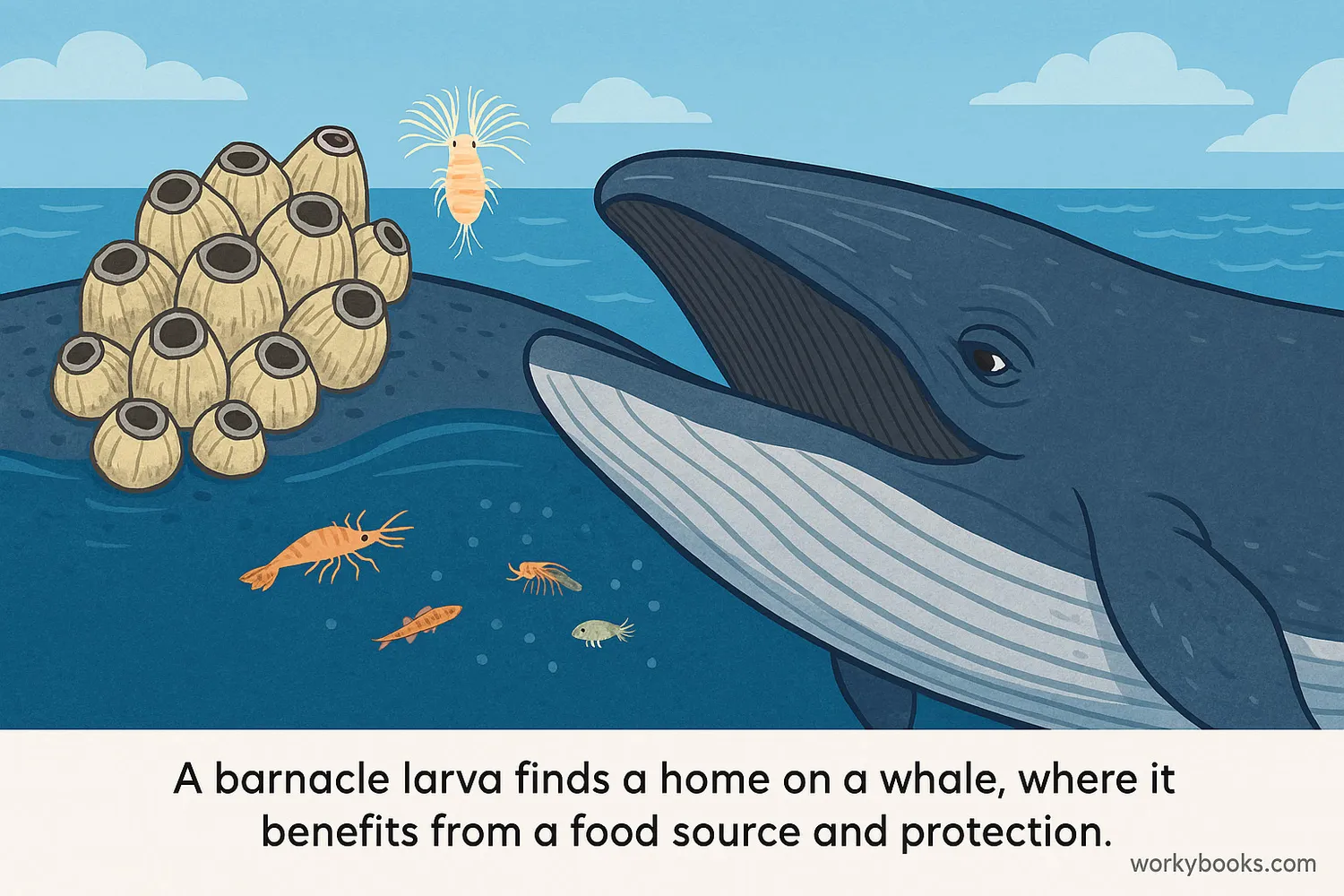
Imagine living on a giant, moving home that takes you to the best restaurants in the ocean. This is exactly what life is like for a barnacle that attaches itself to a whale! This fascinating relationship between barnacles and whales is a perfect example of a symbiotic relationship, where different species live in close contact.
Barnacles are crustaceans, similar to crabs and lobsters, but they spend their adult lives stuck in one place. Young barnacles, called larvae, are free-swimming. When they are ready to settle down, they look for a hard surface. For some species, the skin of a whale makes an ideal home. They secrete a strong, natural glue that holds them firmly in place for the rest of their lives. These barnacles don't dig into the whale's skin; they simply attach to the surface.
This specific type of symbiotic relationship is called commensalism. In commensalism, one organism benefits, and the other is neither helped nor harmed. The barnacle gets several big advantages from its whale host. First, it gets a free ride to food-rich waters. Whales are constantly migrating, moving between feeding grounds and breeding grounds, and the barnacles get to travel along. Second, whales are messy eaters. As whales open their enormous mouths to gulp down krill and plankton, tiny food particles often drift away. Barnacles are filter feeders, meaning they use feathery legs to strain small food particles from the water. They simply extend their legs and catch the stray bits of food the whale misses.
Third, attaching to a whale provides the barnacles with protection from predators that might try to eat them if they were on a stationary rock. It's much harder for a small fish or another predator to pick off a barnacle from a massive, moving whale. From the whale's perspective, the barnacles generally don't cause any problems. Their presence doesn't seem to affect the whale's health, speed, or ability to find food. It's a truly one-sided benefit!
Interesting Fact: Some barnacle species are so specialized that they can only attach to specific whale species, showing a unique evolutionary connection.
Comprehension quiz (10 questions)
1. What do barnacles use to attach to whales?
2. What is plankton?
3. Which of these is NOT a benefit for barnacles?
4. Why is the whale not harmed by barnacles?
5. What describes a barnacle's diet?
6. Barnacles are considered crustaceans. True or False?
7. What term means one organism benefits, other is unaffected?
8. If barnacles helped whales, what would it be?
9. Why is it harder for predators to eat barnacles on whales?
10. What is an example of commensalism?
Perfect for the way you teach
- Build comprehension skills
- Auto-graded quiz
- Differentiated reading
- Read together at home
- Improve fluency
- Quiet reading time
- Reading curriculum support
- Independent practice
- Track Lexile growth