Women Work in Factories: Rosie the Riveter
Interactive passage with audio narration, comprehension questions, and printable PDF.
By completing this purchase you agree to our Terms of Use and Privacy Policy. Your subscription renews automatically until you cancel. You can cancel anytime from your account settings. All sales are final and non-refundable. Digital content is available for download in your account immediately upon purchase.
What's included
Women Work in Factories: Rosie the Riveter preview and details
About this printable Women Work in Factories: Rosie the Riveter reading passage (Grades 3-5)
Sample passage and quiz from Women Work in Factories: Rosie the Riveter
Reading passage and comprehension quiz preview
Rosie the Riveter
Rosie the Riveter was a symbol for millions of American women during World War II. When the United States joined the war in 1941, many men went off to fight in Europe and the Pacific. This left factories and shipyards without enough workers. The country needed airplanes, ships, and weapons for the war. The government asked women to help by working in these important jobs.
Women from all over the country answered the call. They worked in factories, building planes and tanks. They helped make ships at shipyards and built weapons for the soldiers. These jobs were hard and sometimes dangerous. Many women had never done this kind of work before. They learned new skills quickly and worked long hours. Their work was very important to winning the war.
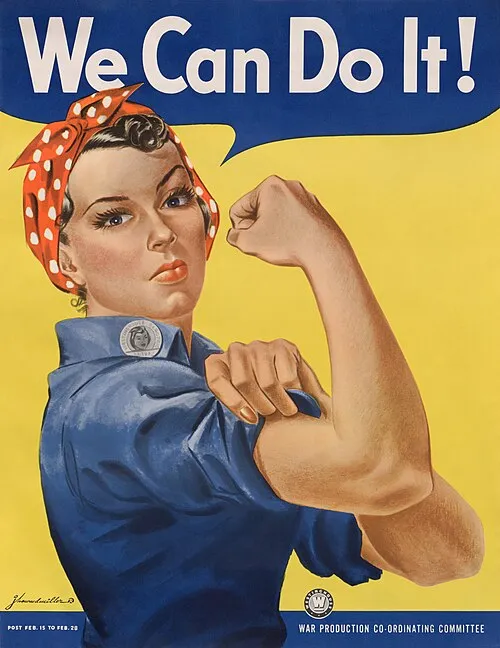
A famous poster showed a strong woman with a red polka-dot bandana and a blue shirt, flexing her arm. The words on the poster said, "We Can Do It!" This woman was called Rosie the Riveter. She became a symbol of bravery, unity, and determination. Rosie showed that women could do tough jobs and help the country. Many women were proud to be called "Rosies."
At home, women also helped by growing food, sewing uniforms, and saving metal for the war. These actions showed teamwork and patriotism. The women who worked during the war changed the way people thought about jobs. Before the war, most women did not work in factories. When the war ended, some women returned home, but others kept working. Their hard work helped start changes for women’s rights in America.
Rosie the Riveter is still remembered today as a hero. She stands for the strength and courage of all women who helped win World War II. Her story reminds us that, together, we can overcome big challenges.
Interesting Fact: More than six million women worked in American factories during World War II, many for the first time.
Comprehension quiz (8 questions)
1. Who was Rosie the Riveter?
2. What did women build in factories?
3. When did the U.S. join WWII?
4. Why did women start working in factories?
5. How did women help on the home front?
6. What did the 'We Can Do It!' poster show?
7. Rosie the Riveter is still a hero today. True or False?
8. What does 'patriotism' mean?
Common Core standards for Women Work in Factories: Rosie the Riveter
Explain events, procedures, ideas, or concepts in a historical, scientific, or technical text, including what happened and why, based on specific information in the text.
Determine the meaning of general academic and domain-specific words or phrases in a text relevant to a grade 4 topic or subject area.
Write informative/explanatory texts to examine a topic and convey ideas and information clearly.
Draw evidence from literary or informational texts to support analysis, reflection, and research.
Perfect for the way you teach
- Build comprehension skills
- Auto-graded quiz
- Differentiated reading
- Read together at home
- Improve fluency
- Quiet reading time
- Reading curriculum support
- Independent practice
- Track Lexile growth