This learning resource is available in interactive and printable formats. The interactive worksheet can be played online and assigned to students. The Printable PDF version can be downloaded and printed for completion by hand.
This history reading passage explores the origins and practice of direct democracy in Ancient Athens, one of the world's first democratic societies. Students will learn how Athenian citizens gathered in the Assembly to vote on laws, the roles of leaders like Pericles, and the importance of citizenship in daily life. The passage includes a glossary of key terms, a Spanish translation, a differentiated version for developing readers, and interactive activities such as a multiple-choice quiz, writing prompts, and graphic organizers. A relevant public domain image and a coloring page prompt are also included. This resource aligns with CA HSS 6.4 and CCSS RI.6-8.1, RI.6-8.3, making it excellent for developing historical thinking skills. Read aloud audio and Spanish translation support diverse learners.
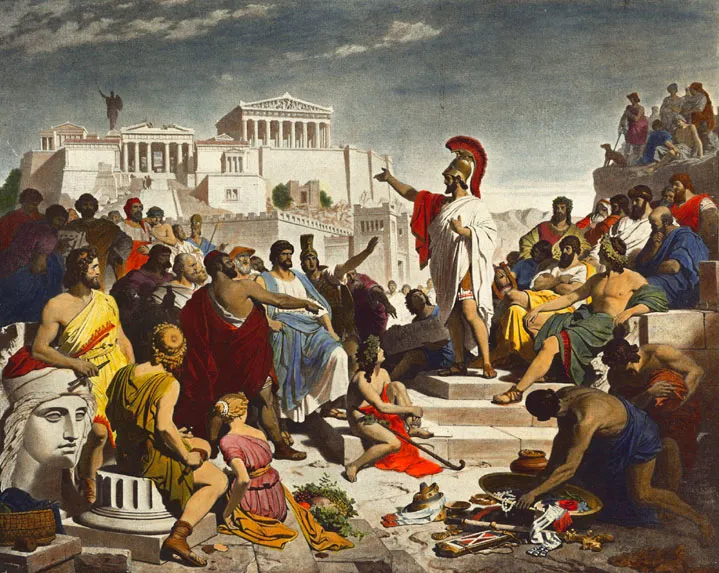
Democracy began in the ancient Greek city-state of Athens around 508 BCE, changing how people participated in government. In Athens, power did not rest with a king or small group. Instead, Athenian citizens gathered to make decisions about their laws and leaders. This system, known as direct democracy, allowed citizens to vote on issues themselves, rather than through representatives.
The Assembly, or “Ekklesia,” was central to Athenian democracy. Any male citizen over 18 could attend meetings, which took place about 40 times a year on the Pnyx hill. At these gatherings, citizens debated new laws, military matters, and even ostracism, which was the temporary removal of a citizen from Athens for ten years. Votes were often done by a show of hands or by using stones. The historian Thucydides described the Assembly’s debates and how ordinary citizens shaped state policy. Archaeological discoveries at the Pnyx, such as stone speaker’s platforms, confirm the Assembly’s importance.
Leadership in Athens was different from monarchies. Instead of inherited power, many officials were chosen by lottery to make government more fair. The most respected leader was the strategos, or general, elected by citizens for military leadership. Pericles, who served as strategos for over 15 years, increased citizen participation and built public buildings like the Parthenon. However, not everyone had a voice. Only free adult male citizens could vote—women, slaves, and foreigners were excluded. This reflected the social hierarchy of Athenian society.
Athenian democracy changed over time. At first, only a small group could vote, but reforms by leaders like Cleisthenes and Pericles expanded participation. During the 5th century BCE, Athens faced wars and internal conflict, yet the Assembly continued to meet. Some decisions, like condemning Socrates, show democracy’s strengths and its limits. The system inspired debates about justice, equality, and citizenship that still influence governments today.
The geography of Athens, with its central meeting places and open spaces, helped direct democracy thrive. Citizens lived close enough to gather easily for discussions. Although Athens eventually fell to outside powers, its experiment with democracy left a major impact. Modern democracies borrow ideas from Athens, such as jury trials and public debate, but now include more people as citizens.
Today, studying Athenian democracy helps us understand how people can shape their governments. The ideas of citizen participation, debate, and voting continue to inspire societies around the world.
Interesting Fact: In some Assembly votes, Athenians dropped pieces of broken pottery called ostraka into containers to decide who would be exiled from the city.
When did democracy begin in Athens?
508 BCE776 BCE1200 BCE331 BCE
What was the Assembly called in Greek?
AgoraAcropolisEkklesiaParthenon
Who could vote in ancient Athens?
All adultsOnly male citizensWomenSlaves
Why did some officials use a lottery?
To be fairTo save moneyTo avoid warTo follow the king
What is ostracism?
A festivalVoting to exile someoneBuilding templesMilitary training
How did geography help democracy in Athens?
Citizens lived far apartCitizens lived close togetherIt was an islandNo assembly met
Athens used direct democracy. True or false?
TrueFalse
What is the meaning of 'hierarchy'?
A voting systemA social rankingA type of buildingA battle
Perfect For:
👩🏫 Teachers
• Reading comprehension practice
• Auto-graded assessments
• Literacy skill development
👨👩👧👦 Parents
• Reading practice at home
• Comprehension improvement
• Educational reading time
🏠 Homeschoolers
• Reading curriculum support
• Independent reading practice
• Progress monitoring
Reading Features:
📖
Reading Passage
Engaging fiction or nonfiction text
❓
Comprehension Quiz
Auto-graded questions
📊
Instant Feedback
Immediate results and scoring
📄
Printable Version
Download for offline reading
🔊
Read Aloud
Voice-over with word highlighting
Reviews & Ratings
No reviews yet. Be the first to share your experience!
Related Content
Ancient Civilizations and the Environment
This engaging history reading passage explores how ancient civilizations such as Mesopotamia, Egypt, and the Maya adapte...
Gender Roles in Ancient Civilizations
This engaging history reading passage explores the roles of men and women in various ancient civilizations, including Me...
Writing Prompts Ancient Civilizations
Step into the shoes of an archaeologist with this engaging worksheet focused on ancient civilizations. Students will be ...
W.5.2.A-2W.5.1.CW.5.1.D
Power and Authority in Ancient Civilizations
This passage explores the roles of men in positions of power within ancient civilizations, focusing on their authority i...
Ancient Monarchy
This reading passage explores the concept of monarchy in ancient civilizations, focusing on the origins, structure, and ...
Evidence in Ancient History
This engaging history reading passage investigates how archaeologists and historians discover clues about how ancient pe...
Ancient Theocracy
This engaging history reading passage explores the concept of theocracy in ancient civilizations, where priests and reli...
Ancient Mathematics
This passage explores the essential role of mathematics in ancient civilizations, including Mesopotamia, Egypt, Greece, ...
Ancient Canaan
This educational passage explores the land of Canaan, the historical homeland of the ancient Israelites. Students will l...
Ancient Money Barter
This passage explores the fascinating evolution from barter to the earliest coins in ancient civilizations, focusing on ...
Ancient Science and Medicine
This comprehensive reading passage explores the development of science and medicine in ancient civilizations, including ...
Ancient Literature
This passage explores the importance of ancient stories and poems from civilizations such as Greece, India, and Israel. ...
Ancient Agriculture Farming
This passage explores the transformative impact of farming on ancient societies, examining how the Neolithic Revolution ...
Ancient Writing Systems
This engaging history reading passage explores the origins and evolution of ancient writing systems, including cuneiform...
Geography of Ancient Israel
This passage explores the rich geography of Ancient Israel, focusing on how landforms, climate, and natural resources sh...
Slavery Across Civilizations
This detailed history reading passage explores the role and impact of slavery across several ancient civilizations, incl...
Social Classes in Ancient Societies
This passage explores the concept of social hierarchies in ancient civilizations, focusing on why societies such as Meso...
Social structures in Ancient World
This passage explores the organization and significance of family life in ancient societies, focusing on how extended fa...
Polytheism and Monotheism in Ancient Times
This passage explores the religious beliefs of ancient civilizations, focusing on the differences and similarities betwe...
Women in Ancient Societies
This reading passage explores the complex roles of women in the ancient world, focusing on civilizations such as Mesopot...