Biotic and Abiotic Factors — Reading Comprehension
Rate this
Present
Present in classroom. No work saved
Assign
Classroom with student accounts, Track progress
Quick Play
No student accounts, assign with a link
Grades
3
4
5
6
PRINT+DIGITAL RESOURCE
This learning resource is available in interactive and printable formats. The interactive worksheet can be played online and assigned to students. The Printable PDF version can be downloaded and printed for completion by hand.
This educational reading passage, designed for 4th-grade students, introduces the concept of abiotic factors in an ecosystem. The passage, which is available in an audio-integrated format, defines key terms like "abiotic" and "biotic" and provides relatable examples of how non-living components, such as sunlight, water, and soil, affect living organisms. It explains that these factors are crucial for the survival and growth of plants and animals. The passage also touches upon how organisms adapt to different abiotic conditions, using examples like a desert cactus or a polar bear. The included fun fact adds a memorable detail for young learners. Following the text, there are eight multiple-choice questions to assess student comprehension at different DOK levels, from recalling basic facts to applying the concepts to new scenarios. This resource aligns with the Next Generation Science Standards (NGSS) for elementary life sciences, specifically focusing on the interdependent relationships in ecosystems. It's a great tool for teachers to use in the classroom to help students understand the foundational elements of ecology.
CONTENT PREVIEW
Expand content preview
An ecosystem is a community of living things and nonliving things that interact with each other in a specific area. An ecosystem can be as large as a forest or as small as a puddle. Understanding ecosystems helps us see how all parts of nature are connected and depend on each other to survive.
Every ecosystem has two main types of factors. Biotic factors are all the living things in an ecosystem. These include plants, animals, fungi, bacteria, and other organisms. For example, in a forest ecosystem, trees, deer, mushrooms, and birds are all biotic factors. They can grow, reproduce, and respond to their environment.
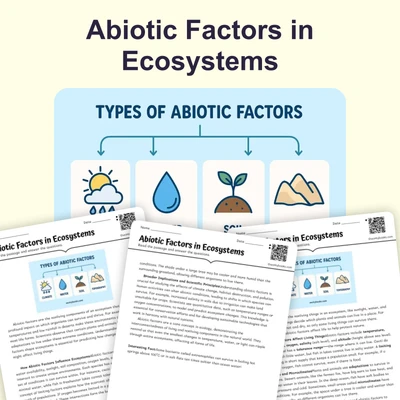
Abiotic factors are all the nonliving things in an ecosystem. These include water, air, sunlight, soil, temperature, and rocks. Abiotic factors do not grow or reproduce, but they are essential for life. Think of abiotic factors like the stage where a play happens—they provide the setting and resources that living things need.
Biotic and abiotic factors work together in important ways. Plants need abiotic factors like sunlight, water, and soil nutrients to grow through photosynthesis. Animals need abiotic factors like air to breathe and water to drink. Decomposers—organisms like bacteria and fungi that break down dead matter—need moisture and dead plants or animals to do their job. When decomposers break down dead material, they return nutrients to the soil, which helps new plants grow.
All parts of an ecosystem are connected through these interactions—the ways that biotic and abiotic factors affect each other. If you remove or change one factor, it affects the whole system. For example, if a forest loses its trees (biotic factor), animals lose shelter and food. If a pond dries up (abiotic factor), fish and frogs cannot survive. This connection shows us that ecosystems are delicate balances where every part matters.
Understanding how biotic and abiotic factors depend on each other helps us protect ecosystems. When we see how removing one piece affects everything else, we can make better decisions about caring for nature.
Interesting Fact: The Amazon rainforest produces about 20% of Earth's oxygen through photosynthesis, showing how biotic factors (trees) use abiotic factors (sunlight and carbon dioxide) to create something all living things need!
What are biotic factors in an ecosystem?
All the living thingsAll the nonliving thingsOnly the plantsOnly the animals
Which is an example of abiotic factor?
A deer in the forestSunlight shining on plantsMushrooms growing on logsBirds building nests
What do decomposers need to work?
Only sunlight and airDead matter and moistureLiving plants onlyRocks and soil only
Why do plants need abiotic factors?
To hide from animalsTo grow through photosynthesisTo move to new placesTo communicate with other plants
What happens if trees disappear from forest?
Animals gain more food sourcesThe soil becomes richer immediatelyAnimals lose shelter and foodMore sunlight helps all organisms
How do decomposers help the ecosystem?
They eat all living plantsThey return nutrients to soilThey create more sunlightThey make water disappear
Biotic factors can grow and reproduce.
TrueFalse
What does interaction mean in ecosystems?
Ways factors affect each otherOnly living things growingTemperature changes onlyAnimals fighting for food
Perfect For:
👩🏫 Teachers
• Reading comprehension practice
• Auto-graded assessments
• Literacy skill development
👨👩👧👦 Parents
• Reading practice at home
• Comprehension improvement
• Educational reading time
🏠 Homeschoolers
• Reading curriculum support
• Independent reading practice
• Progress monitoring
Reading Features:
📖
Reading Passage
Engaging fiction or nonfiction text
❓
Comprehension Quiz
Auto-graded questions
📊
Instant Feedback
Immediate results and scoring
📄
Printable Version
Download for offline reading
🔊
Read Aloud
Voice-over with word highlighting
Reviews & Ratings
No reviews yet. Be the first to share your experience!
Related Content
The Nature of Life Science
This passage, aligned with NGSS MS-LS1-1, introduces students in grades 6-8 to the foundational concepts of life science...
MS-LS1-1
Aerobic Organisms
This engaging, audio-integrated reading passage, titled 'Aerobic Organisms: The Breath of Life,' introduces students to ...
From Cells to Organisms
This educational passage, "From Cells to Organisms," explores the fundamental concept of how living things are built, st...
Using Dichotomous Keys to Identify Organisms
This audio-integrated passage, 'Using Dichotomous Keys to Identify Organisms,' introduces 6th-grade students to a fundam...
Science Vocabulary
This worksheet on domain-specific words will help students learn some science vocabulary. Students will be asked to matc...
L.3.6L.3.4.A
The Aorta: Molecules to Organisms of the Body's Largest Artery
This educational content features a fascinating reading passage, audio integrated for an enhanced learning experience, a...
Simple Machines Science Report
This science writing task requires students to clearly explain how three simple machines work using precise domain-speci...
W.5.4
Tools and Technology for Life Scientists
This informational passage for grades 6-8 explores the essential tools and technology used by life scientists, aligned t...
MS-LS1-1MS-LS1.A
Cryptobiosis: Pausing Life to Survive
This engaging, audio-integrated reading passage explores the amazing biological process of cryptobiosis, where organisms...
From Senses to Actions
This Grade 4-5 science passage, 'From Senses to Actions,' explores how our senses work together with the brain and body ...
The Science of Hibernation
This educational module, featuring an audio-integrated reading passage titled 'The Science of Hibernation,' is designed ...
The Life Cycle of a Giant Panda
This engaging, audio-integrated reading passage, titled "The Life Cycle of a Giant Panda," explores the fascinating stag...
How Bats Use Sound to See
This Grade 4-5 science passage, 'How Bats Use Sound to See,' explores the fascinating process of echolocation in bats. S...
Citizen Science and Ecological Monitoring
This engaging passage for grades 6-8 introduces the concept of citizen science and its critical role in ecological monit...
MS-LS2-1
The Pumpkin Life Cycle
This informational worksheet explores the pumpkin lifecycle, guiding students through procedural steps in a scientific t...
RI.2.3RI.2.10
Life Cycle Stages
This comprehensive word sort activity helps Grade 3 students understand the universal stages of life cycles as outlined ...
What Is Earth Science?
This engaging middle school science passage introduces students to the field of Earth science, aligning with NGSS standa...
MS-ESS1MS-ESS2MS-ESS3SEP
Growth and Development of Organisms
This middle school science passage, aligned with NGSS standards MS-LS1-4 and MS-LS1-5, provides an in-depth look at the ...
MS-LS1-4MS-LS1-5
Life Makers
This engaging word sort activity helps elementary students understand the diverse methods of reproduction in living orga...
Barnacles and Biofouling
This engaging, audio-integrated reading passage, 'Barnacles and Biofouling,' delves into the fascinating world of how ti...