This learning resource is available in interactive and printable formats. The interactive worksheet can be played online and assigned to students. The Printable PDF version can be downloaded and printed for completion by hand.
This educational reading passage, "The Science of Blinking," is designed for a 4th-grade audience to explain the simple but essential reasons why our bodies blink. It aligns with the Next Generation Science Standards (NGSS) for Life Science (LS1.A: Structure and Function), focusing on how the parts of the human body function to support life. The passage uses clear and simple language to define key terms like "reflex" and "tears," explaining how blinking acts as a natural cleaning and moisturizing system for our eyes. It also describes the protective role of blinking as a defense mechanism against foreign objects. The passage includes a fun fact to make the content engaging and memorable. With audio integration, this resource is perfect for a classroom lesson on the human body, providing a comprehensive and accessible way for students to learn about an everyday bodily function they often take for granted. The multiple-choice questions at different DOK levels test students' recall, inference, and application skills.
CONTENT PREVIEW
Expand content preview
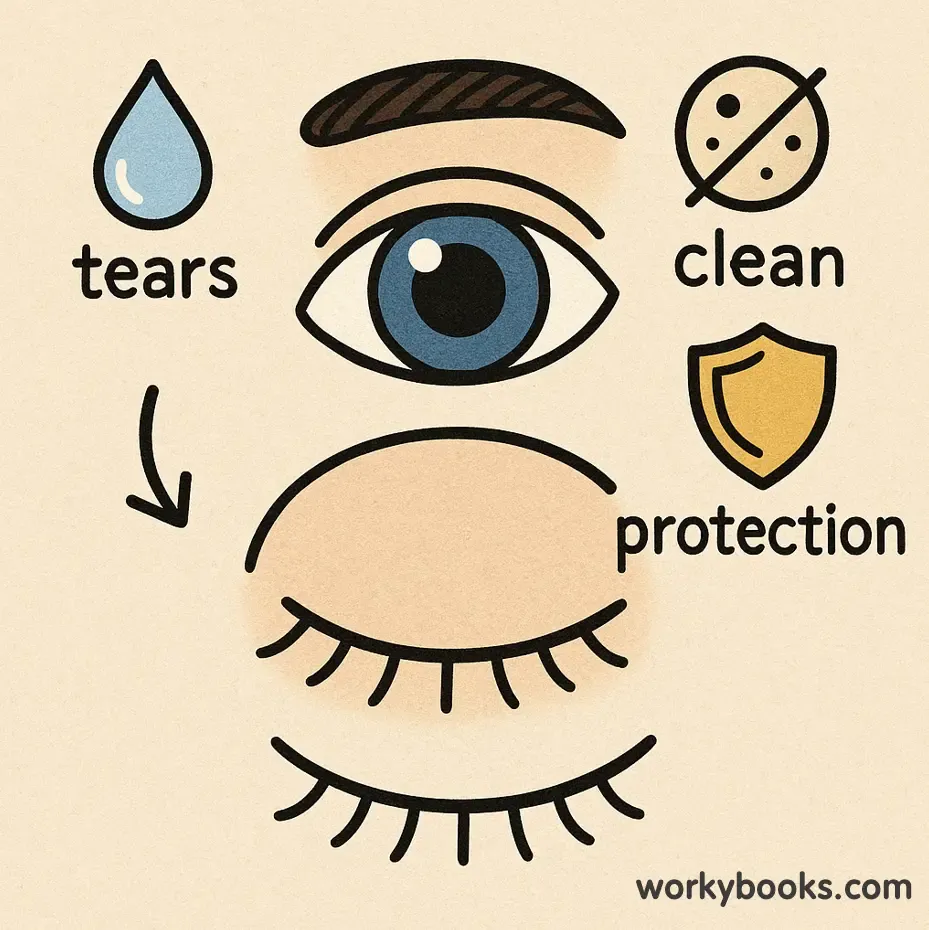
This picture shows the three main jobs of blinking: to keep our eyes moist with tears, to keep them clean from dust, and to protect them from harm.
Why Do We Blink?
Every minute, our eyes blink about 15 to 20 times. Blinking is an automatic action. We do not have to think about it. Our brain controls blinking, just like it controls breathing. Actions like this are called reflexes.
But why do we blink? Blinking is one of the amazing ways our body takes care of itself. When we blink, our eyelids quickly close and open. This helps spread tears across the surface of our eyes. Tears are not just made of water. They also have oil and mucus. Together, these keep our eyes wet, healthy, and comfortable.
Blinking also helps keep our eyes clean. Every time we blink, our eyelids act like tiny windshield wipers for our eyes. They wash away dust, dirt, and even germs that could make us sick.
Blinking is a form of protection. If something comes close to your face, you will blink to protect your eyes. If you see a bright light, you blink more to help shield your eyes. Blinking helps your eyes rest and stay moist, especially when you are tired or using a screen.
You can do a fun experiment: Try to keep your eyes open without blinking. It will feel uncomfortable after a few seconds! That’s because your eyes need blinking to stay healthy.
Interesting Fact: On average, a person blinks about 12,000 times each day! That’s a lot of eye care without even thinking about it.
What is blinking?
An automatic actionA sportA type of foodA musical note
How often do we blink per minute?
15-20 times1-2 times50-60 times100 times
What are tears made of?
Water, oil, mucusOnly waterOnly oilSand and salt
What is the main job of eyelids?
Protect eyesHear soundsHelp us jumpTaste food
Why do we blink more when tired?
To keep eyes moistTo sleepTo see betterTo make noise
What happens if dust gets in your eye?
You blink to remove itYou hear a soundYou taste itYou jump
Blinking is a reflex. True or false?
TrueFalse
What is a reflex?
An automatic actionA loud soundA kind of foodA musical note
Perfect For:
👩🏫 Teachers
• Reading comprehension practice
• Auto-graded assessments
• Literacy skill development
👨👩👧👦 Parents
• Reading practice at home
• Comprehension improvement
• Educational reading time
🏠 Homeschoolers
• Reading curriculum support
• Independent reading practice
• Progress monitoring
Reading Features:
📖
Reading Passage
Engaging fiction or nonfiction text
❓
Comprehension Quiz
Auto-graded questions
📊
Instant Feedback
Immediate results and scoring
📄
Printable Version
Download for offline reading
🔊
Read Aloud
Voice-over with word highlighting
Reviews & Ratings
No reviews yet. Be the first to share your experience!
Related Content
The Nature of Life Science
This passage, aligned with NGSS MS-LS1-1, introduces students in grades 6-8 to the foundational concepts of life science...
MS-LS1-1
Aerobic Organisms
This engaging, audio-integrated reading passage, titled 'Aerobic Organisms: The Breath of Life,' introduces students to ...
From Cells to Organisms
This educational passage, "From Cells to Organisms," explores the fundamental concept of how living things are built, st...
Using Dichotomous Keys to Identify Organisms
This audio-integrated passage, 'Using Dichotomous Keys to Identify Organisms,' introduces 6th-grade students to a fundam...
Science Vocabulary
This worksheet on domain-specific words will help students learn some science vocabulary. Students will be asked to matc...
L.3.6L.3.4.A
The Aorta: Molecules to Organisms of the Body's Largest Artery
This educational content features a fascinating reading passage, audio integrated for an enhanced learning experience, a...
Simple Machines Science Report
This science writing task requires students to clearly explain how three simple machines work using precise domain-speci...
W.5.4
Tools and Technology for Life Scientists
This informational passage for grades 6-8 explores the essential tools and technology used by life scientists, aligned t...
MS-LS1-1MS-LS1.A
Cryptobiosis: Pausing Life to Survive
This engaging, audio-integrated reading passage explores the amazing biological process of cryptobiosis, where organisms...
From Senses to Actions
This Grade 4-5 science passage, 'From Senses to Actions,' explores how our senses work together with the brain and body ...
The Science of Hibernation
This educational module, featuring an audio-integrated reading passage titled 'The Science of Hibernation,' is designed ...
The Life Cycle of a Giant Panda
This engaging, audio-integrated reading passage, titled "The Life Cycle of a Giant Panda," explores the fascinating stag...
How Bats Use Sound to See
This Grade 4-5 science passage, 'How Bats Use Sound to See,' explores the fascinating process of echolocation in bats. S...
Citizen Science and Ecological Monitoring
This engaging passage for grades 6-8 introduces the concept of citizen science and its critical role in ecological monit...
MS-LS2-1
The Pumpkin Life Cycle
This informational worksheet explores the pumpkin lifecycle, guiding students through procedural steps in a scientific t...
RI.2.3RI.2.10
Life Cycle Stages
This comprehensive word sort activity helps Grade 3 students understand the universal stages of life cycles as outlined ...
What Is Earth Science?
This engaging middle school science passage introduces students to the field of Earth science, aligning with NGSS standa...
MS-ESS1MS-ESS2MS-ESS3SEP
Growth and Development of Organisms
This middle school science passage, aligned with NGSS standards MS-LS1-4 and MS-LS1-5, provides an in-depth look at the ...
MS-LS1-4MS-LS1-5
Life Makers
This engaging word sort activity helps elementary students understand the diverse methods of reproduction in living orga...
Barnacles and Biofouling
This engaging, audio-integrated reading passage, 'Barnacles and Biofouling,' delves into the fascinating world of how ti...