Calicut: The Spice Port of India — Reading Comprehension
Rate this
Premium Resource
Present
Present in classroom. No work saved
Assign
Classroom with student accounts, Track progress
Quick Play
No student accounts, assign with a link
Grades
5
6
7
8
PRINT+DIGITAL RESOURCE
This learning resource is available in interactive and printable formats. The interactive worksheet can be played online and assigned to students. The Printable PDF version can be downloaded and printed for completion by hand.
This educational passage examines the crucial role of Calicut (Kozhikode) as a major spice port in ancient India. Students will learn about Calicut's geography, its rise as a bustling trade center, and its interactions with traders from Arabia, China, Africa, and Europe. The passage highlights archaeological evidence, historical records, and the significance of the Zamorin rulers. Activities include a multiple-choice quiz, writing prompts, graphic organizers, and a glossary of key vocabulary. The content is aligned with CA HSS 6.2 and CCSS RH.6-8.1, supporting world history and ELA literacy standards. Both an English and Spanish translation are included, along with audio support. Ideal for students studying sites of encounter in ancient civilizations and the global impact of the spice trade.
CONTENT PREVIEW
Expand content preview
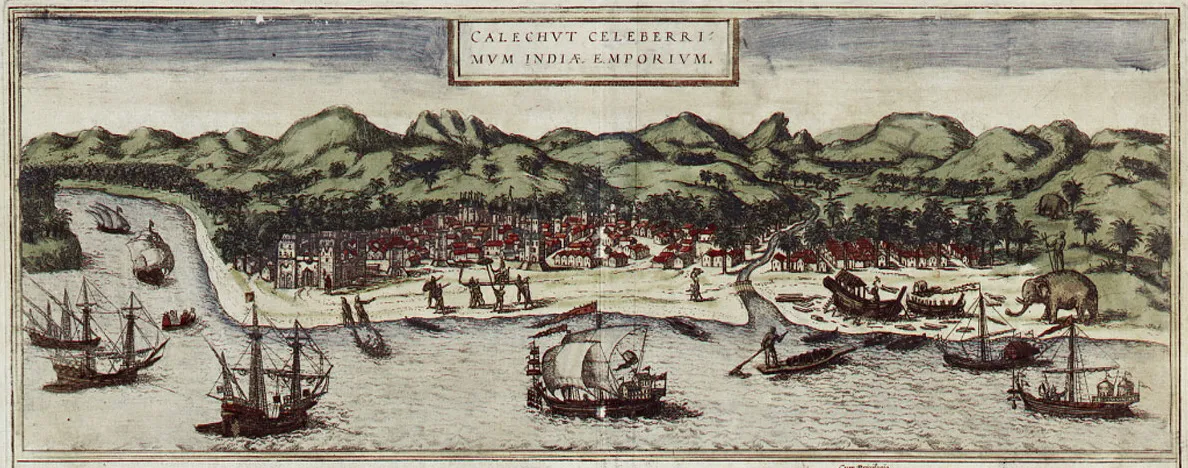
"Braun Calicut Kozhikode HAAB" by Georg Braun; Frans Hogenberg / Source: Wikimedia Commons (Public domain).
Calicut, also known as Kozhikode, was one of the most important ports in ancient India. Located on the Malabar Coast along the Arabian Sea, Calicut became famous for its role in the spice trade. By the 12th century CE, it had developed into a thriving center of international commerce. Merchants from Arabia, China, Africa, and Europe traveled to Calicut to buy and sell valuable spices such as pepper, cardamom, and cinnamon.
The geographic location of Calicut helped it become a powerful site of encounter for many cultures. The city was ruled by a line of Hindu kings known as the Zamorin. The Zamorin encouraged trade by offering protection and fair treatment to foreign merchants. Archaeological discoveries, such as ancient coins from China and Persia, and descriptions from Arab travelers like Ibn Battuta, show that Calicut was a cosmopolitan city. Its bustling markets were filled with goods from across Asia and Africa, and people spoke many different languages.
Calicut’s importance grew further in 1498, when Portuguese explorer Vasco da Gama arrived by sea. This event marked a turning point, as it linked Europe directly to India by ocean. The Portuguese were eager to control the spice trade and tried to take over Calicut’s market. However, the Zamorin and local merchants resisted. Over the next decades, Calicut remained a major trading port, even as European powers competed for influence along the Indian coast.
Life in Calicut was shaped by the spice trade. Rich merchants, skilled artisans, sailors, and laborers all played a role in the city’s busy economy. Spices were not only valuable but also shaped food, medicine, and even religious rituals across the world. The city’s social hierarchy reflected the importance of trade, with merchant families gaining wealth and influence. Calicut’s openness to foreigners created a unique blend of cultures and traditions.
Calicut’s history as a spice port shows how geography, culture, and economic opportunity combined to make it a true site of encounter. Its legacy continues today, reminding us of the power of trade to connect people around the world.
Interesting Fact: In 1406, Chinese explorer Zheng He visited Calicut with a fleet of ships, bringing gifts and establishing diplomatic relations.
This story connects to the broader theme of how ancient ports linked distant civilizations and created lasting cultural exchanges.
Where is Calicut located?
Malabar Coast, IndiaRed Sea, EgyptSouth China SeaMediterranean Sea
Who ruled Calicut in the Middle Ages?
The ZamorinThe PharaohThe MughalThe Roman Senate
Which explorer reached Calicut in 1498?
Vasco da GamaChristopher ColumbusMarco PoloZheng He
Why did traders come to Calicut?
To buy spicesTo find goldTo convert peopleTo build castles
How did the Zamorin encourage trade?
Protected merchantsBanned foreignersClosed the portRaised taxes
What was a result of Vasco da Gama's arrival?
Europe linked to India by seaSpice trade endedCalicut was destroyedIslam spread to China
Calicut was a site of encounter. (True/False)
TrueFalse
What does 'hierarchy' mean?
A ranking systemA type of shipA kind of spiceA market
Perfect For:
👩🏫 Teachers
• Reading comprehension practice
• Auto-graded assessments
• Literacy skill development
👨👩👧👦 Parents
• Reading practice at home
• Comprehension improvement
• Educational reading time
🏠 Homeschoolers
• Reading curriculum support
• Independent reading practice
• Progress monitoring
Reading Features:
📖
Reading Passage
Engaging fiction or nonfiction text
❓
Comprehension Quiz
Auto-graded questions
📊
Instant Feedback
Immediate results and scoring
📄
Printable Version
Download for offline reading
🔊
Read Aloud
Voice-over with word highlighting
Reviews & Ratings
No reviews yet. Be the first to share your experience!
Related Content
Ancient Civilizations and the Environment
This engaging history reading passage explores how ancient civilizations such as Mesopotamia, Egypt, and the Maya adapte...
Gender Roles in Ancient Civilizations
This engaging history reading passage explores the roles of men and women in various ancient civilizations, including Me...
Writing Prompts Ancient Civilizations
Step into the shoes of an archaeologist with this engaging worksheet focused on ancient civilizations. Students will be ...
W.5.2.A-2W.5.1.CW.5.1.D
Power and Authority in Ancient Civilizations
This passage explores the roles of men in positions of power within ancient civilizations, focusing on their authority i...
Evidence in Ancient History
This engaging history reading passage investigates how archaeologists and historians discover clues about how ancient pe...
Ancient Monarchy
This reading passage explores the concept of monarchy in ancient civilizations, focusing on the origins, structure, and ...
Ancient Theocracy
This engaging history reading passage explores the concept of theocracy in ancient civilizations, where priests and reli...
Ancient Mathematics
This passage explores the essential role of mathematics in ancient civilizations, including Mesopotamia, Egypt, Greece, ...
Ancient Canaan
This educational passage explores the land of Canaan, the historical homeland of the ancient Israelites. Students will l...
Ancient Money Barter
This passage explores the fascinating evolution from barter to the earliest coins in ancient civilizations, focusing on ...
Ancient Science and Medicine
This comprehensive reading passage explores the development of science and medicine in ancient civilizations, including ...
Ancient Literature
This passage explores the importance of ancient stories and poems from civilizations such as Greece, India, and Israel. ...
Ancient Agriculture Farming
This passage explores the transformative impact of farming on ancient societies, examining how the Neolithic Revolution ...
Ancient Writing Systems
This engaging history reading passage explores the origins and evolution of ancient writing systems, including cuneiform...
Geography of Ancient Israel
This passage explores the rich geography of Ancient Israel, focusing on how landforms, climate, and natural resources sh...
Slavery Across Civilizations
This detailed history reading passage explores the role and impact of slavery across several ancient civilizations, incl...
Social Classes in Ancient Societies
This passage explores the concept of social hierarchies in ancient civilizations, focusing on why societies such as Meso...
Social structures in Ancient World
This passage explores the organization and significance of family life in ancient societies, focusing on how extended fa...
Polytheism and Monotheism in Ancient Times
This passage explores the religious beliefs of ancient civilizations, focusing on the differences and similarities betwe...
Women in Ancient Societies
This reading passage explores the complex roles of women in the ancient world, focusing on civilizations such as Mesopot...