California Agriculture Growth — Reading Comprehension
Rate this
Premium Resource
Present
Present in classroom. No work saved
Assign
Classroom with student accounts, Track progress
Quick Play
No student accounts, assign with a link
Grades
3
4
5
Standards
HSS 4.4.6
RH.6-8.2
PRINT+DIGITAL RESOURCE
This learning resource is available in interactive and printable formats. The interactive worksheet can be played online and assigned to students. The Printable PDF version can be downloaded and printed for completion by hand.
This passage explores the remarkable growth of California's agriculture during the Progressive Era, focusing on how the state overcame its dry climate to become America's leading farming producer. Students will learn about the importance of irrigation, the development of the Central Valley, and the key role played by immigrant workers from around the world. The text highlights problem-solving, unity, and innovation as farmers worked together to build canals and use new technology. Activities include a glossary of key terms, multiple-choice quiz, writing prompts, a timeline, and graphic organizers to reinforce understanding. The passage aligns with HSS 4.4.6 and RH.6-8.2 standards and includes read aloud audio and a Spanish translation, making it an engaging and accessible resource for learning about U.S. agricultural history.
CONTENT PREVIEW
Expand content preview
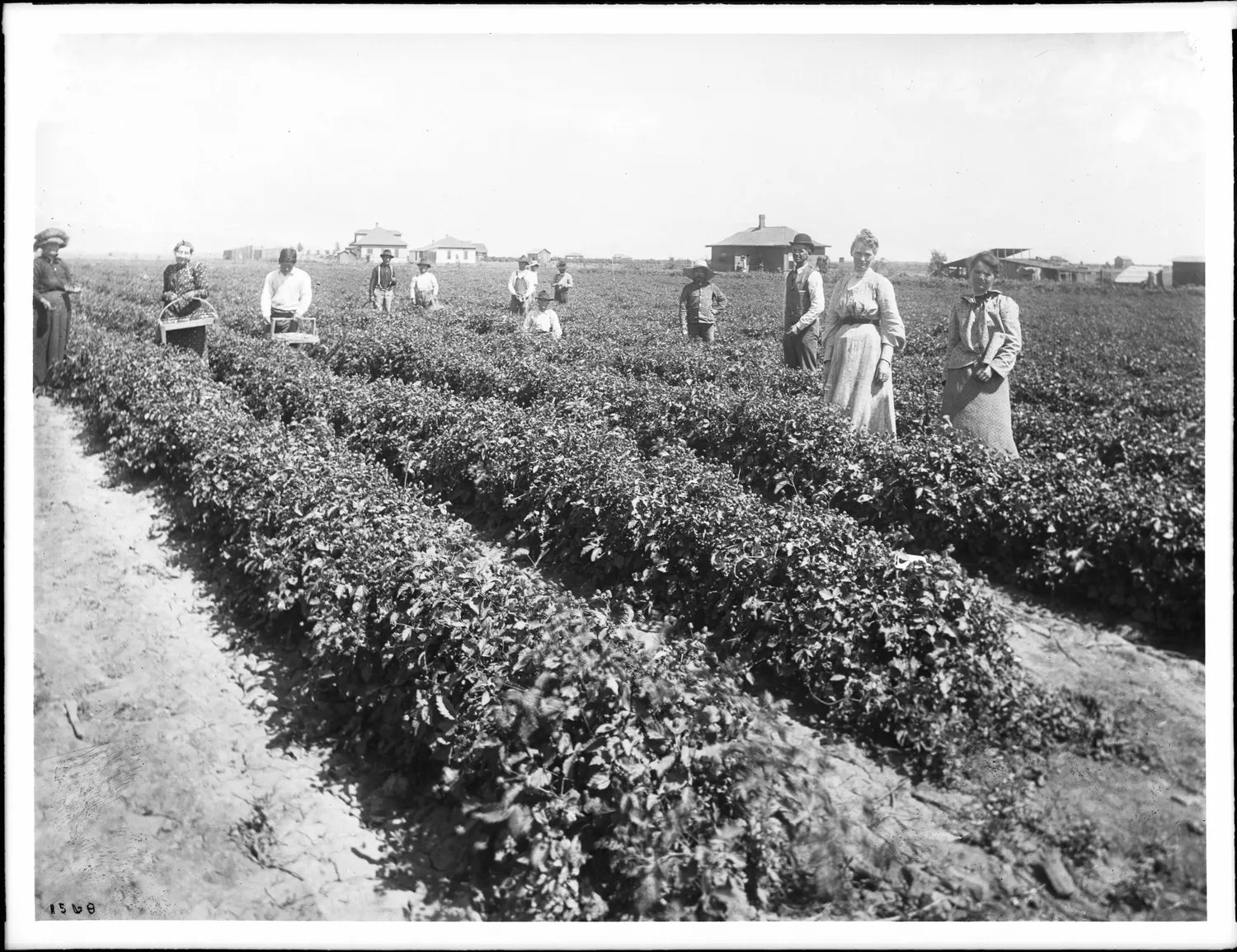
"Group of people picking dewberries (blackberries), Riverside(?), California, ca.1900-1920 (CHS-1568)" by Unknown author / Wikimedia Commons (Public domain).
During the Progressive Era, California became the top farming state in the United States. The state’s rise in agriculture happened because of irrigation, the Central Valley’s rich soil, and the hard work of people from many backgrounds.
California’s climate has little rain, so growing crops was very difficult at first. Farmers needed to find a way to bring water to their fields. In the late 1800s, they started building canals and ditches to move water from rivers and mountains. This system is called irrigation. Irrigation allowed farmers to grow crops like fruits, vegetables, and nuts in areas that would normally be too dry.
The Central Valley became the heart of California agriculture. Its soil was deep and fertile, perfect for farming. With irrigation, fields could bloom with many kinds of crops. Oranges, grapes, tomatoes, and almonds all grew in the valley. The Central Valley’s farms became so successful that they began to feed people all across the United States.
As farms grew larger, they needed more workers. People came from many places to work in California’s fields. Chinese, Japanese, Mexican, Filipino, and European immigrants joined local workers to plant and harvest crops. Their hard work made California’s farms even more productive. This diverse group of people shaped the history and culture of the state.
Another important change was the arrival of the railroad. Trains made it possible to move crops quickly from California to big cities in the east. Farmers could now sell their fruits and vegetables across the country. This meant more people could enjoy California’s fresh produce, and farming families earned more money.
California’s agricultural expansion brought many benefits. The state became a leader in farming and created jobs for thousands of people. New inventions, like mechanical harvesters and better irrigation pumps, helped farms grow even more. Farmers worked together to solve problems and improve their communities.
In the end, the growth of California agriculture shows how people can solve problems with teamwork, new ideas, and hard work. The story of California’s farms is a story of change, hope, and success.
Interesting Fact: California now produces over one-third of all vegetables and two-thirds of all fruits and nuts grown in the United States!
What helped California farms get water?
Irrigation canalsHeavy rainfallWindmillsOceans
Which valley became the farming center?
Central ValleyDeath ValleyNapa ValleySilicon Valley
Who worked on California farms?
Immigrants and localsOnly local peopleOnly machinesOnly children
How did railroads help farmers?
Moved crops to citiesBrought more rainBuilt new canalsPlanted trees
Why was irrigation needed?
There was not much rainThere was too much snowTo build more trainsBecause of earthquakes
What was a result of new machines?
Farms grew biggerLess crops grewTrains stopped comingPeople left the farms
California produces most U.S. fruit. True or false?
TrueFalse
What does 'productive' mean?
Making a lotMoving slowlyUsing waterBeing expensive
Perfect For:
👩🏫 Teachers
• Reading comprehension practice
• Auto-graded assessments
• Literacy skill development
👨👩👧👦 Parents
• Reading practice at home
• Comprehension improvement
• Educational reading time
🏠 Homeschoolers
• Reading curriculum support
• Independent reading practice
• Progress monitoring
Reading Features:
📖
Reading Passage
Engaging fiction or nonfiction text
❓
Comprehension Quiz
Auto-graded questions
📊
Instant Feedback
Immediate results and scoring
📄
Printable Version
Download for offline reading
🔊
Read Aloud
Voice-over with word highlighting
Reviews & Ratings
No reviews yet. Be the first to share your experience!
Related Content
California Water Resources
This engaging U.S. history reading passage explores how California’s need for water shaped its growth during the Progres...
HSS 4.4.6RH.6-8.4
Juan Bautista de Anza's Expedition
This reading passage explores the remarkable journey of Juan Bautista de Anza and his expedition from Mexico to Californ...
HSS 4.2.3RH.6-8.2
How Explorers Changed California
This engaging U.S. History reading passage explores how explorers from Europe transformed California through the Columbi...
HSS 4.2.2RH.6-8.2
California Mining Camps
This engaging history reading passage explores the world of California mining camps during the Gold Rush, aligning with ...
HSS 4.4.2RH.6-8.2
San Francisco Growth
This comprehensive U.S. history passage explores the rapid growth of San Francisco during the California Gold Rush. Stud...
HSS 4.4.3RH.6-8.2
Transcontinental Railroad
This reading passage explores the history and importance of the Transcontinental Railroad, which was completed in 1869. ...
HSS 4.4.1RH.6-8.2
California Progressive Era
This engaging reading passage explores the California Progressive Era, a crucial period in U.S. history when reformers l...
HSS 4.5.2RH.6-8.2
California Citizen Participation
This engaging U.S. History reading passage explores California citizen participation, focusing on how ordinary people he...
HSS 4.5.5RH.6-8.2
Meroë: Capital of Kush
This passage explores the rise and significance of Meroë, once the capital of the Kingdom of Kush in ancient Africa. Loc...
CA HSS 6.2.6RH.6-8.1RH.6-8.2WHST.6-8.2
New Kingdom Egypt
This engaging history reading passage explores the rise of Ancient Egypt during the New Kingdom, when Egypt became a pow...
CA HSS 6.2RH.6-8.2WHST.6-8.2
First Humans
This engaging history reading passage explores the evolution of early humans, tracing the journey from the earliest homi...
CA HSS 6.1RH.6-8.1RH.6-8.2W.6.2
Han Dynasty: Wheelbarrow
This passage explores the invention and historical significance of the wheelbarrow during the Han dynasty in ancient Chi...
CA HSS 6.6CCSS RH.6-8.1RH.6-8.2RH.6-8.4
Han Dynasty: Seismograph
Discover the groundbreaking invention of the seismograph during the Han dynasty in ancient China in this engaging histor...
HSS 6.6.7RH.6-8.1RH.6-8.2WHST.6-8.2
Early Human Migration
This comprehensive history reading passage explores the Out of Africa movement and how early humans migrated across cont...
CA HSS 6.1.1CCSS RH.6-8.1RH.6-8.2RH.6-8.4
Paleolithic Migration by Land and Sea
This passage explores the migration of Paleolithic humans from Africa to the rest of the world, focusing on the routes t...
6.1RH.6-8.1RH.6-8.2RH.6-8.4
Origins of Social Classes
This engaging history reading passage explores how the rise of farming and the spread of pastoral nomads across the Eura...