China After the Han: The Jin Dynasty — Reading Comprehension
Rate this
Premium Resource
Present
Present in classroom. No work saved
Assign
Classroom with student accounts, Track progress
Quick Play
No student accounts, assign with a link
Grades
5
6
7
8
PRINT+DIGITAL RESOURCE
This learning resource is available in interactive and printable formats. The interactive worksheet can be played online and assigned to students. The Printable PDF version can be downloaded and printed for completion by hand.
This passage examines the period in Chinese history after the fall of the Han Dynasty, focusing on the rise, achievements, and challenges of the Jin Dynasty. Students will explore the reunification of China under the Jin, its struggles with internal division and external threats, and the significance of these events in shaping later Chinese civilization. The text highlights primary sources, such as the 'Book of Jin,' and archaeological discoveries to deepen historical understanding. Key vocabulary is integrated, and the passage addresses social structure, governance, and geographic context. Designed for alignment with CA HSS 6.6.7 and CCSS.ELA-LITERACY.RI.6.3, this resource includes a read aloud audio, Spanish translation, and multiple standards-based activities such as comprehension quizzes, writing prompts, and graphic organizers. Ideal for teaching about continuity, change, and cause-and-effect in ancient civilizations.
CONTENT PREVIEW
Expand content preview
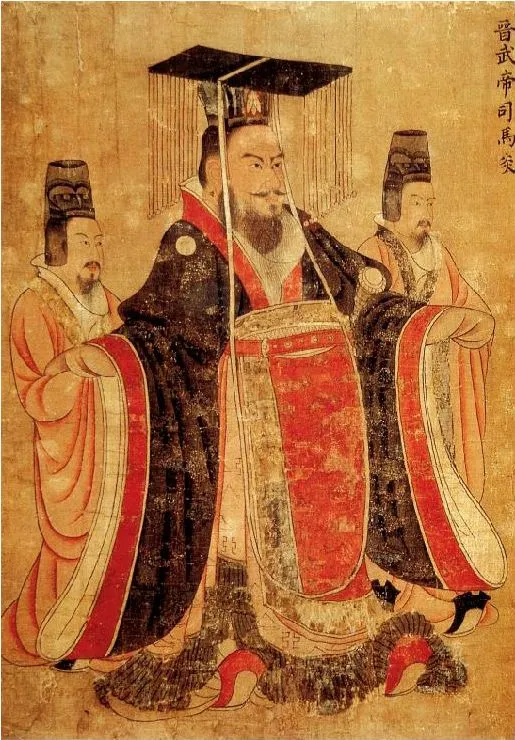
Emperor Wu of Jin. Wikimedia Commons (Public domain).
The Han Dynasty ended in 220 CE, leading to a period of great political division in China known as the Three Kingdoms period. In 265 CE, the Jin Dynasty arose, uniting much of China under one rule. The Jin Dynasty provides a crucial link between the ancient Han and later dynasties, shaping the future of Chinese civilization.
The Jin Dynasty was founded by Sima Yan, also known as Emperor Wu of Jin, who overthrew the Wei kingdom and declared himself emperor in 266 CE. By 280 CE, the Jin forces had conquered the rival kingdoms of Shu and Wu, ending the Three Kingdoms era and bringing most of China back under a single government. This reunification was a significant achievement, as China had been divided and plagued by wars for decades. The Jin capital was established in Luoyang, a major city on the Yellow River, which became a center of administration, culture, and trade.
Despite reunification, the Jin Dynasty faced serious challenges. Powerful aristocrats owned vast lands and often ignored imperial authority, leading to political instability. The government struggled to control regions far from the capital, and conflicts among noble families led to the disastrous War of the Eight Princes (291–306 CE). This civil war weakened the Jin, making it vulnerable to invasions by nomadic groups from the north, such as the Xiongnu and Xianbei. By 316 CE, the Western Jin Dynasty collapsed when its capital was captured by invading forces. However, members of the Jin royal family fled south and established the Eastern Jin Dynasty, continuing the dynasty in a new region.
Archaeological evidence, such as tombs and official documents, reveals details about daily life and social structure during the Jin era. For example, the tomb of Sima Jinlong, a Jin prince, contained beautiful pottery, metalwork, and inscriptions that show the importance of family status and Confucian values. The Book of Jin, a primary source written in the 7th century, records the dynasty's history and provides insight into the challenges faced by rulers and commoners alike.
The Jin Dynasty's brief reunification of China set the stage for future dynasties and influenced Chinese art, literature, and government. Its struggles with internal conflict and foreign invasions highlight the importance of strong leadership and unity. The legacy of the Jin can be seen in the continued development of Chinese civilization, especially in the south, where the Eastern Jin preserved many traditions and cultural achievements.
Studying the Jin Dynasty helps us understand how societies respond to division, war, and change, connecting to the broader theme of how ancient civilizations adapt and shape their futures.
Interesting Fact: The famous Chinese board game Go was especially popular among Jin aristocrats, symbolizing intelligence and strategy.
When did the Han Dynasty end?
220 CE266 CE280 CE316 CE
Who founded the Jin Dynasty?
Sima YanLiu BeiCao CaoSun Quan
What was the Jin capital?
LuoyangBeijingNanjingXi'an
What caused the Jin Dynasty's internal chaos?
War of the Eight PrincesForeign invasionsFamineFloods
Why did the Western Jin collapse?
Invasion from the northPlagueDroughtReforms
What did the tomb of Sima Jinlong show?
Family status importanceMilitary powerTrade routesForeign alliances
The Book of Jin is a primary source. True or false?
TrueFalse
What is an aristocrat?
Rich nobleFarmerSoldierTrader
Perfect For:
👩🏫 Teachers
• Reading comprehension practice
• Auto-graded assessments
• Literacy skill development
👨👩👧👦 Parents
• Reading practice at home
• Comprehension improvement
• Educational reading time
🏠 Homeschoolers
• Reading curriculum support
• Independent reading practice
• Progress monitoring
Reading Features:
📖
Reading Passage
Engaging fiction or nonfiction text
❓
Comprehension Quiz
Auto-graded questions
📊
Instant Feedback
Immediate results and scoring
📄
Printable Version
Download for offline reading
🔊
Read Aloud
Voice-over with word highlighting
Reviews & Ratings
No reviews yet. Be the first to share your experience!
Related Content
Ancient Civilizations and the Environment
This engaging history reading passage explores how ancient civilizations such as Mesopotamia, Egypt, and the Maya adapte...
Gender Roles in Ancient Civilizations
This engaging history reading passage explores the roles of men and women in various ancient civilizations, including Me...
Writing Prompts Ancient Civilizations
Step into the shoes of an archaeologist with this engaging worksheet focused on ancient civilizations. Students will be ...
W.5.2.A-2W.5.1.CW.5.1.D
Power and Authority in Ancient Civilizations
This passage explores the roles of men in positions of power within ancient civilizations, focusing on their authority i...
Evidence in Ancient History
This engaging history reading passage investigates how archaeologists and historians discover clues about how ancient pe...
Ancient Monarchy
This reading passage explores the concept of monarchy in ancient civilizations, focusing on the origins, structure, and ...
Ancient Theocracy
This engaging history reading passage explores the concept of theocracy in ancient civilizations, where priests and reli...
Ancient Mathematics
This passage explores the essential role of mathematics in ancient civilizations, including Mesopotamia, Egypt, Greece, ...
Ancient Canaan
This educational passage explores the land of Canaan, the historical homeland of the ancient Israelites. Students will l...
Ancient Money Barter
This passage explores the fascinating evolution from barter to the earliest coins in ancient civilizations, focusing on ...
Ancient Science and Medicine
This comprehensive reading passage explores the development of science and medicine in ancient civilizations, including ...
Ancient Literature
This passage explores the importance of ancient stories and poems from civilizations such as Greece, India, and Israel. ...
Ancient Agriculture Farming
This passage explores the transformative impact of farming on ancient societies, examining how the Neolithic Revolution ...
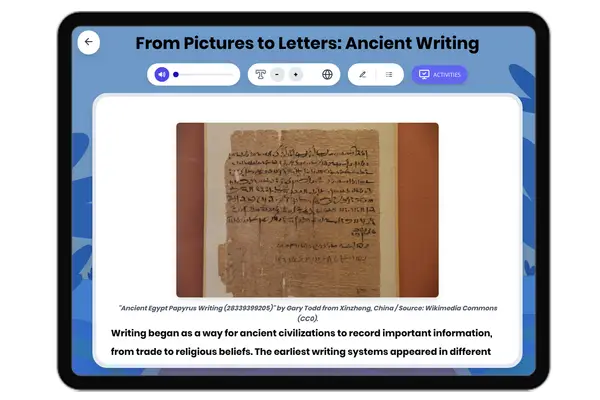
Ancient Writing Systems
This engaging history reading passage explores the origins and evolution of ancient writing systems, including cuneiform...
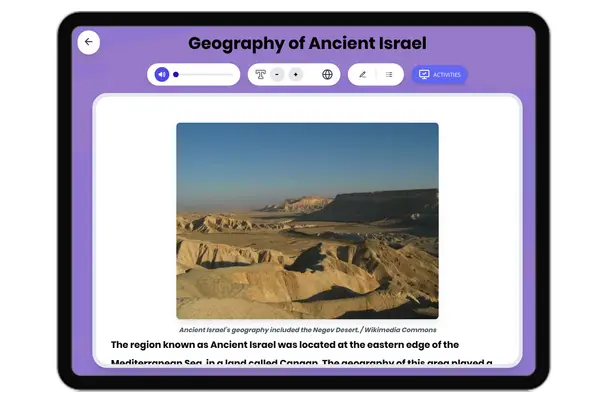
Geography of Ancient Israel
This passage explores the rich geography of Ancient Israel, focusing on how landforms, climate, and natural resources sh...
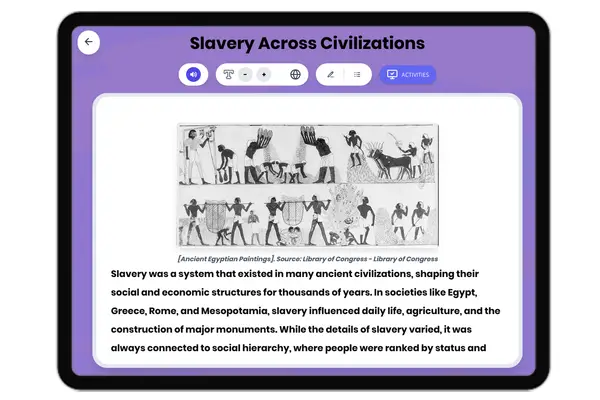
Slavery Across Civilizations
This detailed history reading passage explores the role and impact of slavery across several ancient civilizations, incl...
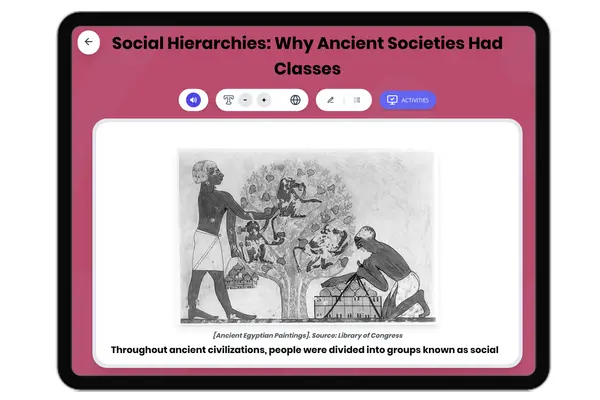
Social Classes in Ancient Societies
This passage explores the concept of social hierarchies in ancient civilizations, focusing on why societies such as Meso...
Social structures in Ancient World
This passage explores the organization and significance of family life in ancient societies, focusing on how extended fa...
Polytheism and Monotheism in Ancient Times
This passage explores the religious beliefs of ancient civilizations, focusing on the differences and similarities betwe...
Women in Ancient Societies
This reading passage explores the complex roles of women in the ancient world, focusing on civilizations such as Mesopot...