This learning resource is available in interactive and printable formats. The interactive worksheet can be played online and assigned to students. The Printable PDF version can be downloaded and printed for completion by hand.
This detailed history reading passage invites students to explore the ancient Sumerian city-state of Ur, one of the most important urban centers of early Mesopotamia. Aligned with HSS 6.2.3 and CCSS RI.6-8, the passage covers the city’s social hierarchy, monumental architecture, and daily life, referencing archaeological discoveries such as the Royal Tombs and ziggurat. Students will learn about Ur's geographic setting near the Euphrates River, its use of cuneiform writing, and its role in the development of civilization. The passage includes a glossary, differentiated and Spanish versions, multiple-choice and writing activities, and graphic organizers—plus a timeline and public domain image. This resource, with read aloud audio and Spanish translation, supports close reading, vocabulary acquisition, and historical analysis for middle school learners.
CONTENT PREVIEW
Expand content preview
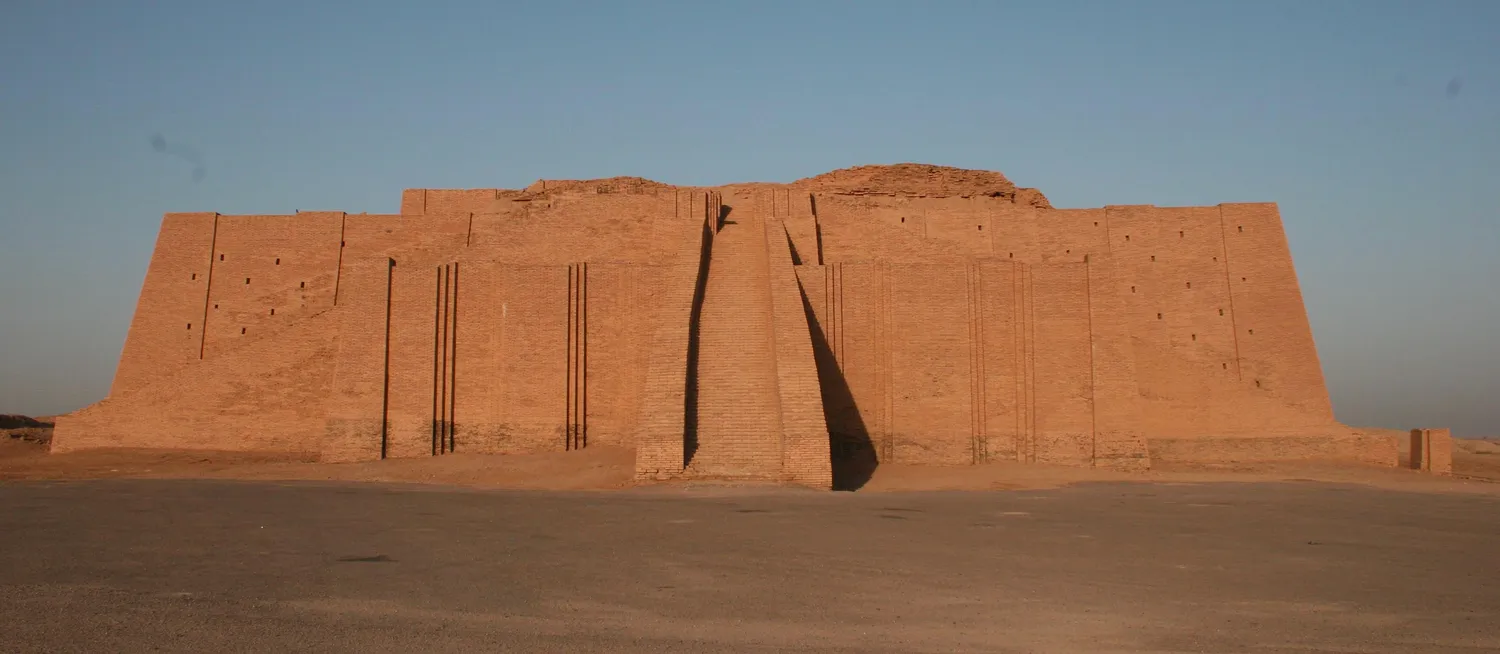
"Ziggarat of Ur. Tla2006 at English Source: Wikimedia Commons
The ancient city of Ur was one of the most influential city-states in Sumer, located in southern Mesopotamia near the Euphrates River. Evidence suggests that Ur reached its peak around 2100 BCE, when it became a center of trade, religion, and government. Archaeologists have uncovered remains of Ur’s impressive buildings, providing insight into ancient Sumerian life.
At the heart of Ur stood the massive ziggurat, a stepped temple dedicated to the moon god Nanna. This structure, built with mud-bricks, towered high above the city and served as a religious and social center. Priests conducted rituals here, and citizens gathered for festivals. The ziggurat was surrounded by administrative buildings, markets, and homes made from sun-dried bricks. Streets were narrow and winding, reflecting the city’s organic growth over centuries.
The people of Ur developed a complex social hierarchy. The ruling class included kings, priests, and wealthy merchants. Most citizens were artisans, traders, farmers, or laborers. Slaves—often prisoners of war—occupied the lowest social ranks. Daily life in Ur was shaped by its environment. Because the region’s climate was dry, Sumerians built an advanced irrigation system to bring water from the Euphrates River to their fields, allowing them to grow crops such as barley and dates. This agricultural surplus supported population growth and economic activity.
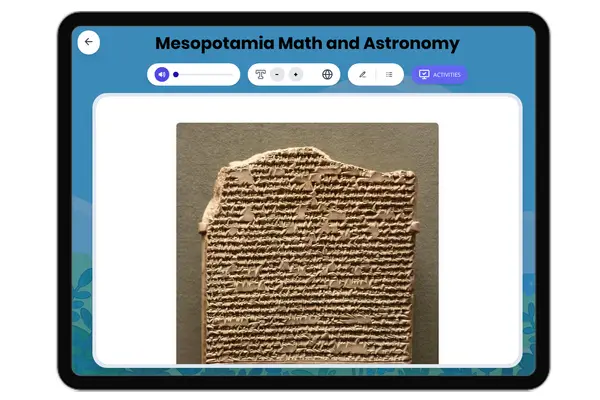
Ur was also known for its advances in writing and record-keeping. Sumerians developed cuneiform, one of the world’s earliest writing systems, pressed into clay tablets with a reed stylus. Archaeologists have discovered thousands of these tablets in Ur, containing information about trade, laws, and daily transactions. The famous Royal Tombs of Ur, excavated by Sir Leonard Woolley in the 1920s, revealed treasures such as gold jewelry, musical instruments, and elaborate headdresses, showing the wealth and artistry of Sumerian society.
Ur’s location near the Persian Gulf made it a hub for long-distance trade. Merchants exchanged goods like wool, grain, and pottery for resources not found locally, such as copper and precious stones. Over time, shifts in the Euphrates River’s course and changing trade routes led to Ur’s decline. By 500 BCE, the city was largely abandoned, but its legacy continued through later civilizations of Mesopotamia.
Studying Ur helps historians understand how geography, technology, and social organization shaped one of the world’s earliest urban societies. Its ruins provide evidence of religious beliefs, economic systems, and daily life in ancient Mesopotamia, connecting to broader themes of cultural development and human innovation.
Interesting Fact: The Ziggurat of Ur has been partially restored and still stands in modern-day Iraq, offering a glimpse into the grandeur of Sumerian architecture.
Where was Ur located?
Southern MesopotamiaNorthern EgyptCentral GreeceWestern India
Who was the ziggurat dedicated to?
Moon god NannaSun god RaGoddess IshtarGod Marduk
What writing system did Sumerians invent?
CuneiformHieroglyphicsAlphabetRunes
Why did Sumerians build irrigation systems?
To water crops in dry climateTo defend the cityTo build templesFor religious rituals
What did the Royal Tombs reveal?
Wealth and artistryMilitary secretsFarming methodsModern tools
How did Ur’s location help it?
Allowed long-distance tradeProtected from floodsGave access to forestsHad many gold mines
Ur was abandoned by 500 BCE. True or false?
TrueFalse
What is a ziggurat?
A stepped templeA riverA clay tabletA farm tool
Perfect For:
👩🏫 Teachers
• Reading comprehension practice
• Auto-graded assessments
• Literacy skill development
👨👩👧👦 Parents
• Reading practice at home
• Comprehension improvement
• Educational reading time
🏠 Homeschoolers
• Reading curriculum support
• Independent reading practice
• Progress monitoring
Reading Features:
📖
Reading Passage
Engaging fiction or nonfiction text
❓
Comprehension Quiz
Auto-graded questions
📊
Instant Feedback
Immediate results and scoring
📄
Printable Version
Download for offline reading
🔊
Read Aloud
Voice-over with word highlighting
Reviews & Ratings
No reviews yet. Be the first to share your experience!
Related Content
Daily Life in Ancient Mesopotamia
This engaging history reading passage explores daily life in ancient Mesopotamia, focusing on the social structure, role...
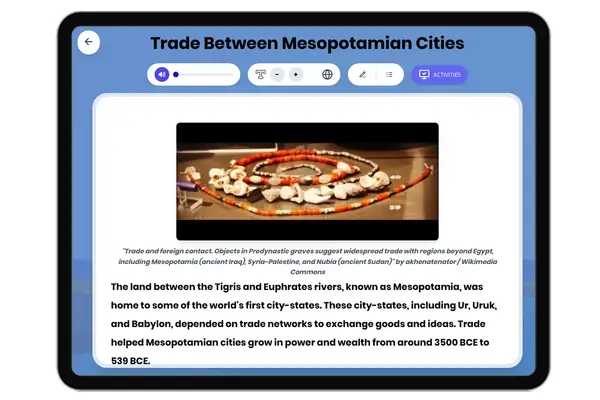
Trade Between Mesopotamian Cities
This history reading passage explores the development and significance of trade networks among ancient Mesopotamian citi...
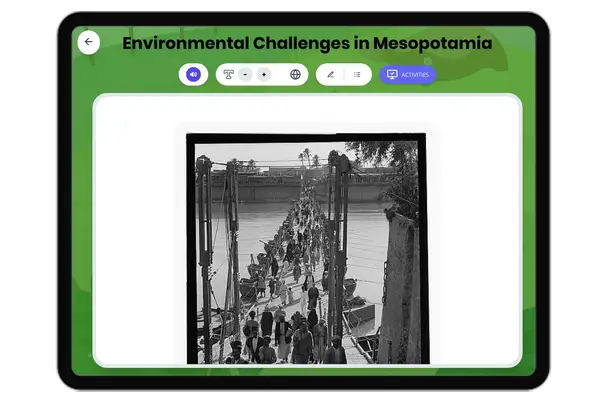
Environmental Challenges in Mesopotamia
This reading passage explores the environmental challenges faced by ancient Mesopotamia, the 'land between the rivers.' ...
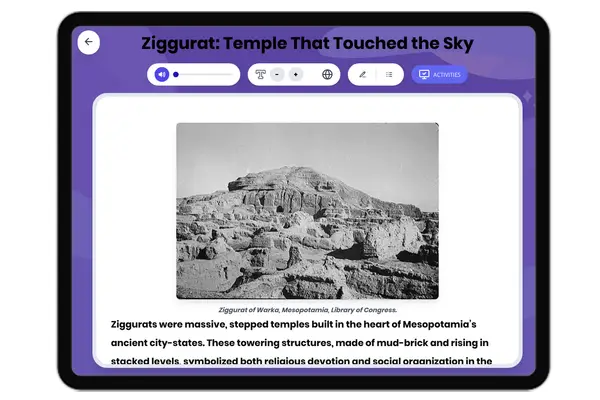
Mesopotamia Ziggurats
This engaging history reading passage explores the awe-inspiring ziggurats of ancient Mesopotamia, focusing on their con...
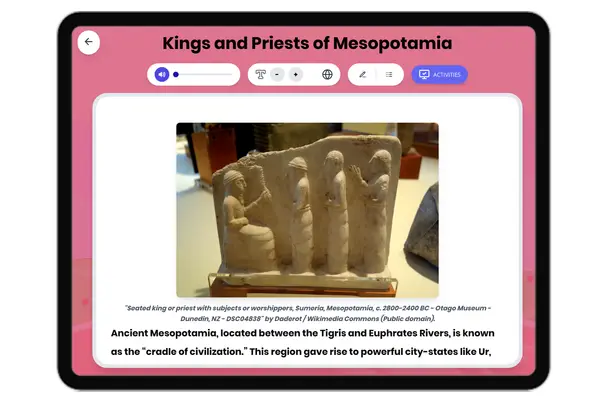
Mesopotamian Kings and Priests
This reading passage explores the complex relationship between power, religion, and patriarchy in Ancient Mesopotamia, f...
Mesopotamia Agriculture
This engaging reading passage explores how the geography of Mesopotamia shaped its civilization through innovative irrig...
Math and Astronomy in Mesopotamia
This engaging passage explores the scientific achievements of ancient Mesopotamia, the region between the Tigris and Eup...
Persian Empire in Mesopotamia
This engaging passage explores the rise of the Persian Empire and its impact on Mesopotamia, aligning with CA HSS 6.2 an...
Mesopotamian Inventions: Wheel, Plow, and More
This passage explores the major inventions of ancient Mesopotamia, focusing on technological breakthroughs such as the w...
Life Under Mesopotamian Empire
This passage explores the transformation of Mesopotamian life under powerful empires, including Sargon’s Akkadian Empire...
Evidence in Ancient History
This engaging history reading passage investigates how archaeologists and historians discover clues about how ancient pe...
Assyrian and Babylonian Empires
This comprehensive history reading passage explores the rise and fall of Assyria and Babylon, two great empires that rul...
The Tigris and Euphrates Rivers
This engaging history reading passage explores the vital role of the Tigris and Euphrates rivers in the development of a...
Ancient Greek City-States
This history reading passage explores the development and significance of city-states in ancient civilizations, focusing...
Code of Hammurabi
This rigorous history reading passage explores Hammurabi's Code, one of the earliest and most influential legal codes in...
Ancient Agriculture Farming
This passage explores the transformative impact of farming on ancient societies, examining how the Neolithic Revolution ...
Epic of Gilgamesh
This engaging passage delves into The Epic of Gilgamesh, the oldest known epic poem and a key artifact from ancient Meso...
Ancient Mathematics
This passage explores the essential role of mathematics in ancient civilizations, including Mesopotamia, Egypt, Greece, ...
Women in Ancient Societies
This reading passage explores the complex roles of women in the ancient world, focusing on civilizations such as Mesopot...
Mesopotamia—Informatonal Text
This informational text on Mesopotamia is a great way to practice reading comprehension. Students will read the text the...