Density and Floating
Interactive passage with audio narration, comprehension questions, and printable PDF.
By completing this purchase you agree to our Terms of Use and Privacy Policy. Your subscription renews automatically until you cancel. You can cancel anytime from your account settings. All sales are final and non-refundable. Digital content is available for download in your account immediately upon purchase.
What's included
Density and Floating preview and details
About this printable Density and Floating science reading passage, NGSS-aligned (Grades 5-8)
Sample passage and quiz from Density and Floating
Reading passage and comprehension quiz preview
Density and Floating

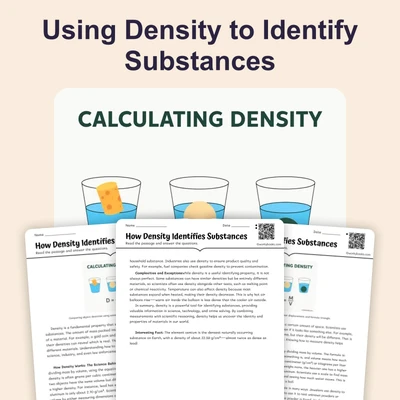
Density determines whether an object will float or sink when placed in a fluid such as water. This property is central to fields like engineering, environmental science, and even climate studies. When objects are placed in water, some float while others sink. Understanding the relationships between mass, volume, and density helps us explain these observations and design technology that interacts safely with water.
How Density Affects Floating and Sinking
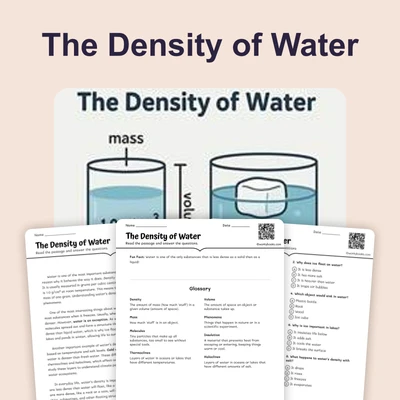
Density is defined as the amount of mass in a given volume, usually measured in grams per cubic centimeter (g/cm³). Water has a density of 1 g/cm³. If an object’s density is less than water’s, it will float; if it is greater, it will sink. For example, a wooden block with a density of 0.7 g/cm³ floats, while a rock with a density of 2.5 g/cm³ sinks. The reason is that objects with lower density than water experience a greater buoyant force pushing them upward than their weight pulling them downward. This cause-and-effect relationship is a key principle in physical science and engineering.
Applications: Steel Ships and Floating Ice
It may seem puzzling that a steel ship floats while a solid steel ball sinks. Steel itself has a density around 7.8 g/cm³, much higher than water. However, ships are designed with hollow spaces filled with air, lowering their average density below 1 g/cm³. This allows the overall vessel to float. This application of density is crucial for transportation, trade, and economy. Another example is ice floating on water. Ice has a density of about 0.92 g/cm³, which is less than liquid water. That’s why ice cubes float in a glass and why polar ice forms on the surface of oceans and lakes. The floating ice insulates the water below, protecting aquatic life from freezing temperatures.
Density, Environment, and Scientific Understanding
The behavior of floating ice has major impacts on Earth’s climate and ecosystems. If ice sank, bodies of water would freeze from the bottom up, threatening aquatic life and disrupting global climate patterns. Scientists use precise tools to measure density and study its effects, from designing safer ships to predicting changes in polar regions. Understanding density and floating connects to larger scientific concepts such as matter properties, states of matter, and conservation of mass.
Density is not just a number—it shapes the world around us, from the ships we build to the survival of entire ecosystems. Mastery of this concept helps us solve real-world problems and reveals the interconnectedness of science and society.
Interesting Fact: Saturn’s average density is so low (about 0.7 g/cm³) that the planet would float in a gigantic bathtub of water!
Comprehension quiz (10 questions)
1. What is the main factor that determines if an object will float or sink in water?
2. What is the density of water in grams per cubic centimeter (g/cm³)?
3. According to the passage, why does a steel ship float while a steel ball sinks?
4. Which of these objects will sink in water based on its density?
5. What is the main function of floating ice for aquatic environments?
6. What does the term 'buoyant force' mean as used in the passage?
7. What might happen if ice sank instead of floated?
8. Which statement best summarizes the passage's main idea?
9. True or False: A wooden block with a density of 0.7 g/cm³ will float in water.
10. True or False: The average density of a steel ship is higher than the density of water.
Perfect for the way you teach
- Build comprehension skills
- Auto-graded quiz
- Differentiated reading
- Read together at home
- Improve fluency
- Quiet reading time
- Reading curriculum support
- Independent practice
- Track Lexile growth