Types of Radiation
Interactive passage with audio narration, comprehension questions, and printable PDF.
By completing this purchase you agree to our Terms of Use and Privacy Policy. Your subscription renews automatically until you cancel. You can cancel anytime from your account settings. All sales are final and non-refundable. Digital content is available for download in your account immediately upon purchase.
What's included
Types of Radiation preview and details
About this printable Types of Radiation science reading passage, NGSS-aligned (Grades 5-8)
Sample passage and quiz from Types of Radiation
Reading passage and comprehension quiz preview
Types of Radiation
Radiation is a process where energy travels from one place to another, often in the form of particles or waves. In science, understanding different types of radiation is essential because they affect both living things and the environment. The three main types are alpha particles, beta particles, and gamma rays. Each type has unique properties and interacts with matter differently, leading to various uses and dangers.
Alpha Particles: Structure and Behavior
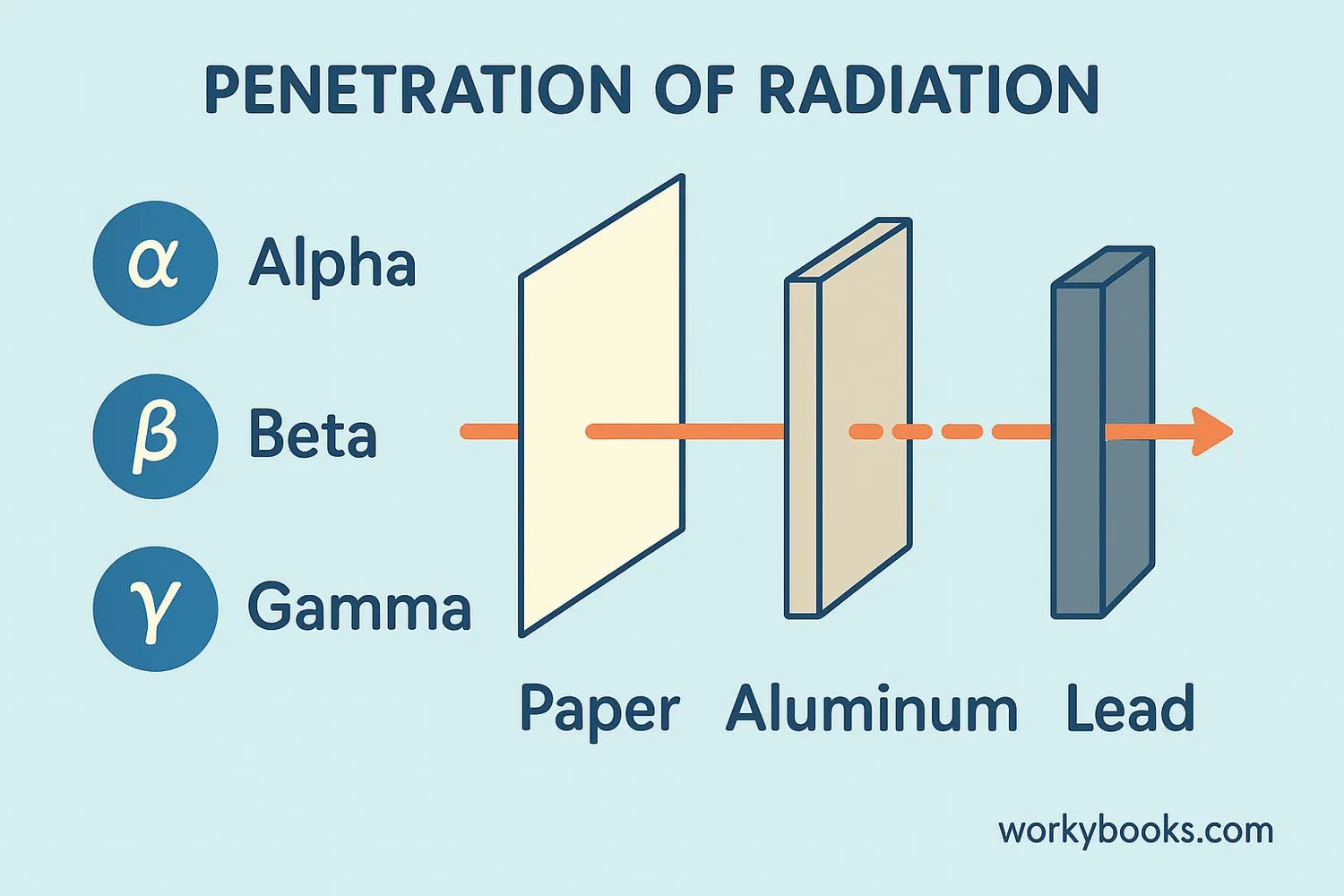
Alpha particles are made of two protons and two neutrons, making them relatively large and heavy compared to other forms of radiation. Because of their size and mass, alpha particles have very low penetration ability. For example, a single sheet of paper or even the outer layer of human skin can stop them. However, if alpha particles get inside the body, such as through inhalation or ingestion, they can cause significant ionization—a process where atoms lose or gain electrons, leading to molecular damage. This is why substances that emit alpha radiation, like radon gas, can be dangerous if inhaled. Alpha particles have a high ionizing ability but are only dangerous when inside the body.
Beta Particles: Properties and Applications
Beta particles are high-speed electrons (or sometimes positrons) released from the nucleus of certain unstable atoms. They are much smaller and lighter than alpha particles, so they can penetrate materials more deeply—passing through paper but being stopped by a few millimeters of aluminum. Beta particles can also ionize atoms, though not as strongly as alpha particles. Scientists use beta radiation in medical treatments, such as targeting cancer cells, and in scientific research. However, beta radiation can burn skin or harm living tissue if not carefully controlled.
Gamma Rays: Energy and Hazards
Gamma rays are not particles but high-energy electromagnetic waves, similar to X-rays but much more powerful. They have very high penetration power, passing through paper and aluminum easily and only being significantly reduced by thick lead or concrete. Gamma rays can travel long distances and are highly dangerous because they can damage body tissues and DNA even from outside the body. Despite their risks, gamma rays are used to sterilize medical equipment and in cancer treatments due to their ability to destroy harmful cells.
Comparing Radiation Types and Real-World Impact
The differences in penetration and ionizing ability among alpha, beta, and gamma radiation shape how they are used and controlled. For example, the strong ionizing power but low penetration of alpha particles means they are mainly a hazard if inhaled or ingested. Beta particles are more penetrating and need thicker shielding, such as aluminum. Gamma rays require even heavier protection, like lead or concrete, due to their deep penetration. Understanding these properties is crucial in fields from nuclear power to medicine and environmental safety. For instance, nuclear power plants are built with thick walls to contain gamma radiation, while smoke detectors often use small amounts of alpha-emitting materials.
By studying how different types of radiation interact with matter, scientists can develop better safety measures and new technologies. The ability to detect, block, or use radiation safely has improved health care, energy production, and our understanding of the universe.
Interesting Fact:
The tracks left by alpha, beta, and gamma radiation in special detectors look very different—scientists can actually “see” the type of radiation by the marks it leaves behind.
Comprehension quiz (10 questions)
1. What are the three main types of radiation described in the passage?
2. What material can stop alpha particles?
3. Which type of radiation has the highest penetration ability?
4. What is ionization?
5. According to the passage, why are gamma rays dangerous?
6. Which type of radiation is most dangerous if inhaled or ingested?
7. What is one use of beta particles mentioned in the passage?
8. True or False: Gamma rays are particles.
9. True or False: Alpha particles can travel through thick lead.
10. Which statement best describes how scientists use knowledge about radiation types?
Perfect for the way you teach
- Build comprehension skills
- Auto-graded quiz
- Differentiated reading
- Read together at home
- Improve fluency
- Quiet reading time
- Reading curriculum support
- Independent practice
- Track Lexile growth