This learning resource is available in interactive and printable formats. The interactive worksheet can be played online and assigned to students. The Printable PDF version can be downloaded and printed for completion by hand.
This comprehensive science passage introduces middle school students to the concept of density, aligning with NGSS standards MS-PS1-1 and MS-PS1-2. It begins with a real-world phenomenon—why objects float or sink—and guides students through the mechanisms of calculating density using mass and volume. The text explains how to measure mass with a balance, determine the volume of both regular and irregular objects, and apply the density formula (D = M/V) in various contexts. Worked examples and practice problems help reinforce learning, while advanced sections discuss real-world implications, such as environmental science and material engineering. The passage includes key vocabulary, glossary, Spanish translations, quizzes, writing activities, and graphic organizers, making it ideal for classroom or independent study. Audio integration ensures accessibility for diverse learners. This resource is perfect for building foundational science skills and connecting physical science concepts to everyday experiences.
CONTENT PREVIEW
Expand content preview
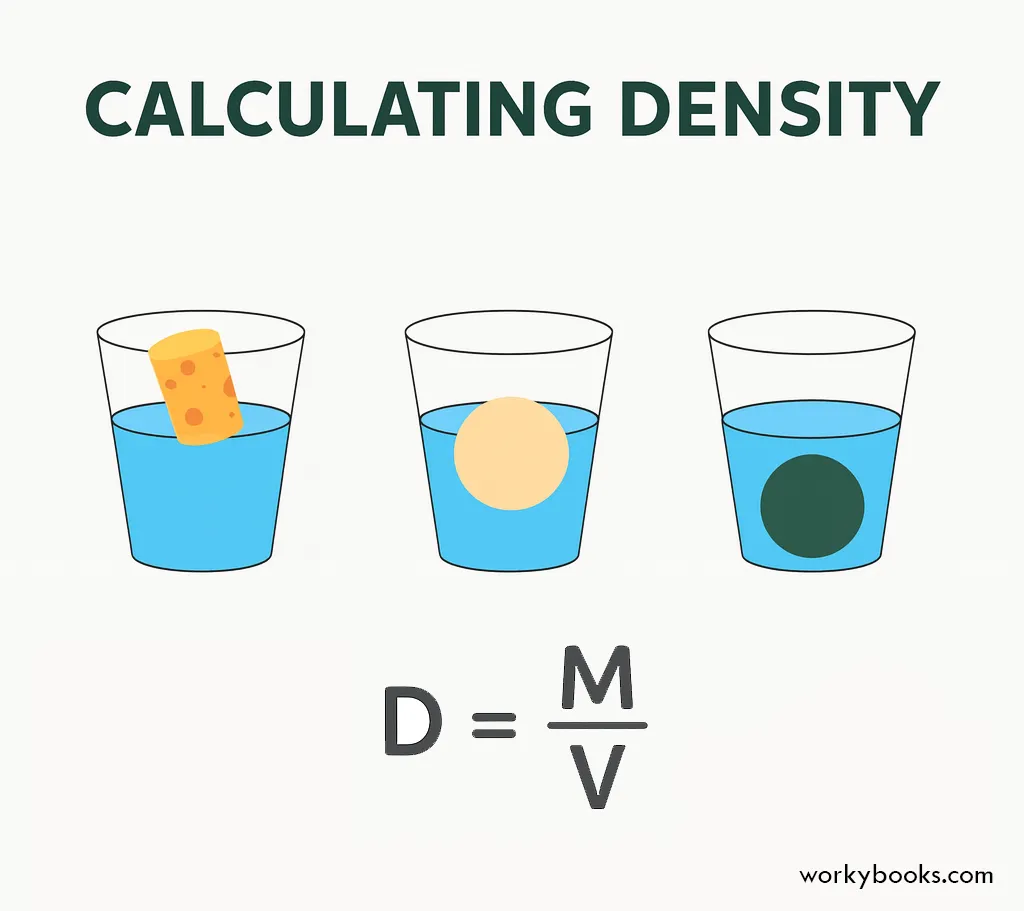
Comparing object densities using water displacement and formula triangle.
Density is a key property that explains why some objects float in water while others sink. Scientists define density as the amount of mass packed into a certain volume. Understanding how to calculate density helps us design ships, identify substances, and solve real-world problems in science and engineering.
How Do We Measure Density? To calculate density, we use the formula Density = Mass ÷ Volume (D = M/V). First, you need to find the object's mass, usually with a balance. For example, if a metal block weighs 200 grams, its mass is 200 grams. Next, determine the object’s volume. For regular shapes like a cube, measure its length, width, and height, then multiply them together (Volume = L × W × H). If the cube’s sides are each 2 centimeters, its volume is 2 cm × 2 cm × 2 cm = 8 cubic centimeters. Finally, divide the mass by the volume: Density = 200g / 8cm³ = 25g/cm³.
Measuring Volume of Irregular Objects Not all objects are perfect cubes or rectangles. To find the volume of an irregular object, like a rock, scientists use water displacement. You fill a graduated cylinder with water and record its initial volume. Drop the rock in and record the new volume. The difference between the two readings is the rock's volume. For example, if the water level rises from 50 mL to 65 mL, the rock’s volume is 15 mL. If the rock’s mass is 45 grams, its density is 45g / 15mL = 3g/mL.
Applications and Rearranging the Density Formula Density is used in many fields. Ships are carefully designed to have a lower density than water so they float. In recycling, density helps sort different plastics. Sometimes, you might know the density and volume, but need to find the mass. Rearranging the formula, Mass = Density × Volume. For instance, if a liquid has a density of 1.2g/mL and a volume of 100mL, its mass is 1.2g/mL × 100mL = 120g. Similarly, if you know mass and density, you can find volume: Volume = Mass / Density.
Understanding density connects to broader scientific principles. It helps explain natural phenomena, such as why oil floats on water or how fish control their position in lakes. Mastering density calculations builds skills needed for more advanced physical science topics.
Interesting Fact: The concept of water displacement was first described by Archimedes over 2,000 years ago, and his method is still used today to measure volume!
What is the formula for calculating density?
Density = Mass ÷ VolumeDensity = Volume × MassDensity = Mass + VolumeDensity = Volume ÷ Mass
Which scientific tool is used to measure the mass of an object?
A thermometerA rulerA balanceA beaker
How do you find the volume of a cube?
Measure the mass and divide by densityMultiply the length, width, and heightAdd the sides togetherUse water displacement
What does 'water displacement' help us measure?
The color of an objectThe temperature of waterThe volume of irregular objectsThe mass of a liquid
What is an example of an irregular object?
A cubeA rockA textbookA metal block
What does the passage say about ships and density?
Ships sink because their density is higher than waterShips float because their density is lower than waterShips float because of their colorShips always have the same density as water
If a rock’s mass is 45 grams and its volume is 15 mL, what is its density?
3g/mL30g/mL0.33g/mL60g/mL
If you know the density and volume of a substance, how can you find its mass?
Add density and volumeDivide density by volumeMultiply density by volumeSubtract volume from density
True or False: Archimedes discovered the method of water displacement.
TrueFalse
True or False: Density can help explain why oil floats on water.
TrueFalse
Perfect For:
👩🏫 Teachers
• Reading comprehension practice
• Auto-graded assessments
• Literacy skill development
👨👩👧👦 Parents
• Reading practice at home
• Comprehension improvement
• Educational reading time
🏠 Homeschoolers
• Reading curriculum support
• Independent reading practice
• Progress monitoring
Reading Features:
📖
Reading Passage
Engaging fiction or nonfiction text
❓
Comprehension Quiz
Auto-graded questions
📊
Instant Feedback
Immediate results and scoring
📄
Printable Version
Download for offline reading
🔊
Read Aloud
Voice-over with word highlighting
Reviews & Ratings
No reviews yet. Be the first to share your experience!
Related Content
Biological Weathering: Types and Examples
This passage details biological weathering processes, connecting to NGSS MS-ESS2-1 (Earth's systems) and LS2.B (ecosyste...
MS-ESS2-1MS-PS1-2RST.6-8.3
Atomic Structure
This reading passage on Atomic Structure provides middle school students with an accessible explanation of the fundament...
MS-PS1-1RI.6.3RI.7.1
Parts of an Atom
This reading passage on Parts of an Atom provides middle school students with a structured and accessible explanation of...
MS-PS1-1RI.6.3RI.7.1
Chemical Bonds
This reading passage on Chemical Bonds provides middle school students with a clear explanation of how and why atoms con...
MS-PS1-1RI.6.3RI.7.1
The Freezing Point of Water
This science reading passage, titled 'The Freezing Point of Water', introduces students to a key physical science concep...
MS-PS1-1RI.6.3RI.7.1
How Many Valence Electrons Does Oxygen Have?
This NGSS-aligned science reading passage teaches middle school students about the number of valence electrons in oxygen...
MS-PS1-2MS-PS1-4
How Many Valence Electrons Does Chlorine Have?
This NGSS-aligned science reading passage explains how many valence electrons chlorine has and why that makes it such a ...
MS-PS1-2MS-PS1-4
The Density of Water
"This NGSS-aligned science passage explains the density of water in a way that is clear and engaging for middle school s...
MS-PS1-2
Physical Properties of Matter
This comprehensive reading passage introduces grades 6-8 students to the concept of physical properties of matter, perfe...
MS-PS1-1
Chemical Properties of Matter
This engaging middle school science passage explores the chemical properties of matter, focusing on how these properties...
MS-PS1-2
Signs of Chemical Change
This comprehensive passage for grades 6-8 explores the key signs that indicate a chemical change, such as color change, ...
MS-PS1-2
Mixtures and Pure Substances
This middle school science passage provides an in-depth exploration of mixtures and pure substances, directly aligned to...
MS-PS1-1
Types of Mixtures
This comprehensive science passage for grades 6-8 introduces students to the concept of mixtures, focusing on distinguis...
MS-PS1-1
Solutions, Suspensions, and Colloids
This comprehensive science passage explores the differences between solutions, suspensions, and colloids, focusing on ho...
MS-PS1-1
Measurement and Units
This comprehensive passage introduces middle school students to the foundational concepts of measurement in science, foc...
MS-PS1-2MS-ETS1-4
The Nature of Science
This passage explores the nature of science for middle school students, aligning with NGSS standards MS-ETS1-4, MS-PS1-1...
MS-ETS1-4MS-PS1-1MS-LS1-1
Scientific Theories
This reading passage for grades 6-8 introduces students to the concept of scientific theories, emphasizing that these ar...
MS-PS1-1MS-PS1-4MS-PS3-4SCIENCE AND ENGINEERING PRACTICES
Particle Model of Matter
This comprehensive science reading passage for grades 6-8 explores the particle model of matter, aligning with NGSS stan...
MS-PS1-1MS-PS1-4
Valence Electrons
This middle school science passage introduces students to the concept of valence electrons, the outermost electrons that...
MS-PS1-1
The Idea of the Atom
This informational science passage introduces middle school students (grades 6-8) to the concept that all matter is made...