

Using Density to Identify Substances — Reading Comprehension
Rate this
Premium Resource
Present
Present in classroom. No work saved
Assign
Classroom with student accounts, Track progress
Quick Play
No student accounts, assign with a link
Grades
5
6
7
8
Standards
MS-PS1-1
MS-PS1-2
PRINT+DIGITAL RESOURCE
This learning resource is available in interactive and printable formats. The interactive worksheet can be played online and assigned to students. The Printable PDF version can be downloaded and printed for completion by hand.
This engaging science passage explores how density acts as a 'fingerprint' property, helping scientists and students identify unknown substances. Aligned with NGSS standards MS-PS1-1 and MS-PS1-2, the text explains the mechanism of density, discusses real-world applications like detecting counterfeit coins, and shows how density is used in forensic science and laboratory experiments. The passage includes a glossary, Spanish translation, differentiated version, and multiple graphic organizers. Activities such as quizzes and writing prompts reinforce scientific thinking, while audio integration supports diverse learners. This comprehensive resource supports middle school science learning while connecting density to larger concepts in physical science and materials identification.
CONTENT PREVIEW
Expand content preview
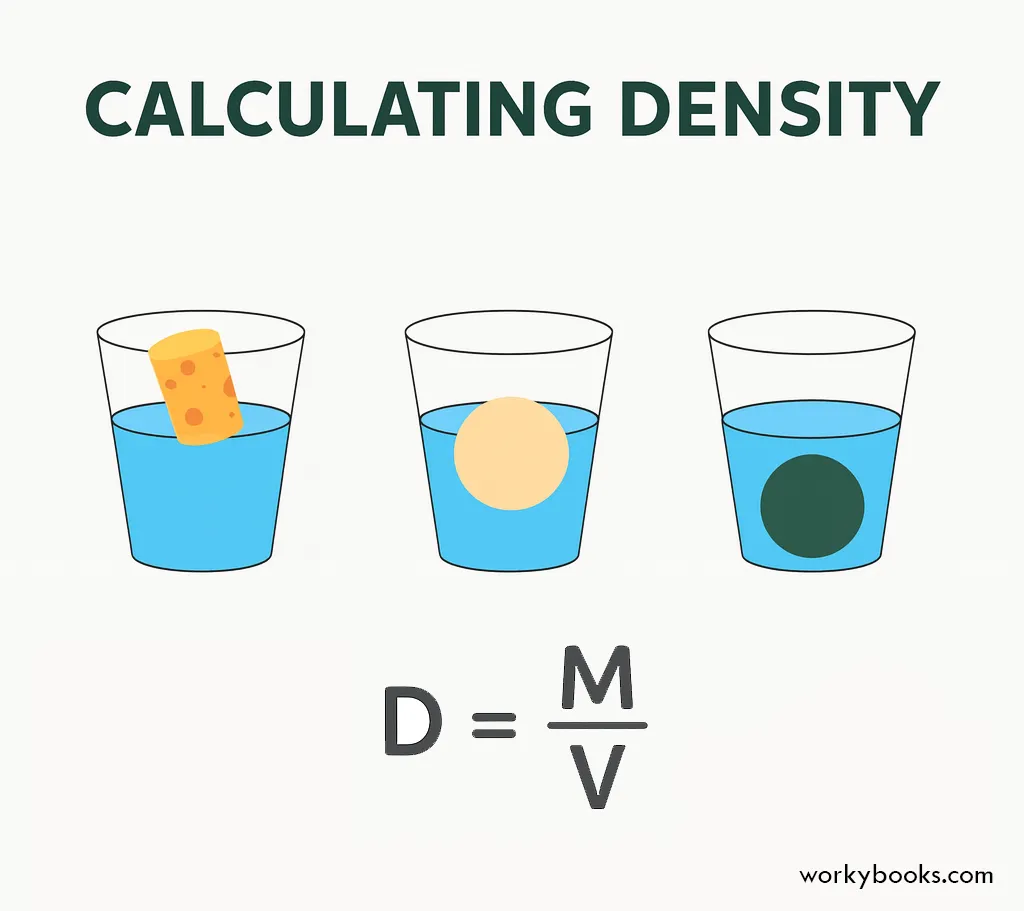
Comparing object densities using water displacement and formula triangle.
Density is a fundamental property that scientists use to identify unknown substances. The amount of mass packed into a certain volume determines the density of a material. For example, a gold coin and a fake coin may look very similar, but their densities can reveal which is real. This makes density a reliable 'fingerprint' for different materials. Understanding how to measure and use density is important in science, industry, and even law enforcement.
How Density Works: The Science Behind the Numbers Density is calculated by dividing mass by volume, using the equation: Density = Mass ÷ Volume. The unit for density is often grams per cubic centimeter (g/cm³) or kilograms per liter (kg/L). If two objects have the same volume but different masses, the one with more mass has a higher density. For instance, lead has a density of about 11.34 g/cm³, while aluminum is only about 2.70 g/cm³. Scientists measure mass with a balance and volume by either measuring dimensions or using water displacement. When a substance is placed in water, the amount of water it moves equals its volume. This method is especially helpful for irregularly shaped objects.
Real-World Applications: From Coins to Crime Labs Density plays a key role in many real-world situations. Jewelers use density to identify precious metals and detect fake gold or silver. In forensics, investigators may test the density of unknown powders or liquids to help solve crimes. For example, if a white powder is found at a scene, measuring its density can help determine if it matches a known drug or household substance. Industries also use density to ensure product quality and safety. For example, fuel companies check gasoline density to prevent contamination.
Complexities and Exceptions While density is a useful identifying property, it is not always perfect. Some substances can have similar densities but be entirely different materials, so scientists often use density alongside other tests, such as melting point or chemical reactivity. Temperature can also affect density because most substances expand when heated, making their density decrease. This is why hot air balloons rise—warm air inside the balloon is less dense than the cooler air outside.
In summary, density is a powerful tool for identifying substances, providing valuable information in science, technology, and crime solving. By combining measurements with scientific reasoning, density helps us uncover the identity and properties of materials in our world.
Interesting Fact: The element osmium is the densest naturally occurring substance on Earth, with a density of about 22.59 g/cm³—almost twice as dense as lead!
What is density?
The amount of mass in a given volumeThe temperature at which a solid meltsThe amount of water an object displacesThe color of a substance
Why is density called a 'fingerprint' property?
Because it is unique for each materialBecause it changes with colorBecause it can be erasedBecause it is only used in crime labs
What is the equation for density?
Density = Mass ÷ VolumeDensity = Volume × MassDensity = Mass × TemperatureDensity = Mass + Volume
Which of the following is a unit for density?
Grams per cubic centimeter (g/cm³)Meters per second (m/s)Kilograms (kg)Liters (L)
What does 'water displacement' help scientists measure?
The volume of irregular objectsThe color of a liquidThe melting point of metalsThe temperature of water
In the passage, which profession uses density to check for fake gold?
JewelersDoctorsTeachersFarmers
According to the passage, why do hot air balloons rise?
Warm air inside is less dense than cool air outsideHot air is heavier than cold airBalloons are made of special materialsThey are filled with water vapor
Why might density alone not be enough to identify a substance?
Some substances have similar densitiesDensity cannot be measuredDensity changes colorAll substances have the same density
True or False: Temperature does not affect density.
TrueFalse
True or False: Osmium is less dense than lead.
TrueFalse
Perfect For:
👩🏫 Teachers
• Reading comprehension practice
• Auto-graded assessments
• Literacy skill development
👨👩👧👦 Parents
• Reading practice at home
• Comprehension improvement
• Educational reading time
🏠 Homeschoolers
• Reading curriculum support
• Independent reading practice
• Progress monitoring
Reading Features:
📖
Reading Passage
Engaging fiction or nonfiction text
❓
Comprehension Quiz
Auto-graded questions
📊
Instant Feedback
Immediate results and scoring
📄
Printable Version
Download for offline reading
🔊
Read Aloud
Voice-over with word highlighting
Reviews & Ratings
No reviews yet. Be the first to share your experience!
Related Content
Biological Weathering: Types and Examples
This passage details biological weathering processes, connecting to NGSS MS-ESS2-1 (Earth's systems) and LS2.B (ecosyste...
MS-ESS2-1MS-PS1-2RST.6-8.3
Atomic Structure
This reading passage on Atomic Structure provides middle school students with an accessible explanation of the fundament...
MS-PS1-1RI.6.3RI.7.1
Parts of an Atom
This reading passage on Parts of an Atom provides middle school students with a structured and accessible explanation of...
MS-PS1-1RI.6.3RI.7.1
Chemical Bonds
This reading passage on Chemical Bonds provides middle school students with a clear explanation of how and why atoms con...
MS-PS1-1RI.6.3RI.7.1
The Freezing Point of Water
This science reading passage, titled 'The Freezing Point of Water', introduces students to a key physical science concep...
MS-PS1-1RI.6.3RI.7.1
How Many Valence Electrons Does Oxygen Have?
This NGSS-aligned science reading passage teaches middle school students about the number of valence electrons in oxygen...
MS-PS1-2MS-PS1-4
How Many Valence Electrons Does Chlorine Have?
This NGSS-aligned science reading passage explains how many valence electrons chlorine has and why that makes it such a ...
MS-PS1-2MS-PS1-4
The Density of Water
"This NGSS-aligned science passage explains the density of water in a way that is clear and engaging for middle school s...
MS-PS1-2
Physical Properties of Matter
This comprehensive reading passage introduces grades 6-8 students to the concept of physical properties of matter, perfe...
MS-PS1-1
Chemical Properties of Matter
This engaging middle school science passage explores the chemical properties of matter, focusing on how these properties...
MS-PS1-2
Signs of Chemical Change
This comprehensive passage for grades 6-8 explores the key signs that indicate a chemical change, such as color change, ...
MS-PS1-2
Mixtures and Pure Substances
This middle school science passage provides an in-depth exploration of mixtures and pure substances, directly aligned to...
MS-PS1-1
Types of Mixtures
This comprehensive science passage for grades 6-8 introduces students to the concept of mixtures, focusing on distinguis...
MS-PS1-1
Solutions, Suspensions, and Colloids
This comprehensive science passage explores the differences between solutions, suspensions, and colloids, focusing on ho...
MS-PS1-1
Measurement and Units
This comprehensive passage introduces middle school students to the foundational concepts of measurement in science, foc...
MS-PS1-2MS-ETS1-4
The Nature of Science
This passage explores the nature of science for middle school students, aligning with NGSS standards MS-ETS1-4, MS-PS1-1...
MS-ETS1-4MS-PS1-1MS-LS1-1
Scientific Theories
This reading passage for grades 6-8 introduces students to the concept of scientific theories, emphasizing that these ar...
MS-PS1-1MS-PS1-4MS-PS3-4SCIENCE AND ENGINEERING PRACTICES
Particle Model of Matter
This comprehensive science reading passage for grades 6-8 explores the particle model of matter, aligning with NGSS stan...
MS-PS1-1MS-PS1-4
Valence Electrons
This middle school science passage introduces students to the concept of valence electrons, the outermost electrons that...
MS-PS1-1
The Idea of the Atom
This informational science passage introduces middle school students (grades 6-8) to the concept that all matter is made...