Echidna: Spiky Mammals of Australia — Reading Comprehension
Rate this
Premium Resource
Present
Present in classroom. No work saved
Assign
Classroom with student accounts, Track progress
Quick Play
No student accounts, assign with a link
Grades
3
4
5
6
7
8
Standards
MS-LS4-D
PRINT+DIGITAL RESOURCE
This learning resource is available in interactive and printable formats. The interactive worksheet can be played online and assigned to students. The Printable PDF version can be downloaded and printed for completion by hand.
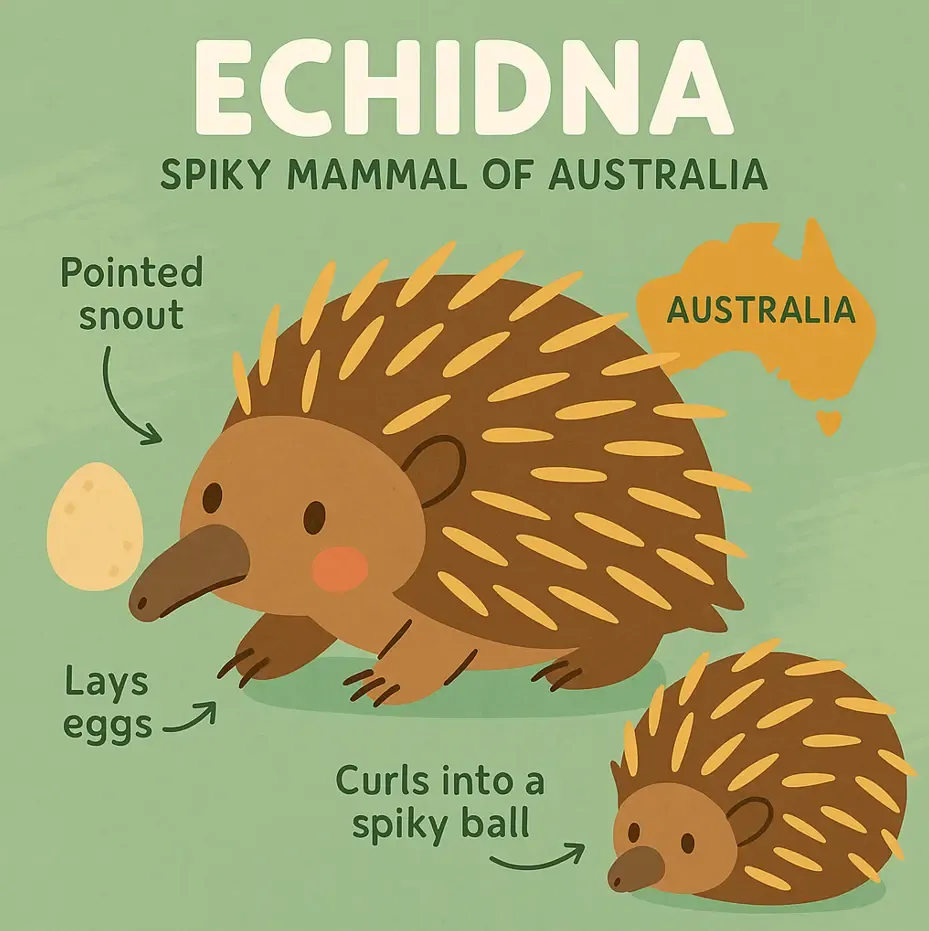
This science reading passage, titled "The Amazing Real Echidna: Spiky Mammals of Australia," introduces students to one of Earth's most fascinating and unique animals. Aligned with NGSS Life Science standards, particularly MS-LS4-D (Biodiversity and Humans), the passage delves into the characteristics of the Echidna, or spiny anteater. It highlights its classification as a monotreme, an incredibly rare type of mammal that lays eggs, making it truly special. The text describes its distinctive physical adaptations, such as its protective spines and its long, sticky tongue used for its insectivore diet of ants and termites. Students will learn about its habitat in Australia and its defense mechanism of curling into a spiky ball. This resource is excellent for fostering reading comprehension, expanding vocabulary related to animal biology and ecosystems, and appreciating the incredible diversity of life on our planet, encouraging awareness of unique wildlife.
CONTENT PREVIEW
Expand content preview
Imagine an animal covered in sharp, strong spikes, but it's not a porcupine! Meet the Echidna! This incredible creature, sometimes called a spiny anteater, is a truly unique animal found mainly in Australia and Tasmania. It's one of only a few monotremes in the world – that means it's a mammal that lays eggs, just like a platypus!
Echidnas have a long, pointed snout that they use to sniff out their favorite foods. Their bodies are covered in sharp, stiff spines (like quills) that protect them from danger. When an echidna feels threatened, it quickly curls up into a tight, spiky ball, making it very hard for predators to grab it.
What do these unique animals eat? Echidnas are insectivores, meaning they love to eat insects! They use their powerful claws to dig into ant nests and termite mounds. Then, they stick out their long, sticky tongue, which can be as long as their snout, to slurp up thousands of tiny ants and termites. They don't have teeth, so their sticky tongue does all the work!
Echidnas live in many different kinds of habitats, from forests to grasslands. Their amazing adaptations, like their spikes and digging claws, help them survive and thrive. Protecting these spiky wonders helps maintain the biodiversity of Australia's amazing wildlife.
Fun Fact: An Echidna's tongue can be as long as its head and body combined – that's almost as long as a pencil!
What is an Echidna sometimes called?
Spiky bearSpiny anteaterHedgehog friendQuill pig
Where are Echidnas mainly found?
AsiaAfricaAustraliaSouth America
What special group of mammals do Echidnas belong to?
MarsupialsMonotremesRodentsPrimates
What do Echidnas eat mostly?
Fruits and leavesFish and crabsAnts and termitesGrass and seeds
What does an Echidna do when it feels threatened?
It runs very fastIt climbs a tree.It curls into a spiky ball.It digs a deep hole.
How does an Echidna get ants and termites?
With its sharp teeth.By using its sticky tongue.By sucking them in.By catching them in a net.
What is the main idea of this passage?
Echidnas are fast runners.Echidnas are unique egg-laying mammals.Echidnas are found everywhere.Echidnas only eat plants.
Why are the Echidna's spikes an important adaptation?
They help it fly.They help it find food.They protect it.They help it swim.
Perfect For:
👩🏫 Teachers
• Reading comprehension practice
• Auto-graded assessments
• Literacy skill development
👨👩👧👦 Parents
• Reading practice at home
• Comprehension improvement
• Educational reading time
🏠 Homeschoolers
• Reading curriculum support
• Independent reading practice
• Progress monitoring
Reading Features:
📖
Reading Passage
Engaging fiction or nonfiction text
❓
Comprehension Quiz
Auto-graded questions
📊
Instant Feedback
Immediate results and scoring
📄
Printable Version
Download for offline reading
🔊
Read Aloud
Voice-over with word highlighting
Reviews & Ratings
No reviews yet. Be the first to share your experience!
Related Content
Where Do Axolotls Live?
This science reading passage, titled "The Axolotl's Home," delves into the specific natural environment of the fascinati...
MS-LS4-DMS-LS2-1
The Blobfish
This science reading passage, titled "The Blobfish: A Deep-Sea Mystery," introduces students to one of Earth's most pecu...
MS-LS4-DMS-LS2-1
Knuckles the Echidna: A Famous Character
This reading passage, "Knuckles the Echidna: A Famous Character," introduces students to the popular video game characte...
MS-LS4-DMS-LS4
The Amazing Red Panda
This engaging science reading passage, titled "The Amazing Red Panda: A Fluffy Tree Dweller," introduces students to one...
MS-LS1-1MS-LS4-D
Przewalski's Horse
This engaging science reading passage, titled "Przewalski's Horse: A Wild Comeback Story," introduces students to the tr...
MS-LS4-DMS-LS1-1
The Quokka
This engaging science reading passage, titled "The Quokka: The Happiest Animal on Earth?", introduces students to one of...
MS-LS4-DMS-LS1-1
The Proboscis Monkey
This interactive science reading passage, titled "The Proboscis Monkey: A Monkey with a Mighty Nose!", introduces studen...
MS-LS4-DMS-LS1-1
The Black-Footed Ferret
This engaging science reading passage, titled "The Black-Footed Ferret: North America's Rarest Mammal," introduces stude...
MS-LS4-DMS-LS1-1
The Wombat
This engaging science reading passage, titled "The Wombat: Australia's Burrowing Buddy," introduces students to one of A...
MS-LS4-DMS-LS1-1
The Orangutan
This engaging science reading passage, titled "The Orangutan: Red Ape of the Rainforest," introduces students to one of ...
MS-LS4-DMS-LS1-1
The Arabian Oryx
This science reading passage, titled "The Arabian Oryx: A Desert Survivor's Comeback," introduces students to a remarkab...
MS-LS4-DMS-LS1-1
The Komodo Dragon
This science reading passage, titled "The Komodo Dragon: A Giant Among Lizards," introduces students to one of the world...
MS-LS4-DMS-LS1-1
Where Do Sloths Live?
This interactive reading passage, titled "Where Do Sloths Live? A Slow Life in the Trees," introduces students to the un...
MS-LS4-DMS-LS1-1
Okapi: The Shy Zebra-Giraffe
This engaging science reading passage, titled "The Okapi: The Forest's Shy Zebra-Giraffe," introduces students to one of...