Przewalski's Horse
Interactive passage with audio narration, comprehension questions, and printable PDF.
What's included
Przewalski's Horse preview and details
About this printable Przewalski's Horse science reading passage, NGSS-aligned (Grades 3-8)
Sample passage and quiz from Przewalski's Horse
Reading passage and comprehension quiz preview
Przewalski's Horse
Imagine a horse that has never been ridden or tamed by humans, a truly wild spirit. That's Przewalski's horse(pronounced shuh-VAL-skee), also known as the Mongolian wild horse or Takhi. This incredibly unique animal holds a special place in history as the last surviving subspecies of true wild horse on Earth. Unlike other "wild" horses like mustangs, which are descended from domesticated horses, Przewalski's horse has never been domesticated.
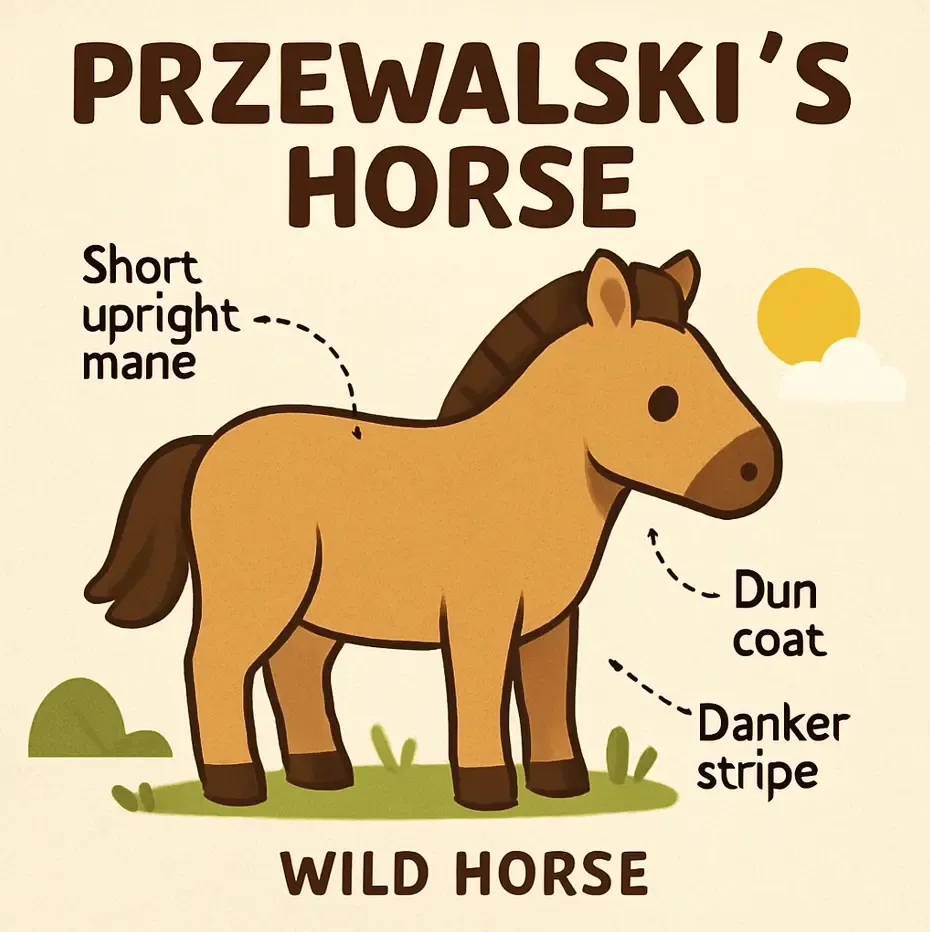
These stocky, powerful horses are built for endurance. They have a distinctive dun or sandy-brown coat, a darker stripe down their back, a short, upright mane that stands straight up, and no forelock (the hair between their ears). These adaptations help them survive in harsh, open grasslands.
For many years, this magnificent creature faced a bleak future. By the late 1960s, Przewalski's horse was declared extinct in the wild, meaning there were no wild populations left. Only a small number survived in zoos around the world, descendants of just 12 wild horses. This was a critical moment for conservation.
Thanks to dedicated conservation efforts and careful breeding programs in zoos, a remarkable rewilding success story began. Starting in the 1990s, groups of these rare animals were reintroduced into their native Central Asia habitat, the vast Mongolian steppes. Today, wild herds once again roam free, a testament to what is possible when humans work to protect endangered species and restore biodiversity. This wild horse's return is a symbol of hope for wildlife everywhere.
Fun Fact: Przewalski's horses have 66 chromosomes, while all other domestic horses have 64. This unique difference shows they are a truly separate wild species!
Comprehension quiz (8 questions)
1. What is another name for Przewalski's horse?
2. What makes Przewalski's horse a "true wild horse"?
3. What kind of mane does Przewalski's horse have?
4. What was the conservation status of Przewalski's horse in the 1960s?
5. Where is the native habitat of Przewalski's horse?
6. How did Przewalski's horse return to the wild?
7. What is the main idea of this passage?
8. Why is the return of this horse a "comeback story"?
Perfect for the way you teach
- Build comprehension skills
- Auto-graded quiz
- Differentiated reading
- Read together at home
- Improve fluency
- Quiet reading time
- Reading curriculum support
- Independent practice
- Track Lexile growth