This learning resource is available in interactive and printable formats. The interactive worksheet can be played online and assigned to students. The Printable PDF version can be downloaded and printed for completion by hand.
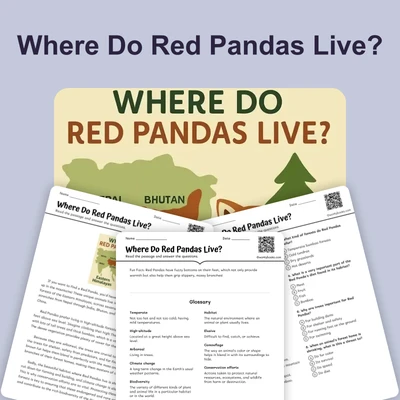
This engaging science reading passage, titled "The Amazing Red Panda: A Fluffy Tree Dweller," introduces students to one of Earth's most captivating and unique mammals. Aligned with NGSS Life Science standards, particularly MS-LS4-D (Biodiversity and Humans), the passage describes the Red Panda's distinctive appearance, including its reddish-brown fur and ringed tail, and clarifies its unique classification as the sole member of its family. It highlights its arboreal (tree-dwelling) and nocturnal habits, showcasing its special adaptations like sharp claws and a false thumb" for gripping bamboo. The text emphasizes the Red Panda's charm and its role in maintaining global biodiversity. This resource is excellent for fostering reading comprehension
CONTENT PREVIEW
Expand content preview
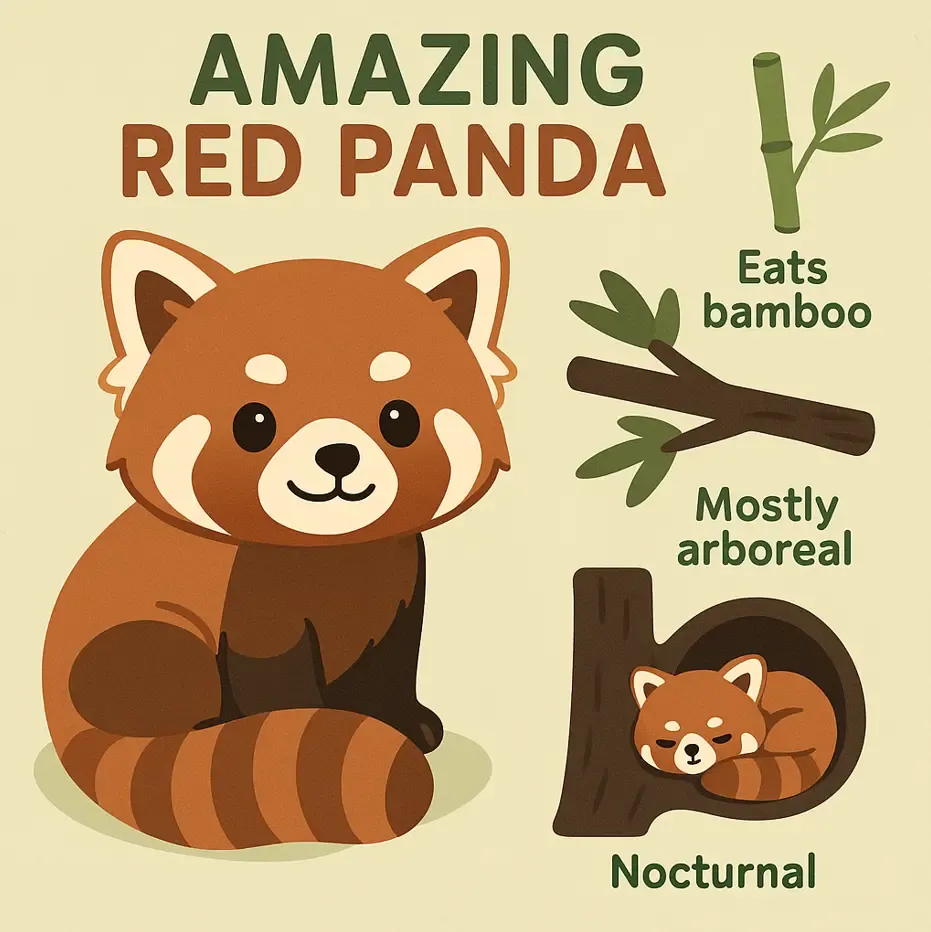
Imagine a cute, furry animal that looks like a mix between a raccoon, a fox, and a small bear! That's the Red Panda, one of the most adorable and unique animals in the world. This fascinating mammal is known for its beautiful reddish-brown fur, a long, bushy, ringed tail, and pointed ears with white markings on its face.
Despite its name, the Red Panda isn't closely related to giant pandas, even though they both love bamboo! It's actually the only living member of its own animal family. Red Pandas are mainly arboreal, which means they spend most of their lives high up in the trees. Their sharp claws and strong, bushy tails help them balance and climb expertly among the branches.
These lovely creatures are also mostly nocturnal or crepuscular, meaning they are most active at dawn, dusk, or throughout the night. During the day, they often sleep stretched out on tree branches or curled up in tree hollows. They have a special "false thumb" – an extra bone on their wrist – that helps them grip bamboo stalks, which is a big part of their diet.
The Red Panda's charm and unique features make it a beloved symbol of its forest home and a crucial part of global biodiversity. Protecting these shy, tree-dwelling wonders is key to keeping our planet's wild places healthy.
Fun Fact: Red Pandas use their long, bushy tails like a cozy blanket to wrap around themselves for warmth during cold mountain nights!
What is a Red Panda known for?
Its blue furIts spiky bodyIts reddish-brown furIts short tail
What does "arboreal" mean for the Red Panda?
It lives in water.It lives on the ground.It lives in trees.It lives in caves.
What is a Red Panda mostly active during?
Only daytimeOnly nightDawn, dusk, or nightOnly midday
What helps the Red Panda grip bamboo?
Its sharp teethIts long tongueIts extra bone (false thumb)Its strong nose
How does the Red Panda's tail help it?
To catch fish.To balance and climb.To warn enemies.To dig holes.
Why is the Red Panda considered a "unique animal"?
It is very common.It looks like many animals.It is the only one in its family.It eats only meat.
What is the main idea of this passage?
Red Pandas love bamboo.Red Pandas are cute, tree-dwelling mammals.Red Pandas are like raccoons.Red Pandas are nocturnal.
If an animal has a special "false thumb" to hold food, what is this an example of?
Its habitatIts diet preferenceAn adaptation for feedingIts social behavior
Perfect For:
👩🏫 Teachers
• Reading comprehension practice
• Auto-graded assessments
• Literacy skill development
👨👩👧👦 Parents
• Reading practice at home
• Comprehension improvement
• Educational reading time
🏠 Homeschoolers
• Reading curriculum support
• Independent reading practice
• Progress monitoring
Reading Features:
📖
Reading Passage
Engaging fiction or nonfiction text
❓
Comprehension Quiz
Auto-graded questions
📊
Instant Feedback
Immediate results and scoring
📄
Printable Version
Download for offline reading
🔊
Read Aloud
Voice-over with word highlighting
Reviews & Ratings
No reviews yet. Be the first to share your experience!
Related Content
Antonie van Leeuwenhoek and the Discovery of Animalcules
This NGSS-aligned science passage explores the groundbreaking work of Antonie van Leeuwenhoek, a pioneer in microscopic ...
MS-LS1-1MS-LS1-2
Robert Hooke and the Naming of 'Cells'
This NGSS-aligned reading passage introduces middle school students to Robert Hooke's discovery and naming of 'cells' in...
MS-LS1-1MS-LS1-2
Rudolf Virchow and His Contribution to Cell Theory
This NGSS-aligned science reading passage introduces students to Rudolf Virchow, a key historical figure in cell biology...
MS-LS1-1MS-LS1-2
Matthias Schleiden and the Discovery That Plants Are Made of Cells
This NGSS-aligned science passage explains how Matthias Schleiden, a German scientist in the 1830s, discovered that all ...
MS-LS1-1MS-LS1-2
When Was the Microscope Invented?
This NGSS-aligned reading passage introduces students to the invention of the microscope, an essential scientific tool. ...
MS-LS1-1MS-LS1-2
What are Prokaryotic Cells?
This NGSS-aligned science reading passage explains prokaryotic cells, the simplest type of cells found in single-celled ...
MS-LS1-1MS-LS1-2
What are Eukaryotic Cells?
This NGSS-aligned reading passage introduces middle school students to eukaryotic cells, which are complex cells found i...
MS-LS1-1MS-LS1-2
Prokaryotic vs. Eukaryotic Cells
This NGSS-aligned reading passage helps middle school students compare prokaryotic and eukaryotic cells. Supporting stan...
MS-LS1-1MS-LS1-2
What is an Organelle?
This NGSS-aligned reading passage introduces middle school students to the concept of organelles. Supporting MS-LS1-
MS-LS1-1MS-LS1-2
Chromoplast: Nature's Color Palette
This passage details chromoplast functions in pigment production, ecological signaling, and nutrition. Aligned with NGSS...
MS-LS1-1MS-LS1-2MS-LS1-6LS1.C
Parts of the Cell
This informational science passage, aligned with NGSS standard MS-LS1-1, introduces students to the parts of the cell an...
MS-LS1-1MS-LS1-2
The Nucleolus and Its Function
This NGSS-aligned reading passage focuses on the nucleolus, a key structure inside the cell’s nucleus responsible for ma...
MS-LS1-1MS-LS1-2
Where Do Axolotls Live?
This science reading passage, titled "The Axolotl's Home," delves into the specific natural environment of the fascinati...
MS-LS4-DMS-LS2-1
The Blobfish
This science reading passage, titled "The Blobfish: A Deep-Sea Mystery," introduces students to one of Earth's most pecu...
MS-LS4-DMS-LS2-1
Echidna: Spiky Mammals of Australia
This science reading passage, titled "The Amazing Real Echidna: Spiky Mammals of Australia," introduces students to one ...
MS-LS4-D
Knuckles the Echidna: A Famous Character
This reading passage, "Knuckles the Echidna: A Famous Character," introduces students to the popular video game characte...
MS-LS4-DMS-LS4
Golgi Apparatus and Its Function
This NGSS-aligned reading passage introduces middle school students to the structure and function of the Golgi apparatus...
MS-LS1-1
Is a Platypus a Mammal?
This interactive science reading passage, titled "Is a Platypus a Mammal? The Monotreme Mystery!", delves into the uniqu...
MS-LS1-1
Where Do Platypus Live?
This engaging science reading passage, titled "Where Do Platypus Live? Finding Australia's Elusive Swimmer," explores th...