The Arabian Oryx
Interactive passage with audio narration, comprehension questions, and printable PDF.
By completing this purchase you agree to our Terms of Use and Privacy Policy. Your subscription renews automatically until you cancel. You can cancel anytime from your account settings. All sales are final and non-refundable. Digital content is available for download in your account immediately upon purchase.
What's included
The Arabian Oryx preview and details
About this printable The Arabian Oryx science reading passage, NGSS-aligned (Grades 3-8)
Sample passage and quiz from The Arabian Oryx
Reading passage and comprehension quiz preview
The Arabian Oryx
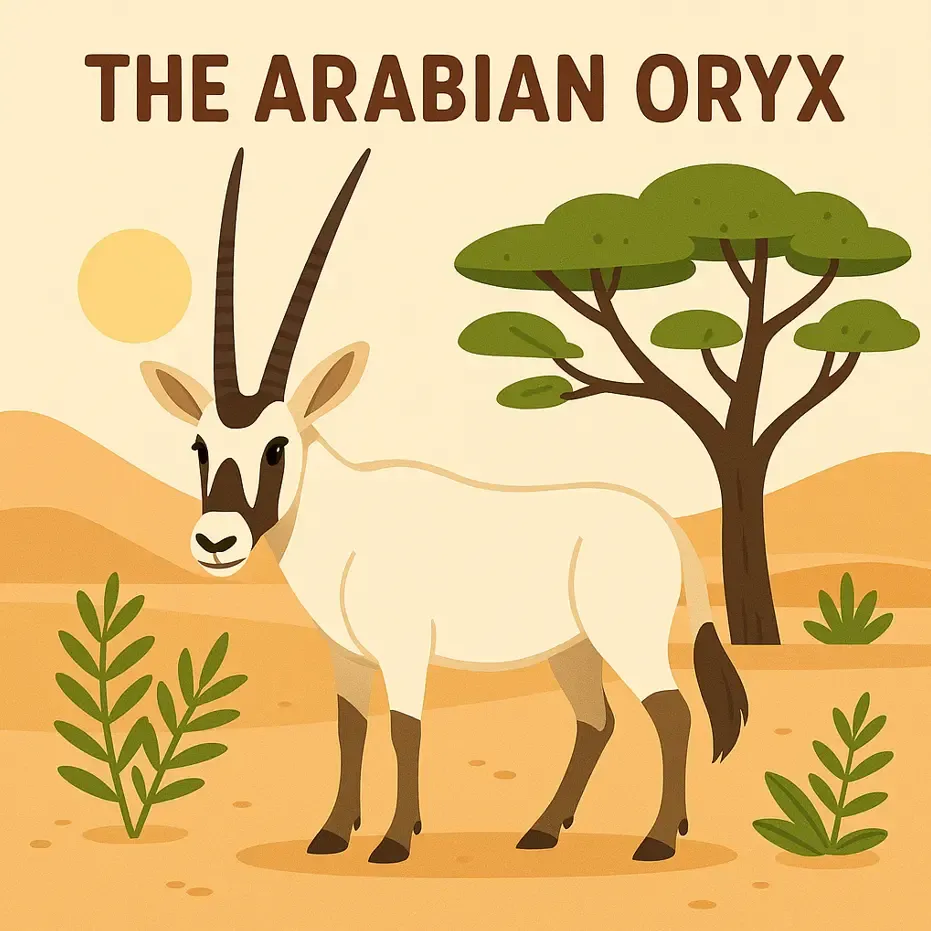
Imagine an animal perfectly designed for life in one of Earth's harshest environments, a place where water is scarce and temperatures soar. That's the Arabian Oryx, a magnificent desert antelope and a true symbol of resilience! This unique animal with its striking appearance is native to the Arabian Peninsula, living in its vast, arid deserts and semi-deserts.
The Arabian Oryx stands out with its brilliant white coat, which reflects sunlight to help keep it cool in the scorching heat. Both males and females sport long, slender, almost straight horns that can reach lengths of 20 to 30 inches. Dark markings on their faces, legs, and tail contrast beautifully with their pale bodies. These features are amazing adaptations that allow them to thrive in their challenging environment.
These desert survivors are master strategists when it comes to finding food and water. They are herbivores, feeding on grasses, shrubs, and acacia leaves. They can go for long periods without drinking, getting most of their moisture from the plants they eat or from dew. They also have an incredible ability to sense rainfall from a distance and will travel far to find new green growth.
Tragically, aggressive hunting and habitat destruction led to the Arabian Oryx being declared extinct in the wild by the early 1970s. However, thanks to one of the most successful conservation efforts in history, often called "Operation Oryx," captive breeding programs were established. Starting in the 1980s, these rare animals were carefully reintroduced into protected areas across the Middle East. Today, wild herds once again roam the deserts, a shining example of how dedicated human intervention can bring an endangered species back from the brink and restore biodiversity.
Fun Fact: The Arabian Oryx's long, sharp horns are sometimes thought to be the inspiration behind the myth of the unicorn!
Comprehension quiz (8 questions)
1. Where is the Arabian Oryx native to?
2. What color is the Arabian Oryx's coat?
3. What do Arabian Oryx eat?
4. What specialized adaptation helps the Arabian Oryx stay cool?
5. What was the conservation status of the Arabian Oryx in the early 1970s?
6. What was the name of the conservation program that helped save them?
7. What is the main idea of this passage?
8. How do Arabian Oryx get most of their moisture?
Perfect for the way you teach
- Build comprehension skills
- Auto-graded quiz
- Differentiated reading
- Read together at home
- Improve fluency
- Quiet reading time
- Reading curriculum support
- Independent practice
- Track Lexile growth