The Orangutan
Interactive passage with audio narration, comprehension questions, and printable PDF.
What's included
The Orangutan preview and details
About this printable The Orangutan science reading passage, NGSS-aligned (Grades 3-8)
Sample passage and quiz from The Orangutan
Reading passage and comprehension quiz preview
The Orangutan
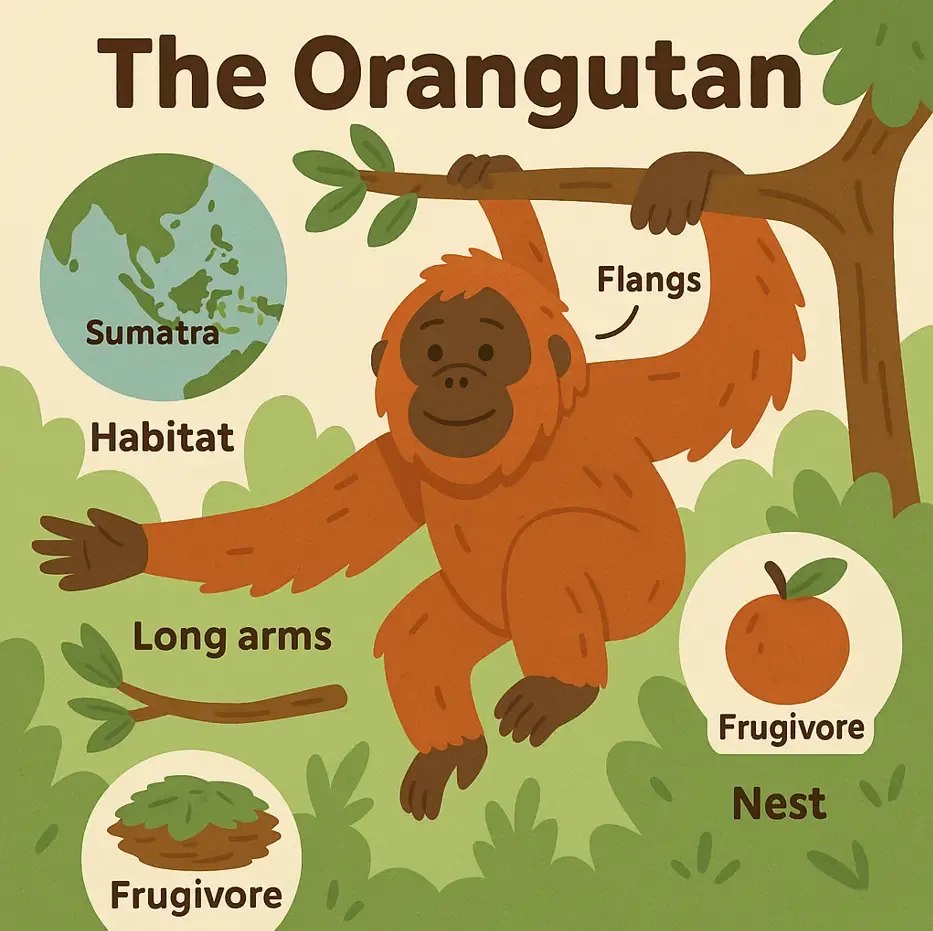
Imagine an ape with shaggy, reddish-brown hair and incredibly long arms, swinging gracefully through the trees. This is the Orangutan, whose name beautifully translates to "person of the forest" in Malay. These magnificent unique animalsare the largest tree-dwelling (or arboreal) mammals on Earth and are native only to the lush rainforests on the islands of Borneo and Sumatra in Southeast Asia.
Orangutans are easily recognized by their distinct reddish fur and powerful, long arms that can stretch over seven feet! Male orangutans can also develop large cheek pads called "flanges," which signify their maturity and dominance. They spend nearly all their lives high in the canopy, using their impressive strength and agility to move from branch to branch, rarely touching the ground.
As primates, Orangutans are highly intelligent, using tools and showing complex problem-solving sk
ills. They are primarily fruit-eaters (frugivores), but also enjoy leaves, bark, and insects. Each night, an orangutan builds a new nest high in the trees, bending branches to create a safe, cozy sleeping platform.
Sadly, all species of Orangutan are now critically endangered. Their precious rainforest habitat is being destroyed at an alarming rate, primarily for the expansion of palm oil plantations, logging, and mining. This rapid deforestation is pushing these gentle "persons of the forest" to the brink of extinction. Intensive conservation efforts are vital to protect these intelligent, unique animals and preserve the incredible biodiversity of their rainforest homes.
Fun Fact: An adult male orangutan's arm span can be over twice his height, allowing him to swing easily through the rainforest canopy!
Comprehension quiz (8 questions)
1. What does "Orangutan" mean in Malay?
2. Where are Orangutans native to?
3. What does "arboreal" mean for Orangutans?
4. What is the primary diet of Orangutans?
5. What unique shelter do Orangutans build each night?
6. What is the biggest threat to Orangutans?
7. What is the main idea of this passage?
8. Why is their habitat being destroyed for "palm oil plantations"?
Perfect for the way you teach
- Build comprehension skills
- Auto-graded quiz
- Differentiated reading
- Read together at home
- Improve fluency
- Quiet reading time
- Reading curriculum support
- Independent practice
- Track Lexile growth