Farming in Ancient Mesopotamia
Interactive passage with audio narration, comprehension questions, and printable PDF.
By completing this purchase you agree to our Terms of Use and Privacy Policy. Your subscription renews automatically until you cancel. You can cancel anytime from your account settings. All sales are final and non-refundable. Digital content is available for download in your account immediately upon purchase.
What's included
Part of this bundle

Farming in Ancient Mesopotamia preview and details
About this printable Farming in Ancient Mesopotamia reading passage (Grades 5-8)
Sample passage and quiz from Farming in Ancient Mesopotamia
Reading passage and comprehension quiz preview
Farming in Ancient Mesopotamia
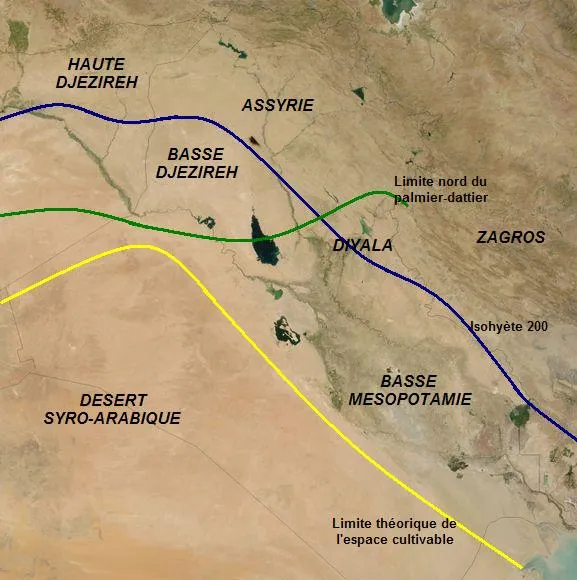
Map of the agricultural regions of ancient Mesopotamia." by Zunkir / Wikimedia Commons
The region known as Mesopotamia is located between the Tigris and Euphrates rivers, in what is today Iraq and parts of Syria, Turkey, and Iran. This area is often called the "Cradle of Civilization" because it was home to some of the world's earliest complex societies, beginning around 3500 BCE. Mesopotamia’s geography, with its fertile land and unpredictable rivers, played a key role in shaping its history, especially through the development of irrigation and agriculture.
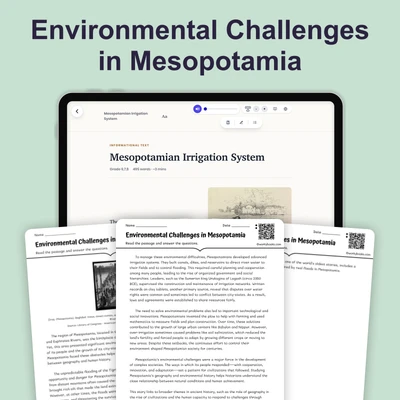
The land of Mesopotamia was both a blessing and a challenge. While the rivers made the soil rich and ideal for farming, the Tigris and Euphrates could flood unpredictably, destroying crops and settlements. Early farmers realized they needed to control the water to survive. Around 3000 BCE, the Sumerians, one of the first city-states in southern Mesopotamia, began building networks of canals, levees, and reservoirs. These irrigation systems allowed them to direct river water to their fields during dry periods and protect against floods. Cuneiform tablets from the city of Lagash record the construction of canals and the disputes over water rights, showing how vital water management was to daily life and government.
Irrigation transformed Mesopotamian society. It led to the growth of large, organized communities that could support many people. Farmers grew crops like barley, wheat, and dates, and raised livestock. Surplus food allowed people to specialize in other jobs, such as scribes, priests, and artisans. Archaeological evidence from Uruk and Ur reveals granaries and storage jars that held crops for the whole city-state. The ability to control water gave some groups more power, leading to complex social hierarchies. For example, rulers like Hammurabi of Babylon issued laws about water use, as seen in the famous Code of Hammurabi from about 1754 BCE.
Over time, the systems of irrigation became more advanced. New technologies, such as the shaduf (a simple water-lifting device), improved efficiency. However, irrigation also had long-term effects. Poor maintenance or overuse could cause soil to become salty, reducing crop yields—a problem known as salinization. Despite these challenges, the relationship between environment and human innovation remained central to Mesopotamian civilization for thousands of years.
In conclusion, Mesopotamia’s geography shaped its people’s lives, pushing them to develop complex irrigation and agricultural systems. These innovations supported the rise of powerful city-states, new forms of government, and some of the earliest written laws. They connect to broader themes in ancient history, such as how humans adapt to and change their environment.
Interesting Fact: The word "Mesopotamia" comes from Greek and means "land between rivers."
Comprehension quiz (8 questions)
1. What two rivers shaped Mesopotamia?
2. Who issued water laws in Babylon?
3. What problem could irrigation cause?
4. Why did Sumerians build canals?
5. How did surplus food change society?
6. What is a city-state?
7. Mesopotamia means 'land between rivers.'
8. What is a scribe?
Perfect for the way you teach
- Build comprehension skills
- Auto-graded quiz
- Differentiated reading
- Read together at home
- Improve fluency
- Quiet reading time
- Reading curriculum support
- Independent practice
- Track Lexile growth