Roles of Women in Ancient Societies
Interactive passage with audio narration, comprehension questions, and printable PDF.
By completing this purchase you agree to our Terms of Use and Privacy Policy. Your subscription renews automatically until you cancel. You can cancel anytime from your account settings. All sales are final and non-refundable. Digital content is available for download in your account immediately upon purchase.
What's included
Roles of Women in Ancient Societies preview and details
About this printable Roles of Women in Ancient Societies reading passage (Grades 5-8)
Sample passage and quiz from Roles of Women in Ancient Societies
Reading passage and comprehension quiz preview
Women in the Ancient World

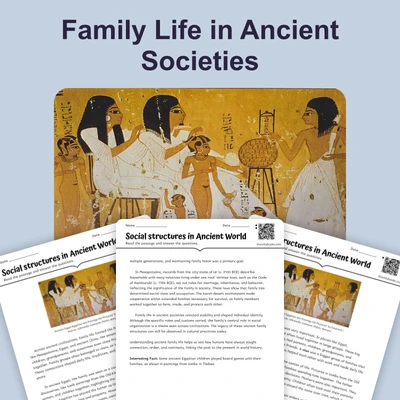
"Egyptian Kemetic women" by Barbardhacii /
Source: Wikimedia Commons (CC0).
Women in the ancient world played essential but complex roles in the daily life and social structures of early civilizations. Their status and rights depended on geography, cultural beliefs, and the hierarchy of their society. By examining ancient Mesopotamia, Egypt, and Greece, historians can better understand how women both shaped and were shaped by their environments.
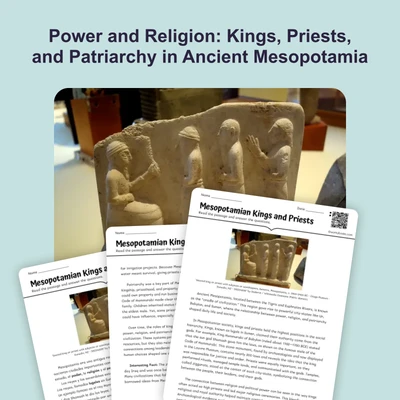
In Mesopotamia (c. 3500–539 BCE), women’s lives were closely tied to the family and home. Most women were responsible for managing households, weaving, and raising children. However, archaeological evidence shows that some women could own property and run businesses, particularly in the city-state of Ur. Ancient laws, like the Code of Hammurabi (c. 1754 BCE), included rules about marriage, inheritance, and divorce. These laws show women had legal protections, but their rights were often limited compared to men. Some priestesses in Sumerian temples held respected positions and participated in religious rituals, showing both restrictions and opportunities within ancient society.
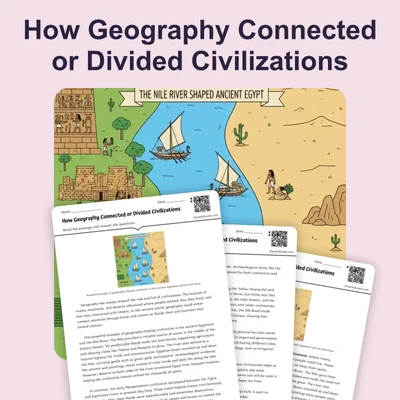
In ancient Egypt (c. 3100–332 BCE), women had more legal rights than in many other ancient places. Egyptian women could own land, sign contracts, and serve as witnesses in court. Queens such as Hatshepsut (ruled c. 1479–1458 BCE) even became pharaoh, the highest ruler. Wall paintings and tombs depict women involved in religious festivals and economic activities. Despite these rights, daily life for most women involved agricultural work, caring for children, and supporting their families. The river Nile shaped their lives, as women played roles in farming and food preparation during the annual floods. Social class mattered: noblewomen had more opportunities than farmers’ wives or servants.
In contrast, women in ancient Greece (especially in Athens, c. 500–300 BCE) faced stricter limitations. Most Greek women could not own property or participate in government. Their main duties were to manage the home and raise children. One exception was the city-state of Sparta, where women received physical education and could own land. This difference was partly due to Sparta’s focus on military strength and the need for women to manage estates while men were at war. Greek myths, like the story of Athena, goddess of wisdom, show that women could be honored in religion, even if their real-life freedoms were limited.
Over time, women’s roles in these societies changed, but most still faced significant barriers due to their gender. Geography, class, and culture shaped their everyday experiences and their potential to influence society. By analyzing ancient artifacts and written records, historians continue to debate how much power women actually held and how their contributions influenced their civilizations.
Learning about women in the ancient world helps us understand broader themes such as social hierarchy, the impact of geography, and the development of civilizations.
Interesting Fact: In ancient Egypt, some women trained as doctors and even wrote medical texts—making them some of the first known female physicians in history!
Comprehension quiz (8 questions)
1. Who could become a pharaoh in Egypt?
2. Where did some women own businesses?
3. What river shaped Egyptian women's lives?
4. Why did Spartan women have more rights?
5. What limited women's rights in most societies?
6. How did geography affect women's work?
7. Women in Athens could join government. True or false?
8. What is a hierarchy?
Perfect for the way you teach
- Build comprehension skills
- Auto-graded quiz
- Differentiated reading
- Read together at home
- Improve fluency
- Quiet reading time
- Reading curriculum support
- Independent practice
- Track Lexile growth