Inventions of Ancient Mesopotamia
Interactive passage with audio narration, comprehension questions, and printable PDF.
By completing this purchase you agree to our Terms of Use and Privacy Policy. Your subscription renews automatically until you cancel. You can cancel anytime from your account settings. All sales are final and non-refundable. Digital content is available for download in your account immediately upon purchase.
What's included
Part of this bundle

Inventions of Ancient Mesopotamia preview and details
About this printable Inventions of Ancient Mesopotamia reading passage (Grades 5-8)
Sample passage and quiz from Inventions of Ancient Mesopotamia
Reading passage and comprehension quiz preview
Inventions of Ancient Mesopotamia
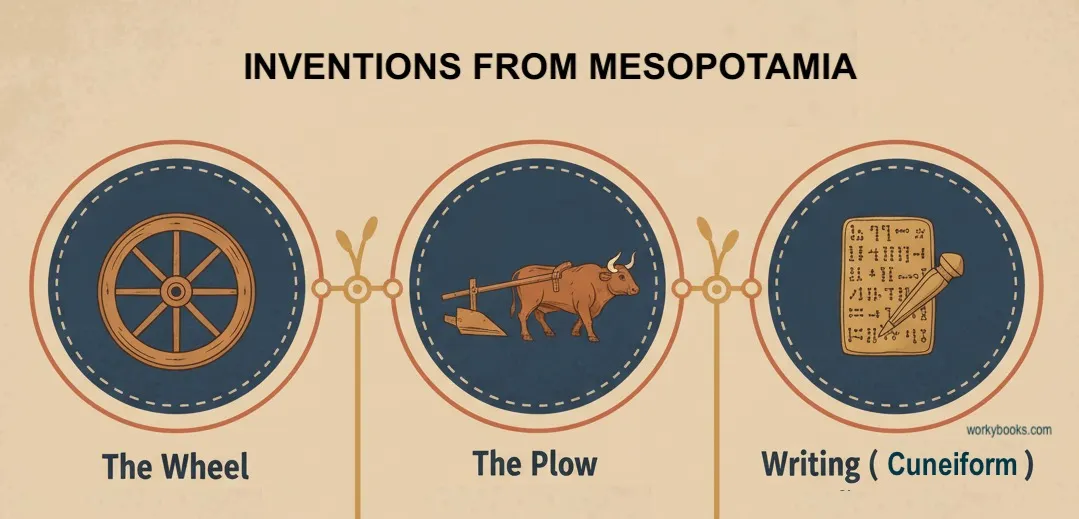
The region known as Mesopotamia, located between the Tigris and Euphrates rivers in present-day Iraq, is often called the "cradle of civilization" because of its many innovations. Some of the most important inventions in human history—including the wheel and the plow—originated in ancient Mesopotamia over 5,000 years ago. These technological advances transformed daily life, shaped social hierarchy, and set the stage for the rise of complex societies.
The wheel is perhaps Mesopotamia’s most famous invention. Archaeological evidence from the city-state of Ur shows that solid wooden wheels attached to carts appeared as early as 3500 BCE. The wheel made transportation of goods and people easier, allowing trade to expand between city-states. Later, wheels were adapted for use in pottery-making, as seen in the potter’s wheel. This technology helped craftspeople produce more uniform pottery, an essential item in everyday life and trade.
Another vital invention was the plow, which revolutionized agriculture. Early Mesopotamians relied on the annual flooding of rivers to irrigate their crops, but farming by hand was slow and inefficient. Sometime before 3000 BCE, Sumerian farmers developed the plow, making it easier to turn and aerate the soil. This allowed them to grow more food, support larger populations, and create surplus crops for trade. The plow’s success led to the development of a social hierarchy where farmers, landowners, and laborers had different roles and status in society.
Mesopotamians also invented complex irrigation systems, such as canals and levees, to manage the unpredictable flooding of the rivers. These projects required careful planning and cooperation, as shown in ancient cuneiform records. With improved irrigation, city-states like Uruk and Lagash could produce enough food for their citizens and support specialized workers such as scribes, priests, and artisans. Another major innovation was cuneiform writing, which developed around 3200 BCE. Written language allowed people to record transactions, laws, and stories, preserving knowledge for future generations.
The inventions of Mesopotamia had lasting effects far beyond their own time and place. The wheel and plow spread to other civilizations, changing how people traveled, traded, and farmed. Innovations in irrigation and writing made it possible for cities to grow and governments to form. These advances show how human creativity and adaptation to geographic challenges can change the course of history.
Mesopotamia’s inventions connect with the broader theme of how early civilizations responded to their environment and shaped the world we live in today.
Interesting Fact: The earliest known map in the world was drawn on a clay tablet in Mesopotamia over 4,000 years ago.
Comprehension quiz (8 questions)
1. Where was Mesopotamia located?
2. What is Mesopotamia’s most famous invention?
3. When did cuneiform writing develop?
4. Why was the plow important for farming?
5. How did irrigation help Mesopotamian cities?
6. What effect did the wheel have on trade?
7. Mesopotamia’s inventions spread to other civilizations. True or false?
8. What does "hierarchy" mean?
Perfect for the way you teach
- Build comprehension skills
- Auto-graded quiz
- Differentiated reading
- Read together at home
- Improve fluency
- Quiet reading time
- Reading curriculum support
- Independent practice
- Track Lexile growth