Geography: Connecting and Dividing Civilizations — Reading Comprehension
Rate this
Premium Resource
Present
Present in classroom. No work saved
Assign
Classroom with student accounts, Track progress
Quick Play
No student accounts, assign with a link
Grades
5
6
7
8
PRINT+DIGITAL RESOURCE
This learning resource is available in interactive and printable formats. The interactive worksheet can be played online and assigned to students. The Printable PDF version can be downloaded and printed for completion by hand.
This history reading passage explores how geography played a crucial role in shaping the development, connection, and division of ancient civilizations. Students will learn how rivers, mountains, and deserts influenced where people settled, how they traded, and how they interacted with other groups. The passage uses evidence from ancient Egypt, Mesopotamia, and China to illustrate the importance of geographical features such as the Nile River, the Zagros Mountains, and the Sahara Desert. Aligned to CA HSS 6.2 and CCSS RI.6.1, this resource includes a glossary, multiple-choice quiz, writing activities, graphic organizers, and a timeline. It also provides read aloud audio and a Spanish translation for accessibility. By examining cause-and-effect relationships and connecting historical developments to geographic contexts, the passage helps students think like historians and understand the lasting significance of geography in world history.
CONTENT PREVIEW
Expand content preview
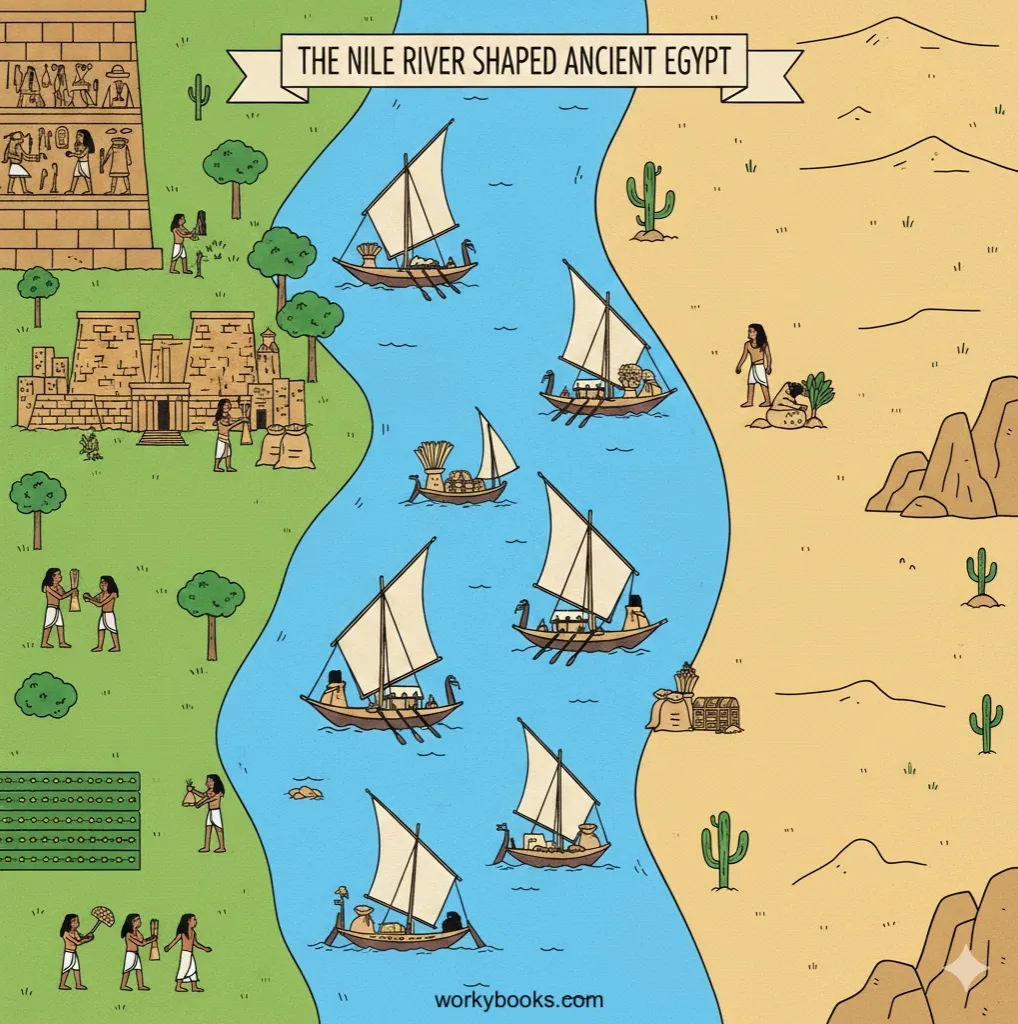
Powerful example of geography shaping civilization is the ancient Egyptians and the Nile River.
Geography has always shaped the rise and fall of civilizations. The location of rivers, mountains, and deserts influenced where people settled, how they lived, and how they interacted with others. In the ancient world, geography could either connect societies through trade and culture or divide them with barriers that limited contact.
One powerful example of geography shaping civilization is the ancient Egyptians and the Nile River. The Nile provided a reliable source of water in the middle of the Sahara Desert. Its predictable floods made the land fertile, supporting agriculture and allowing cities like Thebes and Memphis to grow. The river also served as a natural highway for trade and communication. Egyptian boats traveled up and down the Nile, carrying goods such as grain, gold, and papyrus. Archaeological evidence, like ancient wall paintings, shows scenes of river trade and daily life along the Nile. However, deserts on both sides of the river protected Egypt from frequent invasion, helping the civilization remain unified for thousands of years.
In contrast, the early Mesopotamian civilization developed between the Tigris and Euphrates rivers in present-day Iraq. These rivers helped create rich farmland, but unlike the Nile, their floods were unpredictable and sometimes destructive. Mesopotamian city-states like Ur and Babylon built canals and levees to control the water. Because there were few natural barriers such as mountains or deserts, Mesopotamia was open to migration and attack. Throughout its history, Sumerian, Akkadian, and Babylonian peoples competed for power. Archaeological texts, like the Code of Hammurabi, describe a complex society influenced by both connection and conflict.
Farther east, China’s early civilizations arose along the Yellow (Huang He) and Yangtze Rivers. The fertile plains allowed agriculture to thrive, but China was also surrounded by natural barriers: the Himalaya Mountains, the Gobi Desert, and the Pacific Ocean. These features limited invasion and contact with other civilizations for centuries, encouraging a unique culture to develop. Yet, the Silk Road trade route eventually connected China to the Middle East and Europe, showing that geography could both separate and link societies over time.
Geography’s impact on ancient civilizations was not only physical but also social. In Egypt and Mesopotamia, the need to manage rivers led to organized governments and social hierarchies, with rulers, priests, and farmers each having different roles. The environment shaped daily life, religion, and even technology, such as irrigation systems and boats.
Understanding how geography connected or divided ancient civilizations helps us see the importance of the environment in human history. It explains why some societies flourished, traded, or remained isolated. These patterns can still be seen in the modern world, reminding us that geography continues to shape our lives.
Interesting Fact: Did You Know? The Great Wall of China was built in part to protect against invasions along China’s northern geographic border.
Which river was vital to ancient Egypt?
NileAmazonYangtzeMississippi
Which two rivers shaped Mesopotamia?
Tigris and EuphratesNile and AmazonYellow and YangtzeIndus and Ganges
What natural barriers protected Egypt?
DesertsOceansForestsMountains
How did the Silk Road affect China?
Connected it to other regionsBlocked all tradeCaused floodsLed to city-states
Why did Mesopotamia face more invasions?
Few natural barriersStrong wallsHarsh desertsMountains protected it
What is a trade route?
Path for exchanging goodsWater for farmingAncient law codeMountain barrier
The Great Wall was built to keep out invaders.
TrueFalse
What does 'hierarchies' mean?
Ranking people in societyFlooding riversAncient farmingTrading goods
Perfect For:
👩🏫 Teachers
• Reading comprehension practice
• Auto-graded assessments
• Literacy skill development
👨👩👧👦 Parents
• Reading practice at home
• Comprehension improvement
• Educational reading time
🏠 Homeschoolers
• Reading curriculum support
• Independent reading practice
• Progress monitoring
Reading Features:
📖
Reading Passage
Engaging fiction or nonfiction text
❓
Comprehension Quiz
Auto-graded questions
📊
Instant Feedback
Immediate results and scoring
📄
Printable Version
Download for offline reading
🔊
Read Aloud
Voice-over with word highlighting
Reviews & Ratings
No reviews yet. Be the first to share your experience!
Related Content
Ancient Civilizations and the Environment
This engaging history reading passage explores how ancient civilizations such as Mesopotamia, Egypt, and the Maya adapte...
Gender Roles in Ancient Civilizations
This engaging history reading passage explores the roles of men and women in various ancient civilizations, including Me...
Writing Prompts Ancient Civilizations
Step into the shoes of an archaeologist with this engaging worksheet focused on ancient civilizations. Students will be ...
W.5.2.A-2W.5.1.CW.5.1.D
Power and Authority in Ancient Civilizations
This passage explores the roles of men in positions of power within ancient civilizations, focusing on their authority i...
Evidence in Ancient History
This engaging history reading passage investigates how archaeologists and historians discover clues about how ancient pe...
Ancient Monarchy
This reading passage explores the concept of monarchy in ancient civilizations, focusing on the origins, structure, and ...
Ancient Theocracy
This engaging history reading passage explores the concept of theocracy in ancient civilizations, where priests and reli...
Ancient Mathematics
This passage explores the essential role of mathematics in ancient civilizations, including Mesopotamia, Egypt, Greece, ...
Ancient Canaan
This educational passage explores the land of Canaan, the historical homeland of the ancient Israelites. Students will l...
Ancient Money Barter
This passage explores the fascinating evolution from barter to the earliest coins in ancient civilizations, focusing on ...
Ancient Science and Medicine
This comprehensive reading passage explores the development of science and medicine in ancient civilizations, including ...
Ancient Literature
This passage explores the importance of ancient stories and poems from civilizations such as Greece, India, and Israel. ...
Ancient Agriculture Farming
This passage explores the transformative impact of farming on ancient societies, examining how the Neolithic Revolution ...
Ancient Writing Systems
This engaging history reading passage explores the origins and evolution of ancient writing systems, including cuneiform...
Geography of Ancient Israel
This passage explores the rich geography of Ancient Israel, focusing on how landforms, climate, and natural resources sh...
Slavery Across Civilizations
This detailed history reading passage explores the role and impact of slavery across several ancient civilizations, incl...
Social Classes in Ancient Societies
This passage explores the concept of social hierarchies in ancient civilizations, focusing on why societies such as Meso...
Social structures in Ancient World
This passage explores the organization and significance of family life in ancient societies, focusing on how extended fa...
Polytheism and Monotheism in Ancient Times
This passage explores the religious beliefs of ancient civilizations, focusing on the differences and similarities betwe...
Women in Ancient Societies
This reading passage explores the complex roles of women in the ancient world, focusing on civilizations such as Mesopot...